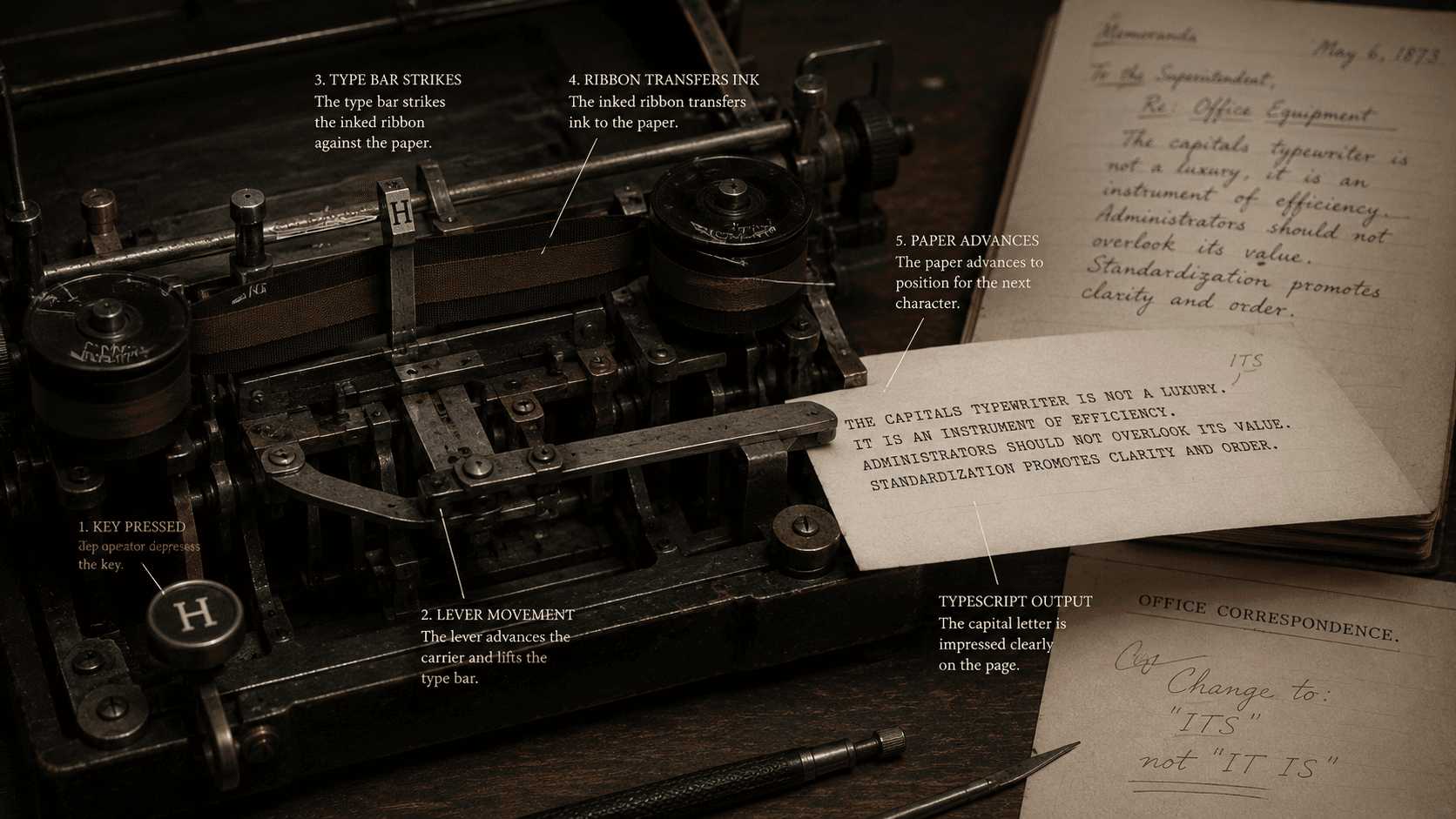
The first Remington-made Sholes & Glidden Type Writer could produce capital letters. Lowercase was outside that machine's installed repertoire, not a stylistic option withheld by its operator.
That constraint marks a change larger than speed. Handwriting permits a writer to alter size, pressure, angle, spacing, alphabet, and mark from one movement to the next. Mechanical writing divides inscription into available keys and repeatable operations. The machine decides which characters exist, how the paper advances, where a strike lands, and what must happen before the next mark can be made.
The typewriter did not mechanize thought. It mechanized the event that put selected characters on paper, redistributing agency among writer, operator, machine, manufacturer, and office.
The mark transfers to the mechanism
Christopher Latham Sholes, Carlos Glidden, and Samuel W. Soule received U.S. Patent 79,868 for an improvement in type-writing machines on July 14, 1868. The drawings describe a system of keys, levers, type bars, paper support, and movement. Six years later, E. Remington & Sons began marketing the Sholes & Glidden machine. The Smithsonian describes it as the earliest commercially successful typewriter, a more precise claim than calling it the first writing machine.
These dates represent different events: patented mechanism, manufactured product, and eventual social adoption. A device can work before a market, training system, maintenance network, job category, and body of conventions make it ordinary.
The early Remington product looked partly like a sewing machine and was made by a company experienced in manufacturing them. Its first model sold slowly. The second model, available in 1878, added upper- and lowercase. The alphabet on the page changed because a mechanism and product line changed.
A key separates the shape of a character from the motion of the hand that makes it. Pressing A does not require drawing an A. It initiates a mechanism whose type strikes a ribbon against paper. The letterform has been manufactured in advance.
This produces regularity without perfect uniformity. Worn type, ribbon condition, alignment, touch, and maintenance leave differences. Still, the typescript presents a far narrower range of letterforms than ordinary handwriting and makes the writer's individual hand less visible. It can be read by people who struggle with that hand and copied into office systems more predictably.
The gain is accompanied by a boundary. A missing symbol must be improvised, added by hand, approximated with another character, or left out. Diacritics, non-Latin writing systems, mathematical notation, and specialized marks become questions for keyboard and machine design. What the tool cannot inscribe cheaply becomes editorial friction.
Software inherited this repertoire problem and moved it. A contemporary system can encode a vast number of characters, while a keyboard exposes only a small subset directly. Fonts may lack a visible glyph; input methods may hide an available character; exports may mishandle it. The layers have changed, but tools still determine which marks are easy to make.
Inscription transfers to the operator
Handwritten authorship often joins verbal composition and mark-making in one person, although scribes and amanuenses complicate that picture across history. Typewriting made the separation a large-scale office practice. A manager or author could dictate or submit handwriting; a trained operator produced the formal text.
This transfer improved legibility and throughput while creating room for uncredited judgment. Typists resolved ambiguous handwriting, normalized format, caught errors, prepared copies, and coordinated corrections. Their names rarely appeared beside those of authors and editors.
The Smithsonian Institution Archives documents a revealing case from the 1930s. Ruth B. MacManus in the Smithsonian's Editorial Division and Gertrude Brown, a publisher's secretary, exchanged typewritten correspondence and managed corrections to the twelve-volume Smithsonian Scientific Series. Brown described the difficulty of raising frequent criticisms from her position as “another one of the girls in the office.” The finished work did not advertise their role, yet its accuracy depended on their editorial traffic.
The typewriter spread during the expansion and mechanization of the American corporate office. Clerical work opened to more women while remaining low paid and offering limited advancement. The machine was one agent within this U.S. reorganization during the late nineteenth and early twentieth centuries. Companies needed growing quantities of correspondence and records; training and hiring practices attached speed, dexterity, gender, and status to the work.
A clean typescript can therefore hide the roughness of composition and the labor that regularized it.
A mistake acquires a surface
On a typewriter, each strike commits ink to a location. Correction can involve overtyping, erasure, correction paper or fluid, a handwritten addition, a pasted strip, or retyping the page. Carbon paper can make several copies at once, but a correction may have to be repeated across them. Revision has a material price.
That price influences workflow without determining literary quality. Some authors drafted by hand and had material typed. Some typed directly. Some dictated. A retyped clean copy could conceal earlier states and also provide the clarity needed for another round of revision. The page did not reveal a universal relation between machine and mind.
Word processing changed the commitment. A character remains discrete and key driven, yet it can be inserted without shifting the rest of the page by hand. Text below it recomposes. A local deletion need not leave an abrasion. Undo may restore an earlier state, and copy-and-paste can move a paragraph without recopying it.
The typewriter's influence survives in keyboards, shift keys, carriage-return language, fixed-width conventions, and the expectation that a writer controls text through discrete character entry. Other constraints have become optional simulations. A monospaced typewriter face is now a design choice. The screen can reveal a proportional font, hidden structure, revision marks, or a page that has not yet been fixed.
Constraint becomes infrastructure
The familiar QWERTY arrangement invites a tidy explanation: it was designed to slow typists so type bars would not collide. Mechanical conflicts mattered, but scholarship reconstructing early layouts identifies changing and contested combinations of mechanical, telegraphic, ergonomic, and adoption factors. One intention does not explain the layout's development or persistence.
QWERTY survives through installed skill, manufacturing, training, interoperability, switching cost, and adequate performance. The same forces help other conventions become infrastructure. A layout or operation does not need to be ideal once people, tools, and institutions have organized around it.
Claims that the typewriter determined prose style deserve similar caution. A tool changes available operations and their costs. Authors respond differently, and their texts also pass through typists, editors, publishers, and genres. The defensible history stops before mechanism becomes destiny.
Mechanical writing divided language into manufactured marks and repeatable actions. It made inscription easier to delegate and correction newly material. It created jobs, obscured contributions, disciplined the page, and left conventions that software later inherited. The typescript's apparent impersonality is a visible effect of decisions already made by machinery, labor, and organization.
SOURCES
- U.S. Patent No. 79,868, “Improvement in Type-Writing Machines.” https://patents.google.com/patent/US79868A/en - Smithsonian Institution. “Sholes & Glidden Type Writer.” https://www.si.edu/object/sholes-glidden-type-writer%3Anmah_850542 - National Museum of American History. “Innovation Prototypes.” https://americanhistory.si.edu/explore/exhibitions/inventing-in-america/innovation-prototypes-I - National Museum of American History. “Big Business.” https://americanhistory.si.edu/explore/exhibitions/american-enterprise/online/corporate-era/big-business - Smithsonian Institution Archives. “Depression-Era Pen Pals: A Correspondence Between Two Hard-Working Women.” https://siarchives.si.edu/blog/depression-era-pen-pals-correspondence-between-two-hard-working-women - Yasuoka, Koichi, and Motoko Yasuoka. “On the Prehistory of QWERTY.” Industry and Corporate Change 18, no. 5 (2009). https://academic.oup.com/icc/article-pdf/18/5/999/2342047/dtp030.pdf