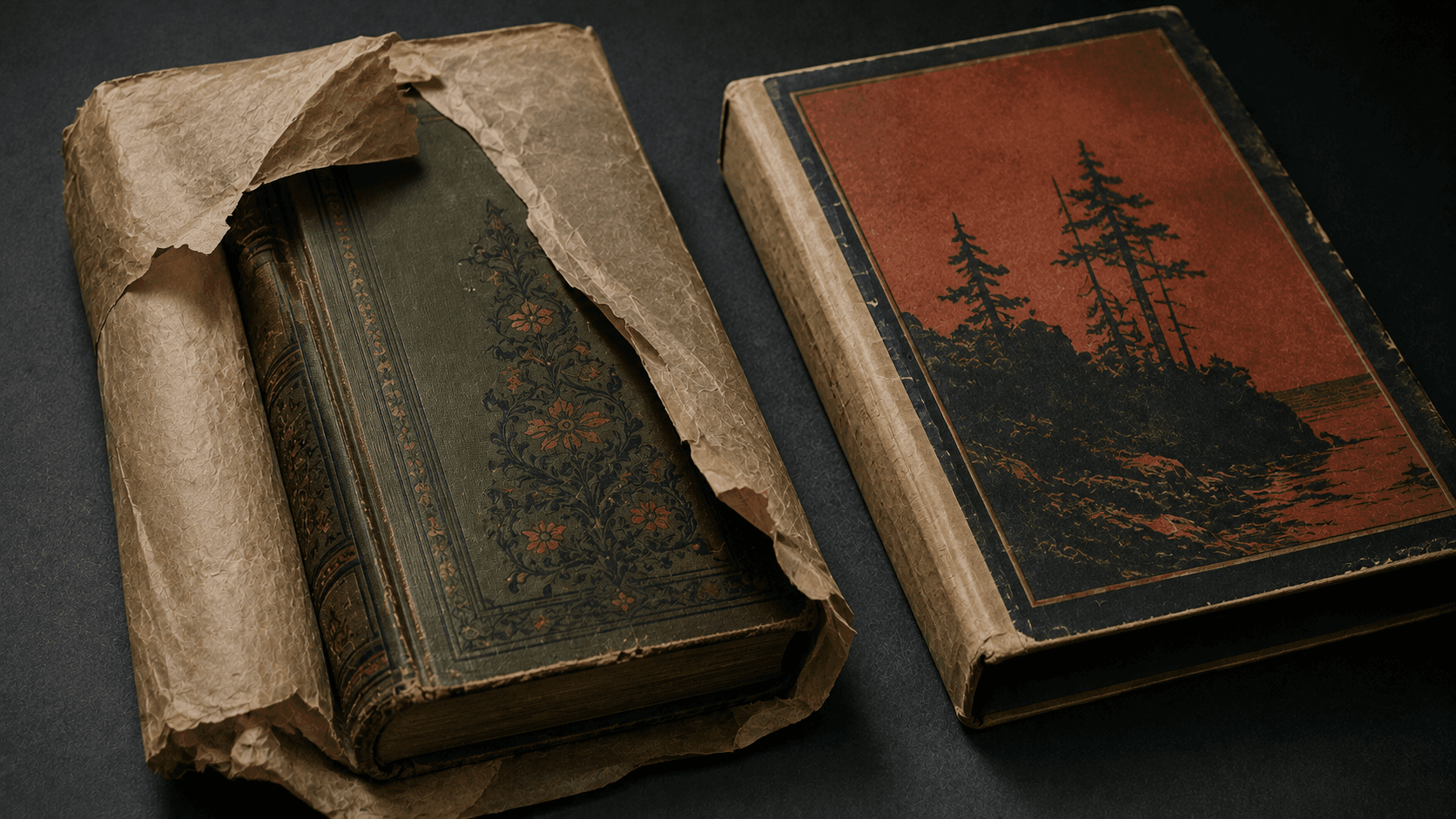
Some early publishers' wrappers enclosed the entire book and were sealed. Opening the package damaged the covering by design. The reader reached the decorated binding by destroying or removing the thing that had protected it.
About two centuries later, a missing wrapper can make a surviving book feel incomplete. Libraries collect jackets they once discarded. Dealers describe copies by the condition of paper meant to absorb wear. A detachable covering has become part of how an edition is identified, valued, and remembered.
The dust jacket did not change status in one moment. Protection, identification, advertising, design, description, and collecting accumulated unevenly. Its history is difficult in part because ordinary disposal removed so much evidence.
Before the jacket carried the cover
Before publishers' bindings became ordinary, books were often sold as sheets or in temporary coverings and bound to a buyer's requirements. A permanent publisher's case created a finished object that could carry decoration and needed protection through transport and handling. Paper wrappers, sheaths, and related detachable coverings appeared in several forms around gift books, annuals, trade books, and other publications.
Mark Godburn's study of nineteenth-century dust jackets begins with an 1819 jacket, the earliest example his research documents. Earlier histories often emphasized an 1829 wrapper for Friendship's Offering or an 1833 jacket for The Keepsake. The 1819 survival is not proof of the first dust jacket ever made. It is a provisional boundary established by surviving evidence and the definition being used.
An all-enclosing wrapper sealed around a book differs from the later sheet folded over boards with flaps. A pasteboard sheath behaves more like a small slipcase, and a temporary paper cover can be called a wrapper without functioning as a detachable jacket. Historical makers did not supply stable terminology for every category later bibliographers would need.
The shared property is removability: a publisher-supplied covering can be separated without disbinding the book. That made the covering versatile and placed its survival at risk.
The protected object was often more decorative
Nineteenth-century publishers' cloth bindings could carry stamped designs, colored cloth, gilt, pictorial imagery, and work by identifiable artists. Yale's Beinecke Library describes such decorated covers as marketing devices much as dust jackets later became. Jackets did not arrive because books lacked visible commercial identity.
Early examples often protected bindings that buyers wanted to see. Some repeated part of the design beneath; others carried only enough type to identify the title. Once the book reached a private shelf, the paper could look like packaging around the actual cover.
Disposal therefore had a practical history. A wrapper might be torn during opening, dirtied in transit, removed for display, or discarded in library processing because it seemed extraneous to the durable binding. The covering had performed the task assigned to it.
Survival is consequently biased toward unusual behavior: an owner kept a book wrapped, a publisher retained file copies, a bookseller stored unsold stock, or a library selected jackets for separate preservation. Missing examples cannot tell us exactly how uncommon jackets were. Ephemera leave a record distorted by the expectation that they will vanish.
The paper moves to the foreground
As jackets took on more printed information, they began to mediate the encounter between book and buyer. Title and author could be joined by illustration, synopsis, biography, review excerpts, series identity, price, publisher promotion, and notices of other books. Flaps added surfaces without altering the case beneath.
During the twentieth century, the jacket increasingly became the primary designed face of many hardcovers while bindings often grew quieter. No single decade contains the change. Decorative jackets existed earlier, decorated bindings persisted, and practice varied by genre, market, price, and country. The 1920s figure prominently in histories of modern jacket design without furnishing a universal beginning.
What changed was the allocation of visual labor. A removable sheet could be redesigned for each title and printed in several colors more readily than an elaborate cloth case. Its front addressed the shop, its spine identified the book on a shelf, and its flaps kept descriptive and persuasive language attached after purchase. The protective layer became a point of encounter.
It also became paratext. A synopsis frames the book before its first sentence; a photograph and biography construct an authorial public person; endorsements nominate authorities; price, imprint, and series locate the work commercially. Removing the jacket can remove evidence of how an edition addressed its first buyers.
The library performs a second removal
Research libraries have often removed jackets during processing. Paper coverings tear, catch on neighboring volumes, conceal labels, and require sleeves or special handling. Cataloging traditionally centered the bound volume, while the jacket appeared to be replaceable publicity.
The New York Public Library's digital Collection of Book Jackets preserves the contradiction. From 1926 to 1947, librarians selected jackets, removed them from books, and mounted them in large scrapbooks. The institution saved the ephemera by separating them from the copies they had described. Thousands of fronts, spines, backs, and flaps survive, though the criteria for selection are unknown.
Conservator Randy Silverman has argued for preserving jackets in research libraries because they carry evidence of marketing, design, biography, reviewing, and consumer culture. Public libraries may retain them for a different immediate purpose: a plastic cover can extend the life of a circulating book and preserve information useful while browsing. Research and use meet around the same fragile sheet.
Keeping a jacket still requires choices. It can remain on the book, receive a protector, be stored separately, or be digitized. Brittle paper may abrade the binding it once protected. Separate storage can protect the sheet while obscuring its relationship unless the catalog records it. Treatment follows condition and collection purpose.
Is the jacket part of the book?
The answer depends on the inquiry. A missing jacket may matter little for reading the verbal work and decisively for identifying an issue, studying cover art, reconstructing a campaign, tracing a blurb, or describing a collectible copy. The jacket can belong to the publication without belonging to the bound structure. Its design may be shared across an issue while its survival is particular to a copy.
Originality also requires evidence. A jacket now surrounding an old book did not necessarily accompany that copy at publication. Price clipping, later-state blurbs, publisher changes, and replacement jackets can distinguish variants. Bibliographers and collectors examine printing, fit, wear, provenance, and comparison copies. “In dust jacket” is the beginning of a description.
Market value has intensified attention to particular modern first editions, but fluctuating prices and famous examples should not define the jacket's cultural importance. The deeper reversal is institutional. Material once excluded from the book's durable identity now helps establish that identity.
The cover that can leave
Paperbacks absorb much of the jacket's visual and commercial work into a cover attached to the text block. Library bindings can reproduce or replace publisher imagery. Digital retailers detach the cover image from every physical surface and display it as a thumbnail; audiobooks use a square or nearly square asset for a work with no boards.
The jacket's history clarifies these descendants by separating the cover's functions. Protection, title recognition, shelf identification, persuasion, edition distinction, and visual memory can live together or migrate to different objects. A digital cover carries no dust while still performing the encounter that the jacket came to dominate.
Detachment gave the jacket unusual flexibility. A publisher could redesign it without rebuilding the case; a reader could remove it; a library could discard it; a collector could reunite it with the book or house it in a sleeve. Each participant could redraw the object's boundary.
Surviving copies record the choices. A faded spine shows shelf exposure. A clipped corner shows that a price was removed, perhaps for a gift. A flap may carry a biography absent from later reference works. A worn wrapper around bright cloth shows that its protective function succeeded.
Temporary enough to become rare
The more completely an object performs a temporary role, the less likely it is to survive as evidence of that role. Dust jackets protected and announced books, then got out of the way. Their scarcity is partly a record of ordinary use.
Once the jacket became the principal visual face, design, information, collecting, and resale encouraged retention. Even then, libraries removed jackets, readers damaged them, and publishers continued to make them detachable. Temporary and integral did not settle into a clean historical succession.
The jacket shows how use makes a book's boundary. Binder, publisher, buyer, reader, librarian, and collector can each include a different layer. A removable sheet becomes part of the book when the question being asked requires the evidence it carries.
SOURCES
- Godburn, Mark R. Nineteenth-Century Dust-Jackets. Folger Shakespeare Library catalog record. https://catalog.folger.edu/record/352373 - Henning, Rebecca. “Dust Jackets, a Short Introduction.” Amherst College Special Collections. https://consecratedeminence.wordpress.amherst.edu/2015/03/01/dust-jackets-a-short-introduction/ - Silverman, Randy. “Jackets Recommended: The Case for Preserving Dust Jackets in Research Libraries.” Book and Paper Group Annual 19 (2000). https://cool.culturalheritage.org/coolaic/sg/bpg/annual/v19/bpga19-19.pdf - New York Public Library. “Collection of Book Jackets.” https://digitalcollections.nypl.org/collections/collection-of-book-jackets - Beinecke Rare Book & Manuscript Library. “Gleaming Gold, Shining Silver: 19th-Century Book Covers.” https://beinecke.library.yale.edu/exhibitions-visiting/special-exhibitions/gleaming-gold-shining-silver-19th-century-book-covers - Victoria and Albert Museum. “Searching for the Scarab: The Binding Designs of A. A. Turbayne.” https://www.vam.ac.uk/blog/museum-life/searching-for-the-scarab-discovering-the-binding-designs-of-a-a-turbayne-in-the-national-art-library