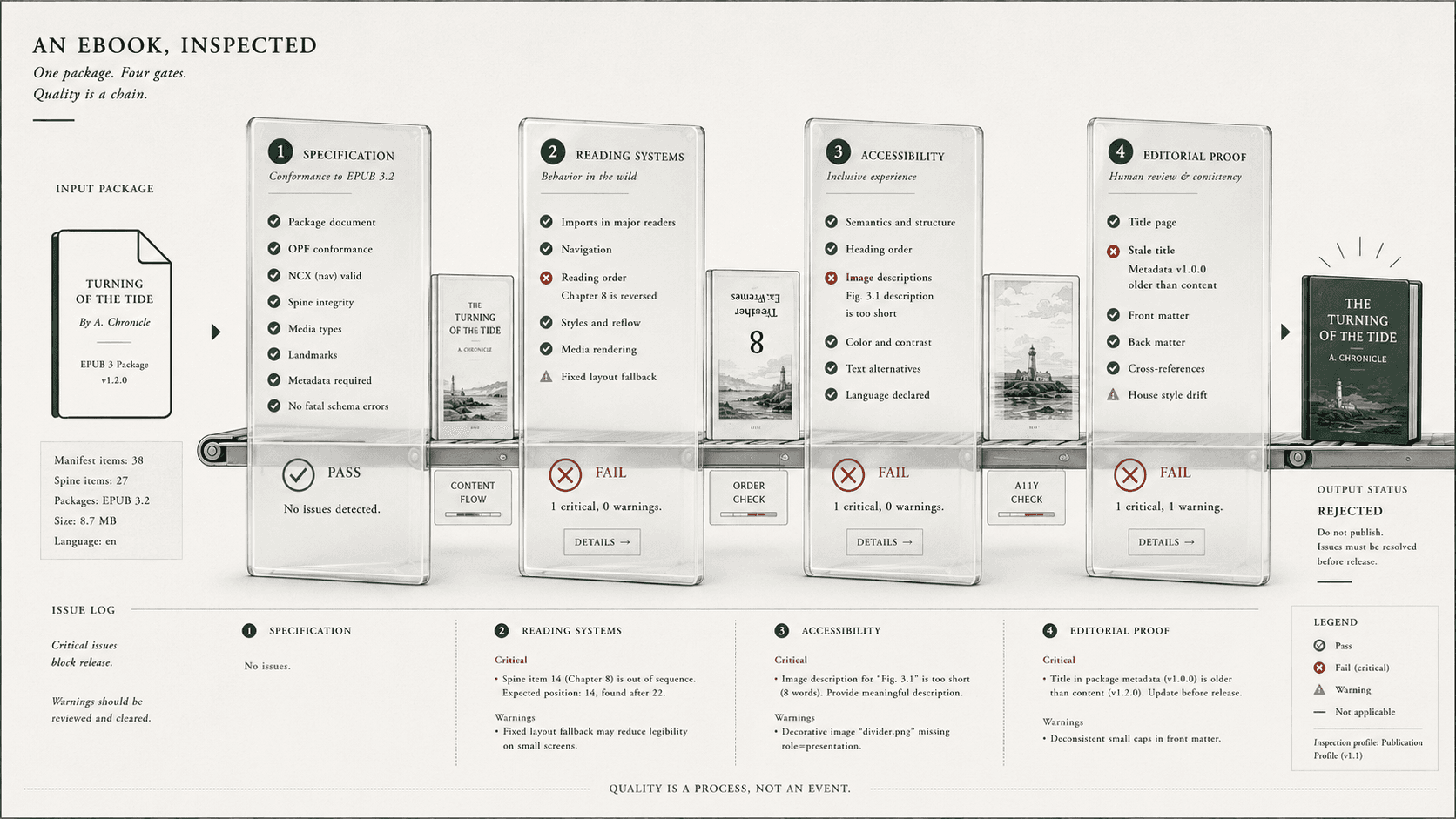
An EPUB can pass its checker with the title misspelled, two chapters reversed, and an image described only as “chart.” Every file may be present. Every link may point to an existing destination. The publication can obey its grammar and still be a bad book.
This is not a limitation that makes validation unimportant. It is the reason to understand the verdict. EPUBCheck is the official conformance checker for EPUB, maintained by the DAISY Consortium on behalf of W3C. It catches a large class of structural and technical failures more reliably than visual inspection. Quality begins by giving that result the authority it has and no authority it does not.
A useful QA program separates four questions: Is the EPUB valid? Is it interoperable in the environments that matter? Is it accessible? Is it editorially sound?
Valid
Validation asks whether the package conforms to a targeted version of the EPUB specification in machine-checkable ways. The checker can identify malformed markup, undeclared resources, invalid metadata patterns, missing files, broken internal references, unsupported media declarations, and many other errors.
Record the checker name and version with the report. Standards and tools are versioned software, and a future reviewer needs to know what produced “no errors.” Resolve errors before treating the file as a candidate for release. Review warnings rather than dismissing them by category; some signal deliberate but risky choices, while others expose obsolete or fragile construction.
Passing means the checker found no reported conformance failures under that configuration. It does not mean a retailer must accept the file. Distribution channels can apply business rules, profiles, metadata requirements, content policies, or conversion steps beyond EPUB validity.
Nor does failure always prove that the intended publication concept is impossible. A tool can contain bugs, and standards can have difficult edges. The evidentiary response is a minimal reproducible case and documented issue, not a decision to ignore the report because the book opens.
Interoperable
EPUB reading systems share a specification and differ in implementation. Some features are optional; presentation choices vary; bugs exist. A book that works in one preview can expose clipped text, missing fonts, unusable notes, incorrect spreads, or surprising navigation elsewhere.
Interoperability testing should follow content risk and audience rather than an arbitrary device count. A plain reflowable novel needs a smaller matrix than a fixed-layout textbook with SVG, MathML, audio, and scripting. Test principal distribution systems, a narrow and wider viewport, relevant operating environments, and the settings readers are likely to change.
Record the file checksum or version, app and device versions, settings, steps, expected result, and observed result. A screenshot can help but rarely explains navigation or speech behavior alone. Reproduce a failure in another environment and inspect the source. A defect appearing across systems may belong to the publication; a behavior isolated to one implementation may belong to the reading system; an interaction can involve both.
The purpose is not identical pixels. Reflow should create different line and page breaks under different conditions. Interoperability means the publication's structure and meaning remain usable across the supported variations.
Accessible
EPUB Accessibility applies to the publication as a whole. It draws on WCAG and adds publication-specific requirements and discovery metadata. Automated tests can detect missing attributes, invalid structures, some contrast issues, and other valuable signals. They cannot determine whether the encoded reading order makes sense or whether an alternative communicates what a figure contributes.
Accessibility review includes navigation, headings, logical sequence, language, links, notes, tables, image alternatives, color use, text resizing, and content-specific interactions. It also includes metadata that allows readers and distributors to discover accessibility features and limitations. That metadata must describe an assessed publication; declaring conformance does not create it.
Test operations, not only screens. Can a reader move by headings and publication navigation? Does the table of contents reach meaningful destinations? Can note references be identified, followed, and returned from? Does an image alternative make sense in the surrounding prose? Does enlarged text reflow without losing content? Can controls be reached and understood without a pointer?
Expert and user testing may be needed for complex works. A passing automated accessibility report is evidence of checks performed, not a certificate for judgments no algorithm made.
Editorially sound
The EPUB can be valid, consistent across apps, and accessible in structure while containing the wrong book. Editorial QA verifies words, order, labels, images, metadata, and intended relationships.
Read the publication in sequence. Compare title, subtitle, contributors, copyright page, and package metadata with the approved edition record. Inspect the contents as an outline and follow every entry. Check chapter openings, scene breaks, notes, cross-references, figures, captions, credits, and the last pages. Search for production placeholders and old titles. Review samples of italics, special characters, block quotations, lists, and page references migrated from print.
Constructed examples clarify the boundary. The alternative “chart” is syntactically present and editorially useless. A contents link to the wrong but existing heading can be valid. Reversed spine items can each be conforming files. Metadata can declare a plausible title that belongs to an earlier draft. A typo is legal markup.
The reviewer must know what was intended. That requires an approved source, metadata sheet, change log, and clear edition identity. QA without a reference becomes preference checking.
A proportionate sequence
Run conformance validation early enough to catch structural defects before they spread, and again on the final package. Editorial review can proceed on a stable candidate while technical issues are resolved, but late rebuilds require regression checks.
A practical sequence is:
1. Confirm the edition and authoritative source. 2. Run EPUBCheck and resolve the report. 3. Inspect package metadata, manifest, spine, navigation, and structural semantics. 4. Conduct editorial read-through and targeted comparison with source. 5. Review accessibility through automated and human methods. 6. Test a risk-based reading-system matrix. 7. Re-test affected areas after changes and run final validation. 8. Archive the exact delivered file, reports, and test record.
The order can adapt to workflow. The four verdicts should remain visible. “Valid but inaccessible” and “accessible but editorially wrong” are intelligible diagnoses; the word “good” alone is not.
Validators are powerful because specifications contain precise rules. Human reviewers are necessary because publications contain meaning. A release decision needs both, along with the exact delivered file and evidence showing which version, environments, and judgments each verdict covered.
SOURCES
- W3C. EPUBCheck repository. https://github.com/w3c/epubcheck - DAISY Consortium. “Validation Overview.” https://kb.daisy.org/publishing/docs/epub/validation/overview.html - DAISY Consortium. “EPUBCheck.” https://kb.daisy.org/publishing/docs/epub/validation/epubcheck.html - W3C. EPUB 3.3. https://www.w3.org/TR/epub-33/ - W3C. EPUB 3.3 Reading Systems. https://www.w3.org/TR/epub-rs-33/ - W3C. EPUB Accessibility 1.1. https://www.w3.org/TR/epub-a11y-11/ - W3C. EPUB Accessibility Techniques 1.1. https://www.w3.org/TR/epub-a11y-tech-11/ - W3C. Web Content Accessibility Guidelines 2.2. https://www.w3.org/TR/WCAG22/