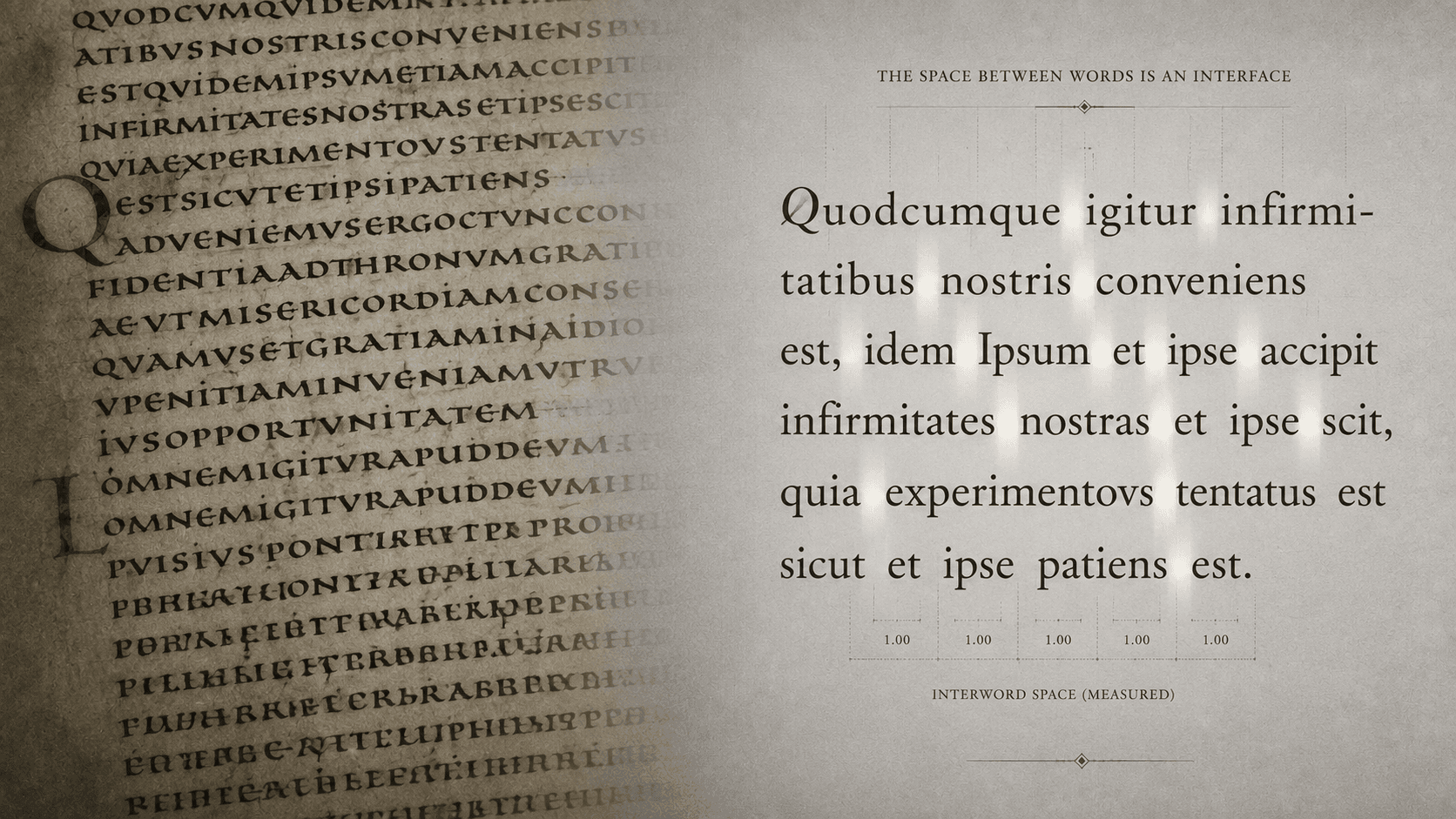
Remove the spaces from an ordinary sentence and the letters do not change. Neither does their order. The vocabulary is still present, in one sense, yet reading slows because the boundary between one word and the next has become a problem the reader must solve.
Greek and Latin texts were often written in what scholars call scriptio continua, with words running together. The practice was neither perfectly continuous everywhere nor devoid of other signs. Ancient and medieval scribes used punctuation, interpuncts, occasional spacing, enlarged letters, and other distinctions with considerable variation. Scriptio continua names a broad graphic habit, not a rule observed by every manuscript.
A fourth-century leaf of the Codex Sinaiticus held by the British Library gives a useful encounter with it. Letters proceed in narrow columns without modern word separation. To an untrained present-day reader, the surface resembles a code from which a basic convenience has been removed. Its historical readers had not suffered the loss of a convention they expected. They had learned another way of entering text.
The modern word space is an interface because it reallocates that work. It supplies in advance a boundary that a reader of continuous script would otherwise have to infer.
Reading without the interval
Continuous writing is possible for a reason familiar from speech. A listener does not normally receive silence between every spoken word. Sounds overlap and vary; vocabulary, syntax, expectation, and context help the listener find boundaries. Reading continuous script required its own trained acts of recognition. The comparison is limited because speech and writing do not present identical signals, but it makes the allocation visible. A modern space places more segmentation in the inscription.
Material economy may have favored dense writing in some circumstances. The British Library includes continuous writing among the ways scribes could conserve expensive surface. Yet economy cannot explain every page across many centuries. Scripts serve institutions, languages, genres, reading practices, and aesthetic expectations. A plausible cause becomes unreliable when promoted to the only one.
The history also resists a civilizational ladder. Word dividers appeared in writing systems long before medieval Latin spacing, and contemporary scripts do not all place spaces between every lexical word. What a boundary looks like depends partly on what a writing system treats as a unit and what its readers learn to recognize.
Separation was a practice before it was a rule
There was no morning on which Western writing acquired spaces. Separation became more systematic in some medieval Latin traditions, especially in insular scribal practice, but surviving manuscripts show gradations rather than a switch. A scribe might separate most lexical words while joining short functional elements, divide one compound in several ways, or leave sequences that a modern editor would regularize.
This variability is now itself an object of research. Projects measuring manuscript word division do not merely label pages “spaced” or “unspaced.” They record where gaps occur, how large they are, and which linguistic or graphical units they distinguish. The method matters because an interval on a manuscript page does not always announce whether it was deliberate, incidental, or part of another layout decision.
Regular spacing changed what a reader could expect. Familiar word forms became easier to identify before the full sentence had been parsed. Scanning, reference, and private reading could demand less effort at the point of lexical division. That is a substantial change without being an invention of comprehension itself.
Did the space make reading silent?
Paul Saenger's influential history, Space Between Words, gives word separation a large role in the development of silent reading. His argument connects graphic separation with easier visual recognition, new reading physiology, and a growing ability to read rapidly without vocal mediation. The thesis is powerful because it gives a markless feature consequences for intellectual practice.
It should not be compressed into the claim that nobody read silently before spaces. Evidence of silent reading exists in antiquity. That establishes possibility, not prevalence, speed, or social habit. A person's choice to read aloud or silently also depends on purpose, training, setting, and genre. A convention can lower the cost of an activity and help it spread without creating the activity from nothing.
The dispute offers a useful caution about interfaces. Identifying a task that a tool makes easier is not the same as proving that the tool caused every behavior it enabled. Pages, indexes, hyperlinks, and search fields invite the same mistake. They alter the available effort; institutions and readers determine what follows.
The interval becomes material
Mechanical composition gave spacing physical components and measurements. A compositor could insert blank material between sorts, and the line's remaining measure determined how spacing expanded during justification. The interval was unprinted, but it was not immaterial. It occupied metal and governed where the printed marks could go.
Digital text makes this still clearer. The common space is an encoded character. Other spacing characters can have different widths or line-breaking behavior. A nonbreaking space between “10” and “km” may look ordinary while preventing the number from being stranded at the end of a line. A narrow no-break space can carry a language-specific typographic convention. Software can collapse repeated ordinary spaces in one context and preserve them in another.
Visible width, word boundary, and break opportunity are related rather than identical. A designer who presses the space bar repeatedly to position a heading is using word-separation data as improvised geometry. The arrangement may collapse in HTML, reflow badly in an ebook, be handled unexpectedly by speech or braille systems, and fail when the typeface changes. A style or structural element should carry the position.
Search reveals another distinction. Two intervals can look alike while the underlying strings contain different characters and fail to match. Conversely, language-aware software can infer boundaries where no space is present. The blank shown on screen is not a reliable picture of the data.
Who is being asked to divide the text?
The word space is so successful that its assistance becomes noticeable mainly when it fails. OCR joins two words. A line breaks between a number and unit. Copied text contains an unfamiliar gap. In each case, the interruption is small enough to expose a continuous operation beneath ordinary reading.
Writing systems distribute interpretation among author, inscription, tool, and reader. Vowels may be explicit or inferred. Direction may be encoded or established by convention. Word boundaries may be marked, derived, or ambiguous. These arrangements decide which uncertainties the publishing system resolves before reading begins.
That decision continues through contemporary production. An editor chooses whether a compound is open, closed, or hyphenated. A typesetter determines how intervals respond to justification. A character standard distinguishes one space from another. A search engine proposes tokens. A braille transcriber applies rules that do not reduce neatly to printed gaps.
When OCR accidentally produces `inthe` or a copied line places a break inside `10 km`, the empty interval stops being invisible. It becomes what it has been all along: recorded work performed upstream, waiting to be tested by a reader.
SOURCES
- British Library. “Palimpsests: The Art of Medieval Recycling.” https://www.bl.uk/stories/blogs/posts/palimpsests-the-art-of-medieval-recycling - Saenger, Paul. Space Between Words: The Origins of Silent Reading. Stanford University Press. https://www.sup.org/books/title?id=683 - Biblissima. “Measuring and Recording Manuscript Word Division Using Computer Vision.” https://projet.biblissima.fr/en/calls-projects/selected-projects/measuring-and-recording-manuscript-word-division-using-computer - Burns, Rachel. “The Visual Craft of Old English Verse.” UCL Discovery. https://discovery.ucl.ac.uk/id/eprint/10056489/7/Rachel%20Ann%20Burns_PhD%20Thesis_EDITED%20VERSION_19092018.pdf - Unicode Consortium. The Unicode Standard, Version 17.0, Chapter 6. https://unicode.org/versions/Unicode17.0.0/core-spec/chapter-6/