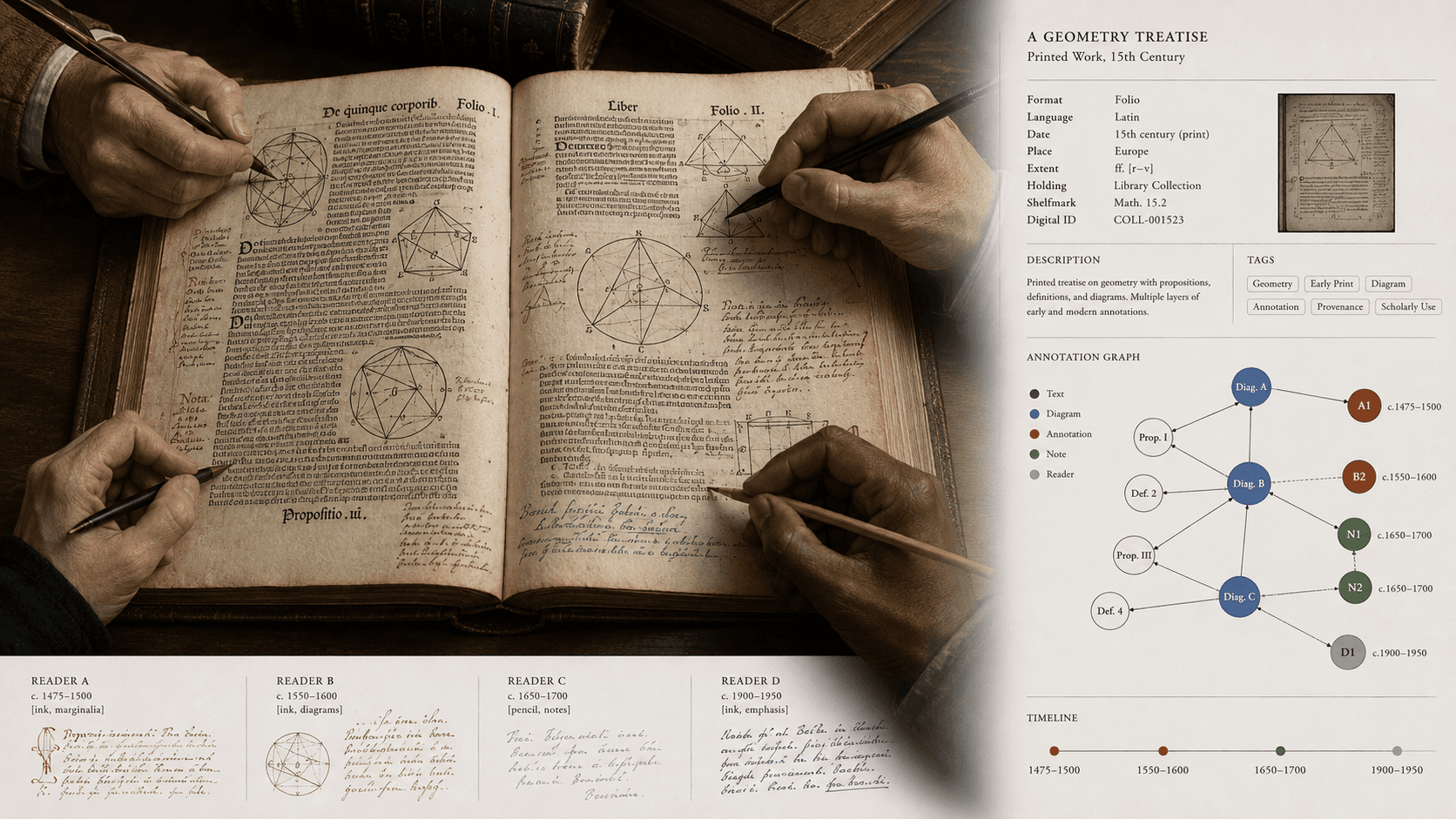
A reader writes beside a theorem to remember a proof. Years later, a bookseller describes the volume as marked, a library catalogs it as annotated, and a scholar uses the several surviving hands as evidence of mathematical study. The ink remains on the same page while custody and description give it a different status.
Marginalia begin as local acts made for a present purpose: remember this, question that, correct an error, translate a word, claim ownership, calculate, point, argue, or pass instruction to another reader. When audience changes, the same marks can become records of reception. The transformation is valuable and dangerous because evidence invites a story faster than provenance can support one.
From aid to artifact
The Folger Shakespeare Library holds a 1482 edition of Euclid with printed diagrams and extensive handwritten work. Several hands appear in the book. Readers drew, calculated, and proved in its spaces, turning the volume into a workplace across time.
It is tempting to narrate “the reader” wrestling with geometry. Several hands make that singular character unstable. The marks may belong to owners, students, teachers, sellers, or other users at different dates. Their coexistence supports a history of use more securely than a biography of one mind.
Cataloging creates the second life by describing what can be responsibly observed: inscriptions, underlining, drawings, corrections, language, likely date, number of hands, provenance, binding, and relation to known owners. The catalog creates an address through which other readers can discover this particular copy and compare it with others.
Description is therefore an interface to evidence. “Annotated in several hands” opens one set of questions while refusing a false attribution. A note about trimming or rebound leaves can warn that the present relation among marks and text may not be original. A provenance statement connects the object to people and institutions without claiming that every owner wrote in it.
This does not make every scribble important. A multiplication sum may matter greatly in a study of schooling and little in an edition of the printed text. Research value belongs to a question and context, not an intrinsic glow around handwriting.
What a mark can prove
A mark proves, at minimum, that someone made a mark on that object or component before the moment of observation. Even this modest statement can require checking whether leaves or annotations were added later.
Handwriting, ink, textual references, dates, ownership inscriptions, sale records, and binding history can narrow who and when. Attribution gains strength when independent evidence converges. Ownership alone is opportunity, not authorship. “In Milton's copy” is not equivalent to “written by Milton” unless the hand is established.
Meaning requires another step. Underlining shows selection, but selection can mean agreement, dispute, memorization, teaching, copying, censorship, or future reference. A manicule points; it does not tell us why. A hostile comment is stronger evidence of response, though irony, quotation, and later hands can still complicate it.
Interpretation is necessary. Restraint does not reduce scholarship to inventories. It keeps observed feature, attributed maker, inferred practice, and speculative motive distinct enough that readers can judge where evidence ends and argument begins.
Survival is editorial
Marginalia survive unevenly. Trimming during rebinding can remove outer notes. Erasure and washing can fade marks. A collector may prefer a clean copy and discount a used one. Libraries can catalog annotations in detail or leave them hidden inside a generic record. Digitization can crop an edge or, with high-resolution images and metadata, make a faint note available to far more readers.
The original context can also split. A loose leaf loses the binding sequence that established what passage a note faced. A quotation copied into a commonplace book preserves selected words while leaving the source relation uncertain. A catalog description can amplify one famous association and cause anonymous marks to be ignored.
Preservation therefore includes attention. The mark must remain physically present, but someone must also notice, describe, attribute cautiously, and make it discoverable. An uncataloged annotated copy can sit safely for decades without entering histories of reading.
Access is not automatically owed. Marginal notes in modern personal books can reveal health, relationships, political belief, or information about other people. Archival value and ethical publication are separate decisions. Restrictions, redaction, or delayed access can preserve material without exposing it immediately.
The digital note separates from the book
Paper binds an annotation to one copy. The note travels when that object is sold, donated, inherited, stolen, or destroyed. Its physical adjacency survives until someone erases, trims, or separates it. The custody is imperfect but visible.
Digital annotation can separate note, target, and reader. The W3C Web Annotation model represents an annotation as a relationship among a body, a target, selectors, creator, and motivation. In principle, this allows notes to be shared, layered, reused, and migrated independently of one reading interface.
The model reveals what paper made implicit. A note needs an address to a target. If the ebook edition changes, the selected phrase moves, or a proprietary location disappears, that address may fail. Text quotation and surrounding context can help reattach it. Stable identifiers and portable export can help. A standard supplies a vocabulary; a platform must still implement it.
Separation creates remarkable possibilities. A reader can keep annotations private while sharing a book, display only a teacher's layer, search years of notes, or attach media and links beyond the margin's surface. It also divides custody. The publication may be owned or downloaded, while the notes live in an account the reader cannot export fully. Service closure, permissions, identifiers, and format support join ink and trimming as survival conditions.
Digital abundance does not guarantee future interpretability. Thousands of highlights with timestamps but no edition information can be less useful than a dozen dated notes in a well-provenanced copy. Conversely, structured digital annotations with targets, creators, and motivations can preserve context paper rarely states.
Four distinctions for later readers
A private note acquires a second life through sale, inheritance, archive deposit, cataloging, digitization, publication, or sharing. Each transition can add context and remove it. Responsible interpretation preserves four distinctions.
The first is the observed mark: what is visibly present on this object or in this record. The second is custody: what is known about the copy, its sequence, and its movement among owners or systems. The third is attribution: who probably made the mark and how strong that conclusion is. The fourth is interpretation: which reading practice or response the evidence supports and which alternatives remain.
These distinctions protect marginalia from dismissal as damage and from romanticization as direct access to a private mind. They let a later reader make a claim proportionate to the surviving ink, address, and provenance.
SOURCES
- Folger Shakespeare Library. “Mathematical Diagrams from 1482.” https://www.folger.edu/explore/collection-highlights/mathematical-diagrams-from-1482/ - Folger Shakespeare Library. “Memory, Marginalia, and the Art of Reading.” https://www.folger.edu/blogs/collation/folger-deep-dives-memory-marginalia-and-the-art-of-reading-v-b-32-and-beyond/ - Folger Shakespeare Library. Marginalia collection portal. https://shakespearedocumented.folger.edu/medium/marginalia - Folger Shakespeare Library catalog. Annotated-copy record. https://catalog.folger.edu/record/544890?ln=en - W3C. Web Annotation Data Model. https://www.w3.org/TR/annotation-model/ - Library of Congress. “Sustainability Factors.” https://www.loc.gov/preservation/digital/formats/sustain/sustain.shtml - UNESCO. “Recommendation concerning the Preservation of, and Access to, Documentary Heritage Including in Digital Form.” https://www.unesco.org/en/legal-affairs/recommendation-concerning-preservation-and-access-documentary-heritage-including-digital-form?hub=177179