An author submits a chapter with a running head at the top, a page number in the corner, three blank lines before each scene break, bold fourteen-point chapter titles, and carefully adjusted spaces around an image. The document resembles a book. Production still does not know what several of those choices mean.
Is the bold line a chapter heading or a visual preference? Are three blank lines a scene break, or ordinary spacing that happened to fall there? Must the image remain beside that paragraph, and does it have a caption, credit, or text alternative? Is the running head part of the work or a preview convenience?
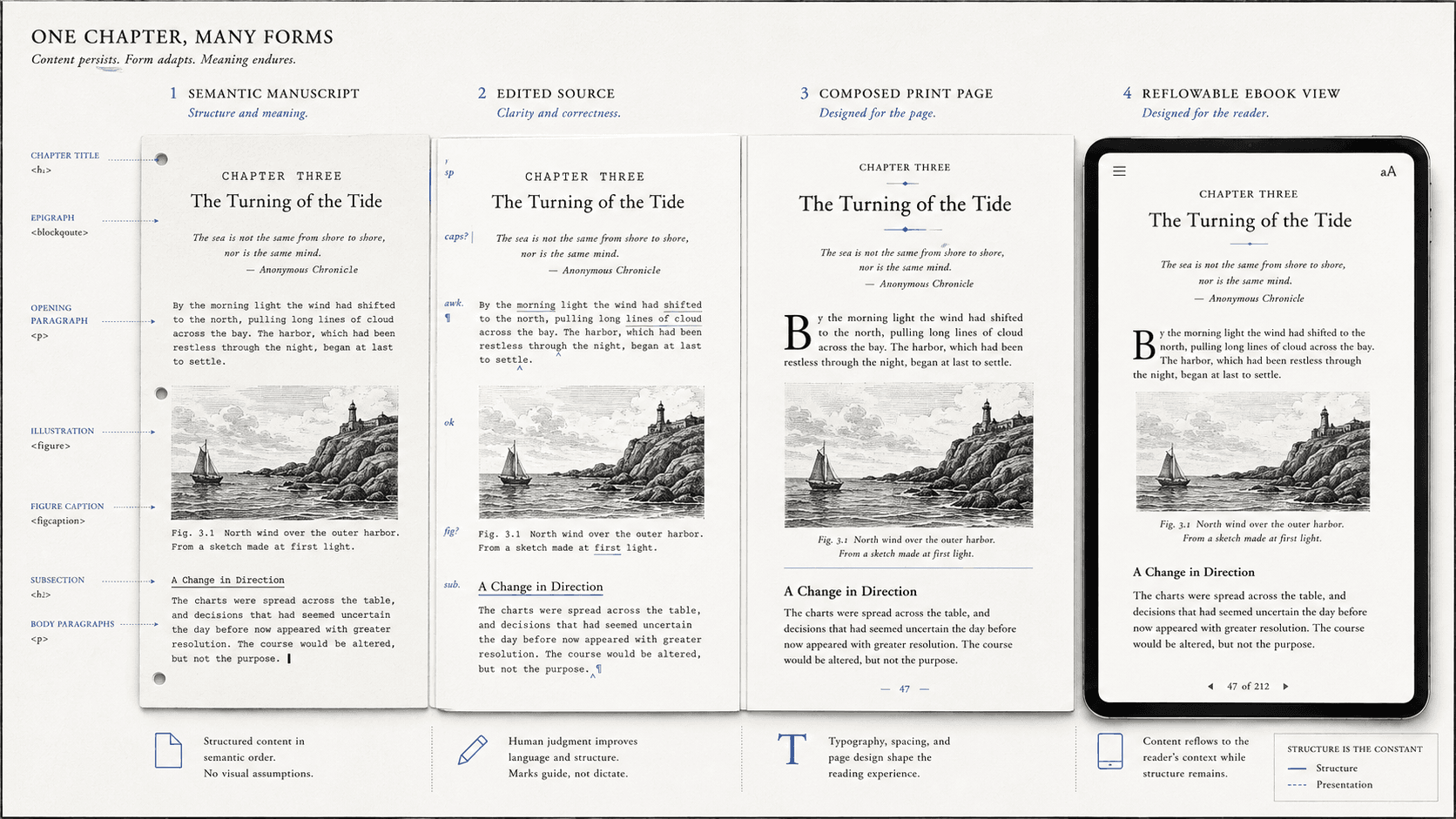
A manuscript is a revisable source containing the text and the author's declared intentions. A published book is a particular edition in which structure, design, navigation, rights, metadata, and output behavior have been resolved. Making a manuscript imitate one finished page can hide the information needed to create several honest editions.
The chapter as content
At the manuscript stage, the central questions concern meaning. What are the chapter's words? Where are its divisions? Which line is a heading, quotation, list, note, caption, or scene break? What is the intended order? Which emphasis is authorial? What must an image communicate?
These decisions can be expressed cleanly without stripping the manuscript to featureless text. A real heading should be marked consistently as a heading. A scene break should use an agreed marker or style rather than an uncertain number of blank paragraphs. Italic emphasis, meaningful line breaks, tables, notes, and spatial writing should remain identifiable. Unusual visual intent should be explained, especially when ordinary semantic structure cannot carry it.
The useful distinction is between “what is this?” and “how should this edition render it?” A clearly identified block quotation can be indented in print, styled differently in EPUB, and read appropriately in another mode. A paragraph indented with repeated spaces supplies only an appearance that can collapse during conversion.
House requirements vary. Some publishers supply templates; others want a simple word-processing file; scholarly projects may require complex markup. Robust preparation follows the receiving workflow while keeping structural intent explicit. There is no universal manuscript template that eliminates conversation.
The chapter as edited source
Copyediting resolves language, consistency, references, style, and many structural questions in collaboration with the author and publisher. A style sheet records decisions that should remain consistent beyond one visible page. Permissions, captions, credits, references, and front matter join the main text as production inputs.
Cambridge University Press's manuscript-delivery guidance illustrates the breadth of this handoff. Production needs finalized text along with preliminaries, images, captions, credits, bibliography, and other components. The list is specific to a press, but the principle travels: prose alone is not the whole source of a book.
Version control matters at this boundary. The final manuscript should be identifiable, and late changes need a controlled route. A corrected chapter attached to an email, another in a shared folder, and a third in the layout create three possible authorities. Naming and storage do not guarantee control, but production needs a declared source.
The edited manuscript remains revisable. It has not yet acquired final line endings, page references, or rendition behavior. Treating it as fixed too early encourages authors and editors to spend time repairing pagination that design will replace.
The chapter as a print composition
Print design gives the chapter a page geometry. Typeface, size, measure, leading, margins, folios, running heads, paragraph treatment, image placement, and recto/verso openings become concrete. The first line may fall at a chosen depth. A scene break near a page boundary may require special treatment. Widows, orphans, hyphenation, and page turns enter review.
These are substantive publishing decisions even when no word changes. A figure moved to the next page can affect comprehension. A running head can reveal a spoiler. A display heading can misstate hierarchy. Page numbers create edition-specific addresses later used by an index or cross-reference.
The PDF delivered to a printer preserves this final-state composition. It is not merely the manuscript with nicer fonts. It is one resolved rendition of the source for a particular trim, paper, binding, and production path.
Proof corrections should be controlled because changing text after composition can repaginate later material and invalidate an index or contents page. That cost is a reason to stabilize the source, not a reason to leave known errors uncorrected.
The chapter as reflowable publication content
In EPUB, the chapter becomes one or more structured content documents inside a package. The publication needs metadata, a manifest of resources, a spine establishing default reading order, and machine-readable navigation. CSS proposes presentation, while the reading system and reader influence type, line, and page.
The print page number and running head usually do not belong in the chapter's content. Forced line and page breaks may damage reflow. The scene break still matters and needs a durable representation. The heading retains its structural level even when a reader changes its font. The image needs responsive sizing, a meaningful relation to prose, and an appropriate text alternative.
Print and EPUB can share the edited words and semantic distinctions. They cannot share every composition. A facing-page reference in print may need a figure label in EPUB. A footnote may become linked note content rather than text fixed at a screen's bottom. A table that fits a wide print page may need redesign for a narrow viewport.
One-source publishing reduces duplicated editorial truth. Each output still requires composition and review suited to its behavior.
The book acquires an edition identity
Publication adds facts that do not belong to an abstract chapter. The hardback, paperback, and EPUB can have separate ISBNs. A copyright page records rights and product information. Cover, description, contributor metadata, price, availability, accessibility metadata, and distribution settings attach to a particular publication.
The International ISBN Agency's treatment of ebook master files is clarifying. An internal master that is never offered to the public does not receive an ISBN simply because it can generate several products. The source and the publication are different entities in the supply chain.
Metadata can be drafted early, but it must be verified against the delivered edition. A manuscript working title left in the package or an old subtitle sent to retailers creates a book whose identity disagrees across surfaces.
Preparing a source that travels
Authors can make production easier by supplying explicit, consistent intentions:
- Use real, logically ordered headings.
- Mark scene breaks and special structures consistently.
- Distinguish notes, captions, credits, and source text.
- Provide image files separately at suitable quality and record placement and purpose.
- Preserve meaningful emphasis and lineation; remove only accidental simulation.
- Identify the authoritative version and include every required component.
- Explain unusual spatial or typographic requirements instead of relying on one screenshot.
Publishers should respond with specifications and examples rather than scolding authors for formatting. Visual choices often carry real intent. The production editor's task is to identify which part belongs to the work and which part can change with the edition.
The manuscript's value lies in being a source before one rendition has been mistaken for the only possible form. It should declare what the parts mean clearly enough for each edition to resolve their design, navigation, identity, and behavior with purpose.
SOURCES
- Cambridge University Press. Manuscript delivery checklist. https://www.cambridge.org/authorhub/application/files/4017/5256/1325/6738_5867_ChecklistDetail_Proof3.pdf - Cambridge University Press. Editorial services style guide. https://www.cambridge.org/authorhub/application/files/9817/5344/9894/6738_A4_EditorialServices_Proof4.pdf - Butcher's Copy-editing, Cambridge University Press front matter. https://assets.cambridge.org/052184/7133/frontmatter/0521847133_frontmatter.htm - W3C. EPUB 3.3. https://www.w3.org/TR/epub-33/ - W3C Web Accessibility Initiative. Technique C22. https://www.w3.org/WAI/WCAG22/Techniques/css/C22.html - Library of Congress. “PDF Family, Portable Document Format.” https://www.loc.gov/preservation/digital/formats/fdd/fdd000030 - International ISBN Agency. “About ISBN.” https://grp.isbn-international.org/content/about-isbn/349 - International ISBN Agency. “Guidelines for Assignment to E-books.” https://www.isbn-international.org/content/guidelines-assignment-e-books/26