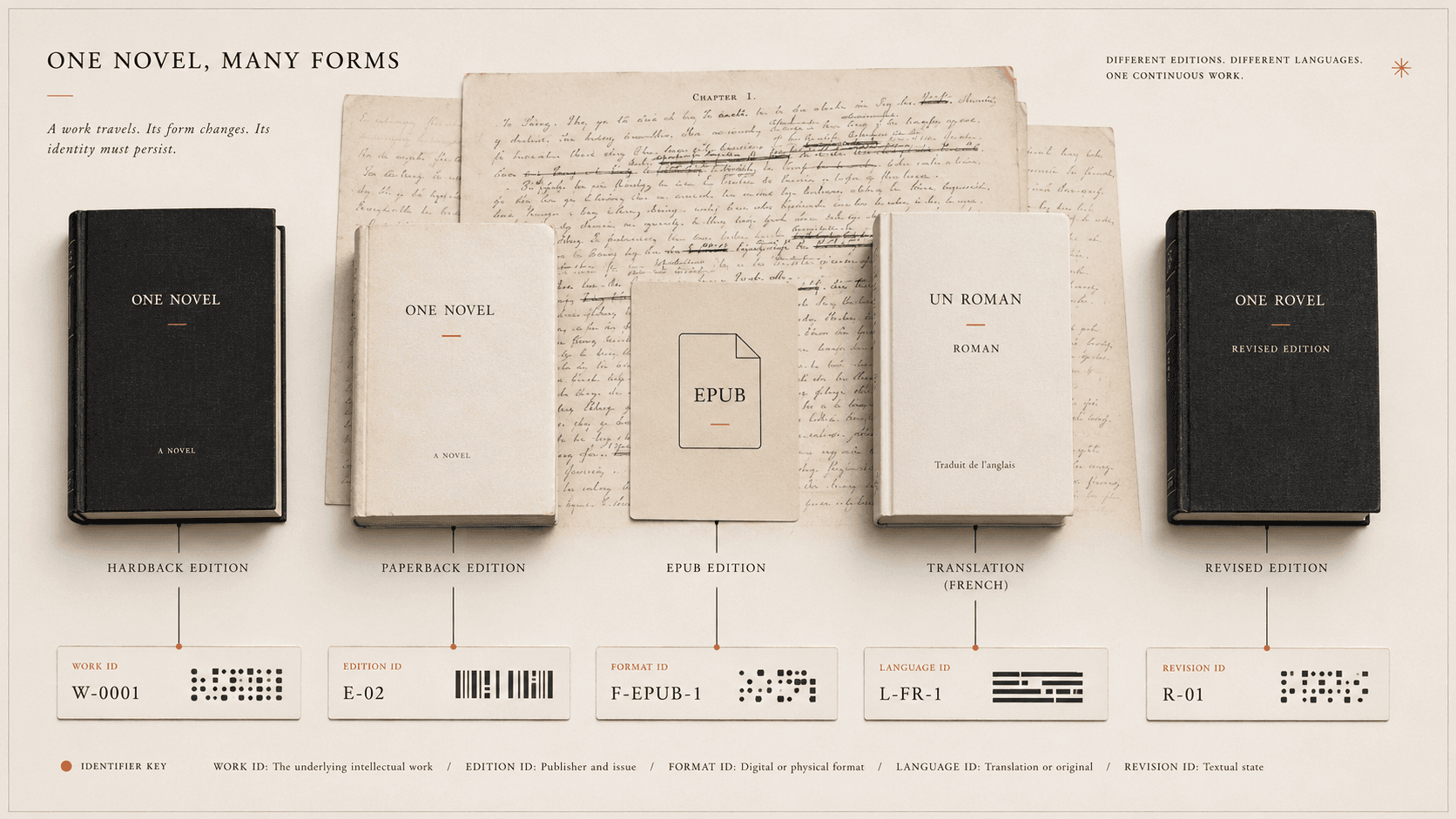
Suppose a novel appears as a hardback, paperback, and EPUB. Two years later it is translated into Spanish. A new edition adds an afterword. The author recovers rights and licenses the original text to another publisher. Readers may call every object “the same book,” while the supply chain has to distinguish what someone can order and receive.
Each product has to be stocked, described, sold, reported, and sometimes withdrawn without being confused with the others. That is the work of the International Standard Book Number.
The title of this article uses “edition” in the broad everyday sense. The more exact unit is a specified monographic publication product associated with a publisher or imprint. An ISBN does not identify an idea, an author's ownership, or a title in the abstract. It identifies the particular thing the trade is being asked to recognize.
The first novel becomes three products
The hardback and paperback need different ISBNs because a buyer can order one and receive something materially different from the other. Binding, dimensions, price, availability, and production are not accidental metadata around one warehouse object. They distinguish products.
The EPUB normally receives another identifier. It is delivered through a different channel and has different technical characteristics. A source file used internally to create the EPUB does not need its own ISBN if it is never made available as a publication product. The International ISBN Agency explicitly separates the production master from what readers can acquire.
The creative work can remain recognizable while publication products multiply. The number belongs at the level where someone can ask for one version and reasonably object to receiving another.
The translation changes expression and market
A Spanish translation receives a different ISBN from the English publication. Language is part of the identity a catalog, seller, or reader needs. The translator should also be represented accurately in metadata and credits. Reusing the English number would make one key point to incompatible descriptions.
The ISBN itself does not contain the title, language, author, or price as readable facts. Its digits identify a registration group, registrant, publication, and check digit within the system. Descriptive facts live in metadata records connected to the number, which acts as the stable key used to retrieve and update them.
This explains how a valid ISBN can retrieve wrong information. The check digit can be correct while a retailer lists the wrong cover or contributor. A metadata update can correct the description without changing the number when the underlying product has not changed. Identity and description cooperate; they are separate operations.
The new afterword may create a new edition
A substantively revised text, added major contribution, or other change that creates a new publication edition generally calls for a new ISBN. An unchanged reprint in the same format generally keeps the existing one. The boundary requires judgment because not every corrected typo or cover refresh creates a different product.
Ask whether buyers, libraries, or rights and inventory systems need to distinguish the result from what came before. A new afterword advertised as a feature may justify distinct edition identity. Silent correction of a handful of typographical errors ordinarily does not. A format change does. A price change by itself usually updates metadata rather than identity.
The decision should be documented and propagated. Copyright-page edition statement, cover, metadata feeds, distributor records, and internal files need to agree. Assigning a new number while leaving every description as “first edition” defeats the distinction the identifier was meant to establish.
A new publisher creates a new product identity
If another publisher acquires the right to publish the novel, it does not inherit the prior publisher's ISBN for a newly issued product. The registrant element and associated metadata identify the responsible publishing entity within the ISBN system. The new publication receives a number assigned through the new publisher's appropriate agency arrangements.
This can feel counterintuitive when the text is unchanged. It becomes clearer if the number is treated as supply-chain identity rather than a fingerprint of words. Publisher, availability, cover, price, distribution, and edition responsibility have changed. The old and new products may coexist in catalogs or used-book channels and need to be distinguished.
National ISBN agencies administer assignments within territories, so acquisition processes and fees are local. International assignment principles should not be confused with one country's commercial procedure.
Digital constraints complicate “one format”
Ebook assignment is more nuanced than one ISBN per filename or one per retailer. International ISBN Agency guidance says separately available digital products may need separate identifiers when their formats or usage constraints differ significantly. Distinct EPUB and PDF products are a clear format difference. Two files with the same format, DRM, and usage conditions can share an ISBN when they represent the same available product, even if device software renders them differently.
Materially different usage constraints can create distinguishable products within what casual language calls the same ebook format. The agency's guidance asks whether users and the supply chain need to identify which product they are acquiring. Device capability alone does not necessarily create a new product, and an internal master remains outside the assignment unless it is separately supplied.
Retailers sometimes assign their own identifiers. Those numbers can coexist with an ISBN and serve a platform's catalog. They do not transform the ISBN's function or make one mandatory in every publishing context. A book can be made available in settings that do not use ISBNs; the number is an international trade and discovery mechanism, not legal permission to publish.
What the number does not do
An ISBN does not register copyright. The International ISBN Agency states that assignment has no implication for rights ownership. Copyright and ISBN systems answer different questions: who holds rights in protected material, and which publication product is this?
It does not guarantee quality, availability, accessibility, or factual metadata. It does not create a barcode, though a barcode can encode it for scanning. It does not permanently bind all future versions of a title to one record.
The number's modesty is its strength. A stable identifier allows many systems to refer to the same product without packing every changing fact into the identifier itself. Prices can change. Descriptions can improve. Availability can end. The key remains attached to the product whose record those systems are updating.
A decision sequence
When considering a new ISBN, begin with what will be offered to the public. Is this file merely a production master, or can someone acquire it? Is the output a different format, language, publisher's product, or substantively revised edition? Do DRM or usage constraints make one digital offer meaningfully different from another? Would a buyer, library, seller, or report need to distinguish it from an existing product?
Then consult the current International ISBN Agency manual and the relevant national agency for the actual case. Record the decision with format, edition, language, publisher, and date. Supply accurate metadata wherever the number is used.
The hypothetical novel did not become several ideas. It entered several material, linguistic, contractual, and technical lives, and its identifiers keep those lives distinguishable wherever the products are described and exchanged.
SOURCES
- International ISBN Agency. “About ISBN.” https://grp.isbn-international.org/content/about-isbn/349 - International ISBN Agency. ISBN Users' Manual. https://www.isbn-international.org/content/isbn-users-manual/29 - International ISBN Agency. “Guidelines for Assignment to E-books.” https://www.isbn-international.org/content/guidelines-assignment-e-books/26