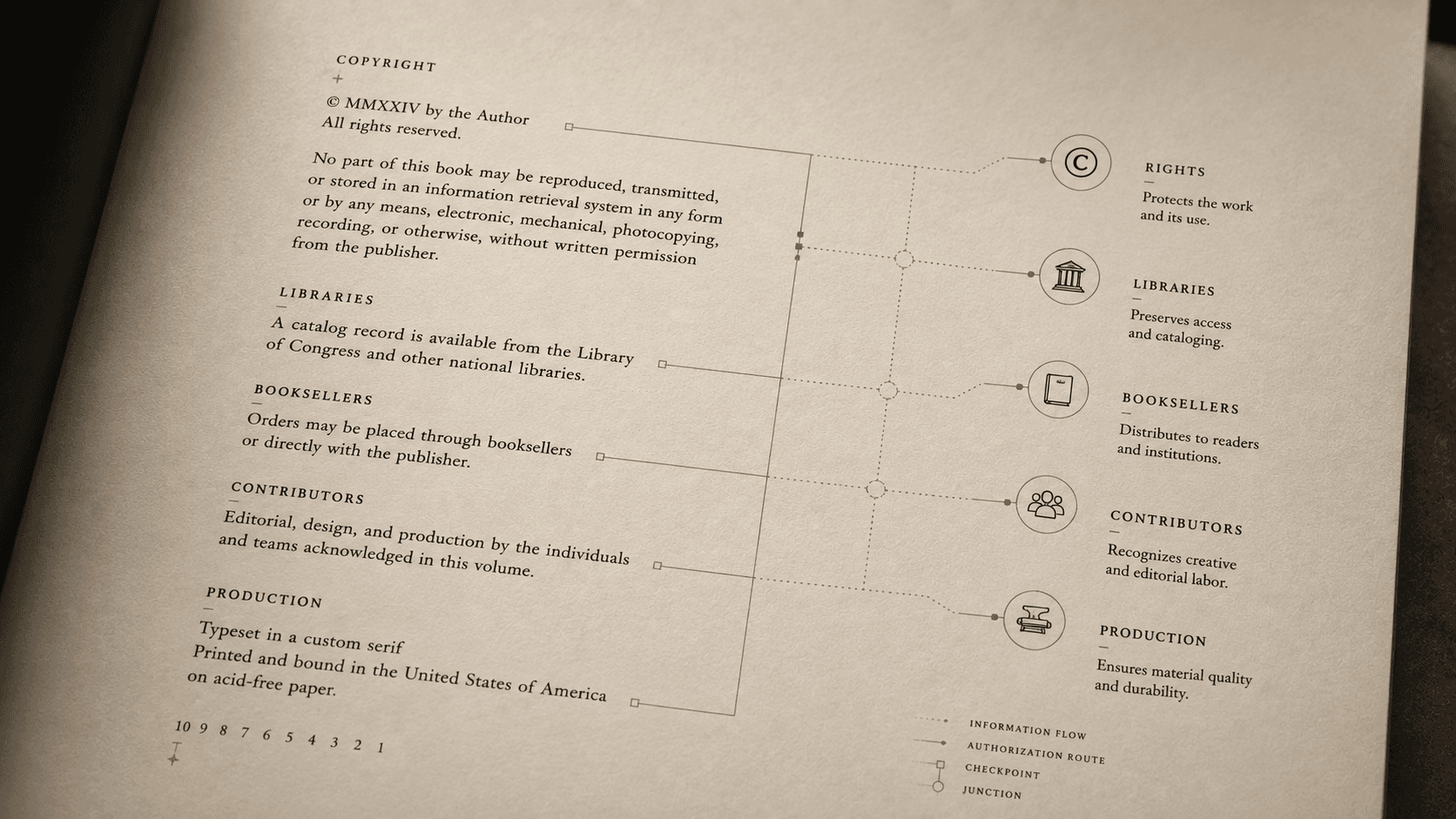
The copyright page is often written by borrowing one from another book. The result looks professional because the source looked professional. It may also name the wrong rights, repeat a convention with no present purpose, assign one ISBN to several products, or claim cataloging data the publisher never received.
The page becomes easier to build when its lines are sorted by addressee. Some speak to readers about rights. Some identify a publication product for booksellers and libraries. Some credit contributors and licensed material. Some record edition and manufacturing history for the publisher. They share a small page without sharing one legal status.
This guide uses current United States copyright rules for its legal examples. Other jurisdictions and older U.S. works can differ, and a general article cannot replace advice about a particular rights problem.
To the public: the copyright notice
For works first published in the United States on or after March 1, 1989, a copyright notice is optional. Protection does not spring into existence because the symbol was printed, and leaving it out does not automatically place a new work in the public domain. The U.S. Copyright Office still identifies practical and legal benefits to notice, including informing the public and limiting certain claims by an alleged infringer.
A conventional notice for a visually perceptible work contains three elements: the copyright symbol or permitted word or abbreviation; the year of first publication; and the name of the copyright owner. A simple example has the shape “Copyright © [year] [owner].” The correct year is not automatically the year the manuscript was drafted or the current printing. Revised editions, compilations, and contributions can require more careful analysis.
Notice is distinct from registration. The presence of a symbol does not register the work with the Copyright Office, and the absence of a registration number from the page says nothing by itself about whether registration occurred. “All rights reserved” is a conventional assertion, not the source of modern U.S. copyright protection. Its implications outside the United States and in historical treaty practice are too broad for casual universal claims.
The useful editorial question for every rights line is: whose rights, in which material, under which jurisdiction and agreement? If the answer is unclear, boilerplate does not cure the uncertainty.
To the trade: identifying this product
An ISBN identifies a specified publication product. A hardback, paperback, EPUB, translation, or substantively revised edition commonly has a different number because a buyer must be able to order the intended thing. The ISBN does not identify the creative idea in the abstract, prove ownership, or create copyright.
List the ISBN or ISBNs that actually belong to the product in hand, with clear format labels when several appear on one page. A print edition may list its own number and related digital or hardback numbers for convenience, but the label must prevent confusion. An ebook should not inherit a paperback identifier merely because the text is similar.
A barcode is a machine-readable representation used in physical distribution; it is not the ISBN itself. Price and other data may be encoded or printed nearby according to a market's practice. Those details belong to cover and distribution production rather than the logic of copyright.
Publisher name, imprint, place of publication where used, website, and edition statement also help identify the product and responsible entity. Ownership of rights, ownership of an imprint, ISBN registrant, distributor, and printer can belong to different parties. The page should not flatten them into one vague “published by” line when precision matters.
To libraries: cataloging data
The Library of Congress Cataloging in Publication program creates cataloging data before publication for eligible U.S. publishers. The publisher applies with required materials, receives a supplied block, and prints it in the book, traditionally on the title-page verso. The data also enters library channels.
CIP data should not be invented, imitated, or relabeled from another service. Eligibility and workflow belong to the Library of Congress program. Other cataloging records and publisher services may be legitimate, but their names should describe what they actually are.
The distinction reflects a larger rule. The copyright page is a place to record authoritative identifiers and data, not to manufacture the appearance of institutional recognition.
To contributors and rights holders: credits and permissions
Cover art, interior illustrations, photographs, maps, epigraphs, translations, song excerpts, and other components may have separate creators and licenses. Agreements can require precise credit language or placement. The copyright page often consolidates those credits, while captions, acknowledgments, or a dedicated permissions section may be more usable for a complex work.
Credits should be checked against contracts and permissions logs. A phrase such as “used by permission” belongs only when permission was actually obtained and the named owner and material are accurate. Public-domain status, licensed use, fair use, and publisher-owned material are distinct bases. Where the legal basis is uncertain, seek qualified advice rather than writing a more confident sentence.
Editorial and production roles may also be credited here: cover designer, illustrator, translator, photographer, or typeface, depending on house policy and agreement. These are social and production records. Their absence can make important labor invisible even when no law requires the line.
To the publisher and printer: edition history
Edition statements and number lines record aspects of manufacturing and publication history. Their conventions vary. A descending sequence can indicate a printing, but interpreting every number line requires knowing the publisher's practice. Print-on-demand and short-run workflows further loosen older assumptions about a discrete warehouse printing.
Use a clear edition statement when the text has been revised or when readers need to distinguish versions. Do not label an unchanged reprint as a new edition merely to make it appear current. Coordinate the statement with the ISBN decision and external metadata.
Printer or manufacturer names and locations may be recorded for operational, contractual, or market reasons. An ebook has no physical printer, so copying “Printed in…” into it turns provenance into fiction. Digital production credits, accessibility information, or version dates may be more relevant, provided the page does not become a dump for private project notes.
To risk managers: disclaimers and marks
Fiction disclaimers, medical or financial warnings, trademark statements, and restrictions on reproduction are highly contextual. None belongs in every book by default. A disclaimer cannot transform negligent or infringing material into safe publication, and an overbroad reproduction prohibition can conflict with statutory exceptions, licenses, or the publisher's intended permissions.
Decide what specific misunderstanding or risk the statement addresses. Check that it is accurate for the work and jurisdiction. Legal review is appropriate when the line is expected to carry legal weight.
Private production information usually belongs elsewhere. Vendor account numbers, confidential contact details, internal filenames, rights negotiations, and obsolete draft dates should stay in the publisher's records. The copyright page is public infrastructure, not the project folder.
One work, several pages
Print and ebook copyright pages can share a rights notice and much of their publication history while differing in ISBN, format statement, production credit, accessibility note, and manufacturing detail. A revised edition may add a new notice for new material while preserving the original publication year where appropriate. A translation may have its own rights and contributor lines.
This is why copying one page into every output is risky. Each page should be generated from a common, verified record and reviewed as part of that particular edition.
A compact final check can be made by labeling every line:
- Rights: authority, owner, year, jurisdiction.
- Identity: publisher, imprint, edition, format, ISBN.
- Cataloging: supplied program data reproduced accurately.
- Credits: contributor and license obligations.
- Production: printing or digital information true for this output.
- Risk: a specific, reviewed purpose rather than inherited theater.
Anything that fits no category may not need to be there. Anything that fits a category but lacks a verified source is not ready.
The copyright page looks backward because it records ownership and publication history. It also looks outward, passing facts to libraries, sellers, printers, rights holders, and future editions. Read that way, the small type is less mysterious. It is the book introducing its obligations and its place in a supply chain.
SOURCES
- U.S. Copyright Office. Circular 3, “Copyright Notice.” https://www.copyright.gov/circs/circ03.pdf - U.S. Copyright Office. Copyright Law, 17 U.S.C. § 401. https://www.copyright.gov/title17/92chap4.html - U.S. Copyright Office. “Frequently Asked Questions: Definitions.” https://www.copyright.gov/help/faq/definitions.html - International ISBN Agency. “About ISBN.” https://grp.isbn-international.org/content/about-isbn/349 - International ISBN Agency. “Guidelines for Assignment to E-books.” https://www.isbn-international.org/content/guidelines-assignment-e-books/26 - Library of Congress. “About the CIP Program.” https://www.loc.gov/publish/cip/about/index.html - Library of Congress. “PrePub Book Link Technical Information.” https://www.loc.gov/publish/prepubbooklink/technical-info/