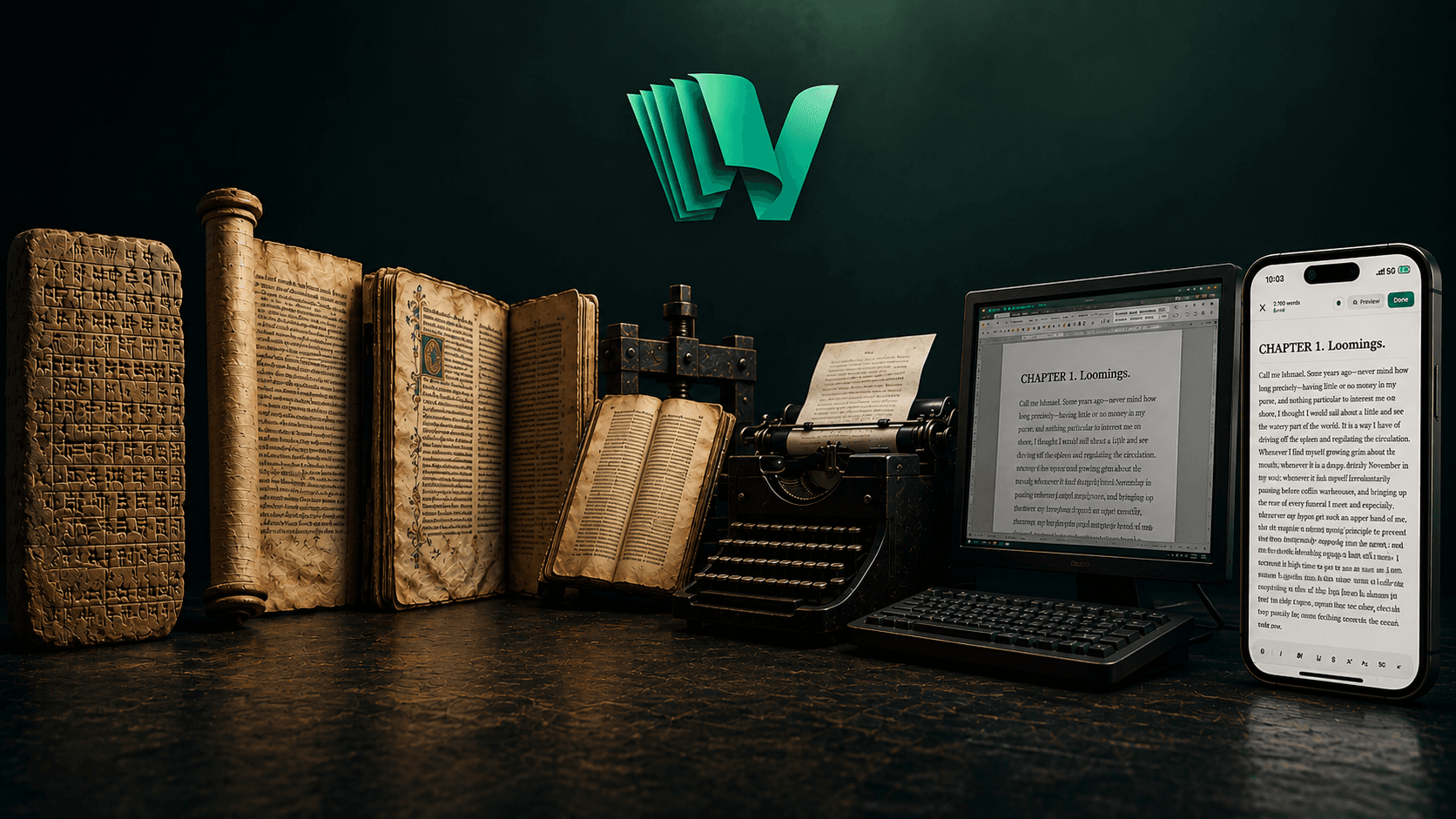
There is something strange about calling a book a book.
Place a clay tablet, a papyrus scroll, a medieval codex, a paperback novel, and an EPUB beside one another and very little about them appears related. They differ in material, shape, manufacture, distribution, durability, and even in the physical movements required to read them. Yet we are comfortable placing them along the same historical continuum.
Why?
Because somewhere beneath the objects is something more persistent than the objects themselves. The history of the book may not really be the history of an object at all. It may be the history of interfaces humans have invented for carrying thought through time.
Before the Page
Long before anyone turned a page, humans were already confronting a problem that remains familiar today: memory is fragile. A thought can exist brilliantly inside one mind and disappear with it. Spoken language allows the thought to travel, but every transmission depends upon another person remembering it.
Writing changed that relationship.
Among the earliest surviving examples are the clay tablets of ancient Mesopotamia. Wet clay could be impressed with cuneiform signs and subsequently dried or fired. The resulting object could preserve information far beyond the moment in which it was created. Some contained literature, mathematics, legal material, religious texts, administrative records, and correspondence. Others were remarkably ordinary.
Around the eighteenth century BCE, a man named Nanni had a complaint recorded about a merchant named Ea-nāṣir after an unsatisfactory copper transaction. Thousands of years later, the complaint survives. In modern language, a customer effectively left an unfavorable merchant review.
The customer disappeared. The merchant disappeared. The civilization surrounding them changed beyond recognition.
The complaint remained.
There is something profound hidden inside something so mundane. Of the countless thoughts Nanni must have experienced throughout his life, we know this one partly because this one got clay. Storage had already begun influencing memory.
When Thought Learned to Roll
Clay was durable, but durability has a price: it is heavy.
Writing technologies consequently continued changing. Papyrus offered something dramatically different: a lightweight surface that could accommodate substantially longer texts and be rolled into scrolls. The container changed, and the behavior surrounding information changed with it.
This is an important pattern. New publishing technologies rarely just give us another material. They change what becomes practical to write, preserve, transport, copy, organize, and read.
A scroll could contain considerably more continuous writing than a convenient clay tablet, but the scroll also imposed its own interface. Reading involved physically navigating through a rolled document. Moving between distant sections was cumbersome. Comparing passages required manipulation of the object itself.
The information existed, but access remained partly dictated by its container. That distinction would become enormously important, because eventually humans developed another interface.
The Radical Idea of Turning a Page
The codex now feels so ordinary that its brilliance is easy to miss. Sheets could be gathered, bound along one edge, and protected between covers. A reader could open the object almost anywhere.
Information suddenly had a more practical physical geography: beginning, middle, end, individual pages, and sections that could be revisited without unrolling everything that came before them.
The page became such a successful interface that we eventually stopped noticing it was an interface at all. For centuries, it became inseparable from our mental image of a book.
But the book had existed before the page, and eventually it would exist without one.
The Manuscript Was Once the Technology
Before mechanical reproduction transformed publishing in Europe, producing books could require extraordinary amounts of human labor. Texts were copied by hand. The physical object could be expensive, materials were valuable, skilled labor was necessary, mistakes could enter during copying, and decoration could require specialized craftspeople.
A book was not simply something someone wrote. It was something that had to be manufactured individually.
This affected who could produce books, who could possess them, how widely ideas could circulate, and how quickly another copy could appear. The limitations of publishing were partly the limitations of reproduction.
Then reproduction itself changed.
When Copies Became Cheap Enough to Change Civilization
Movable-type printing existed in East Asia centuries before Gutenberg, including important innovations associated with Bi Sheng in eleventh-century China and later metal movable type in Korea. In fifteenth-century Europe, Johannes Gutenberg's system combined movable metal type with technologies and processes suited to large-scale European book production.
The consequences were enormous.
The important innovation wasn't merely that machines could put letters onto paper. It was that reproduction became dramatically more scalable. Once type had been composed, many copies could be produced from essentially the same arrangement.
The economics of the written word changed. Copies could circulate farther, ideas could reach people their authors would never meet, and knowledge could be reproduced with a consistency and volume that manuscript culture struggled to match.
Something subtle happened alongside it: the relationship between the writer and the reader expanded beyond physical proximity. Publishing increasingly became an infrastructure for communicating with strangers.
Writing Becomes Mechanical
Centuries later, the typewriter changed another part of the interface. For most of writing's history, creating text meant directly forming individual marks with the hand. The typewriter inserted a machine between intention and inscription.
Press a key and produce a standardized character. The writer no longer needed to draw the letter.
That sounds trivial now. It wasn't.
Writing had become increasingly mechanical before it became digital, and once writing entered machinery, the distance between thought and final form would continue shrinking.
The Page Enters the Computer
The personal computer produced one of the strangest transitions in the history of writing: the physical page became a simulation.
Margins existed without paper. Fonts existed without metal type. Pages could be created without sheets. Characters could be deleted without erasure. Paragraphs could move after they had already been written. An entire manuscript could be duplicated without producing another physical object.
Eventually desktop publishing brought capabilities once distributed among specialized equipment and professions onto a computer. The writer's environment increasingly absorbed the publisher's environment.
But something historical happened here that is easy to overlook. We carried the language of the old interface into the new one. We still had pages, documents, folders, files, and desktops.
Digital systems borrowed physical metaphors because physical metaphors helped humans understand unfamiliar technology. Eventually the metaphor became familiar enough that we forgot it was a metaphor.
Then the Book Lost Its Page
The ebook complicates the definition of a book even further.
Consider an EPUB. The reader can change the font, increase its size, change line spacing and margins, rotate the device, or move from a phone to a tablet. The same chapter may occupy twenty screens for one reader and forty for another.
So where, exactly, is page 47?
For much of digital reading, the answer is: there isn't one.
The book continues to exist even when one of its most recognizable historical properties disappears. That tells us something important. The page was never the book. It was one extremely successful interface for the book.
We Keep Confusing the Container With the Thing
Every generation inherits technologies that feel natural because they were already present when that generation arrived. Eventually convention begins masquerading as necessity.
Books are pages. Writing happens at desks. Publishing requires certain machines. Professional work belongs on certain classes of computers.
Until it doesn't.
History repeatedly demonstrates that the written word is remarkably indifferent to the objects carrying it. Clay disappears and the writing continues. The scroll recedes and the writing continues. Hand copying becomes unusual and the writing continues. Metal type gives way to digital typography and the writing continues. The page itself becomes optional.
Still, the writing continues.
What survives is not the interface. What survives is the need.
Human beings want to externalize thought. We want to organize it, preserve it, reproduce it, and give it structure. We want to send it somewhere our bodies cannot go, and sometimes somewhere our lifetimes cannot reach.
The Computer May Be Another Container
That brings us to a peculiar assumption of the present. We readily accept that people should be able to read serious work on a phone. We communicate, photograph, edit video, bank, run businesses, sign contracts, and publish thoughts to audiences of millions from phones.
Yet professional book production remains culturally associated with sitting in front of a traditional computer.
Perhaps there are good historical reasons for that. Desktop computers inherited decades of publishing conventions. Large displays accommodate complex interfaces. Professional software accumulated features around keyboards, mice, windows, menus, and persistent workspaces.
But history gives us another question to ask:
Is the computer essential to publishing, or has publishing simply been designed around the computer?
Those are not the same question.
A clay tablet once represented a perfectly reasonable interface for recorded information. So did the scroll, the manuscript, and metal type. Each was extraordinarily useful within the technological environment that produced it. None deserved permanence simply because it had become familiar.
Neither does the desktop.
A Publishing Interface in Your Pocket
The smartphone is not interesting because it is small. It is interesting because billions of people already carry one. For many people around the world, the smartphone is not a companion to their primary computer. It is their primary computer.
That changes the publishing question.
Instead of asking how much of a desktop publishing application can be squeezed onto a smaller display, perhaps we should ask something more fundamental:
What would professional publishing look like if we designed it for the device people already have?
That question requires stripping away assumptions accumulated from earlier interfaces. What does a writer actually need to turn a manuscript into a professional publication? What information belongs to the document itself? Which decisions require persistent visibility? Which controls can disappear until they're needed? Which complexities exist because publishing is inherently complex, and which exist because previous software inherited decades of desktop conventions?
Those are interface questions, and publishing has been answering interface questions for thousands of years.
The Book Was Never the Object
Perhaps the strangest thing about the history of books is how many times the book has survived its own supposed definition. It survived the tablet, the scroll, handwritten reproduction, the transition from physical type to digital type, and even the loss of fixed pages.
It will survive whatever comes next.
Because a book was never merely the object sitting on the shelf. The object was a temporary agreement between human thought and the technology available to contain it.
Our ancestors pressed thought into clay because clay was there. They rolled it into papyrus because papyrus was there. They bound it into codices, pressed it into paper, encoded it into files, and rendered it onto screens.
And now billions of those screens live in our pockets.
The interesting question isn't whether the phone looks enough like the publishing tools that came before it.
The interesting question is what publishing becomes when we stop requiring it to.
Wexley Pro is exploring that question by building professional publishing tools around a mobile-first interface. This journal follows the larger ideas surrounding that work: the history of books, writing systems, typography, publishing technology, preservation, accessibility, and the evolving relationship between human thought and the tools we use to carry it forward.