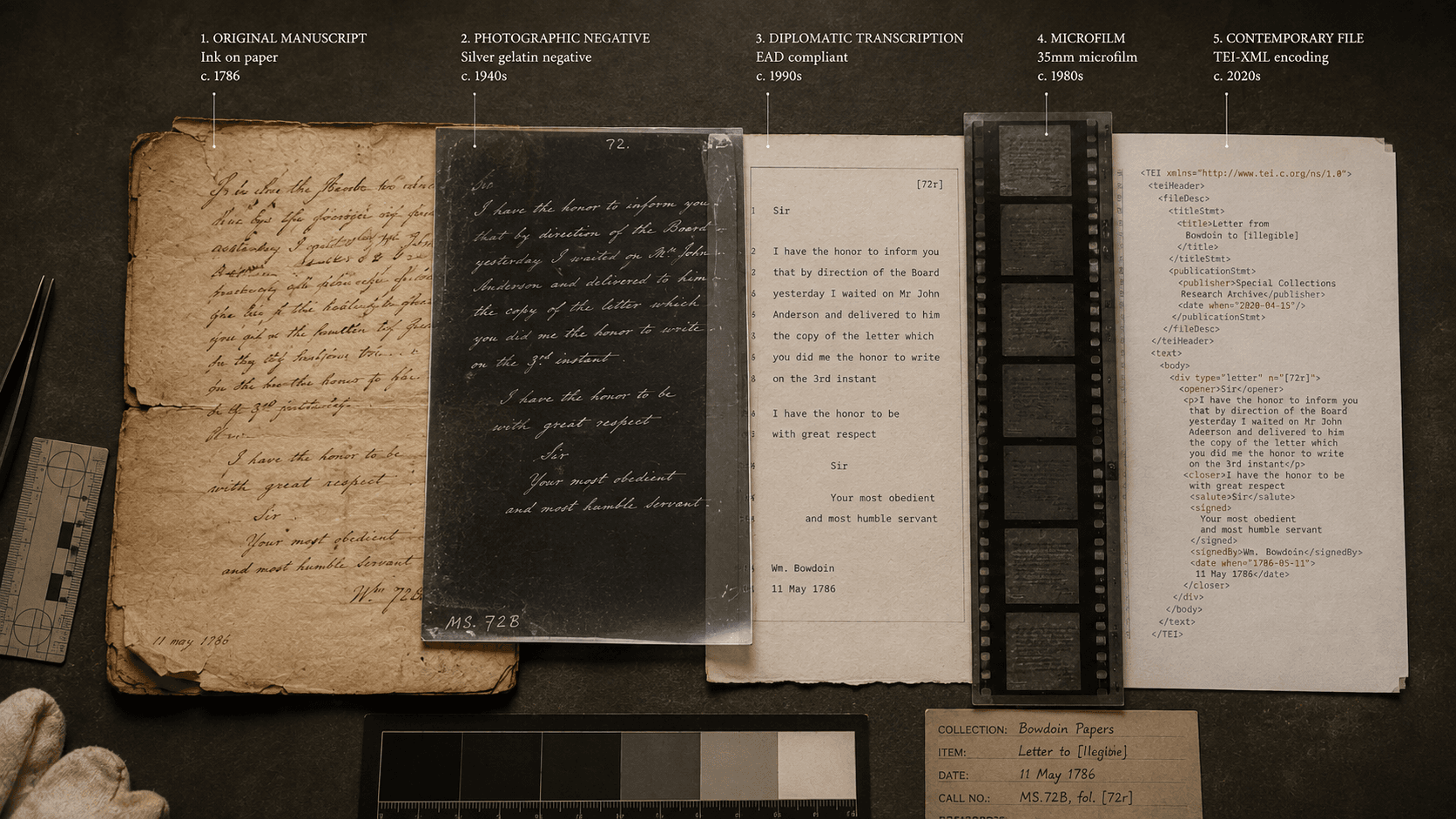
Open a manuscript in the Newton Project and several objects appear. There is the image of a page, with its spacing, additions, deletions, and material disorder. There is a diplomatic transcription intended to preserve much of that visible evidence in encoded text. There is a normalized reading version that regularizes features to make the words easier to follow.
These are not three increasingly inferior replicas. They are copies made for different questions. The image helps a reader inspect the witness. The diplomatic text makes textual states legible and searchable. The normalized version supports continuous reading. Each preserves something by changing something else.
Archives are often pictured as places where originals wait safely. The image honors an important duty and conceals another. Long-term access is repeatedly manufactured through photography, microfilm, digitization, replication, migration, and emulation. Refusing every transformation can protect a carrier until its information becomes too fragile, obscure, or technically dependent to use. Preservation requires choosing which changes can carry important properties forward.
No copy carries everything
A photograph can preserve visible marks while omitting weight, texture, binding movement, watermarks, or the way ink sits in a surface. A transcription can make a text searchable while requiring an editor to decide what an uncertain character is and how a spatial arrangement should be represented. A microfilm image can distribute a threatened newspaper while compressing tonal detail. A format migration can recover words from obsolete software while changing fonts, margins, pagination, comments, or interaction.
Calling these losses does not make the copies failures. It makes their purposes explicit. A preservation copy, an access copy, a surrogate for teaching, and a transformed file for current software answer different needs. Trouble begins when the convenient copy is allowed to impersonate the whole object.
The original remains valuable because later questions are unpredictable. A future imaging method may reveal erased writing. A binding may establish sequence. Paper and ink can assist dating. Marginal wear can document use. Retaining the source, when possible and justified, keeps open forms of inquiry that the first copy did not anticipate.
At the same time, originals do not provide access by merely existing. A unique manuscript kept in darkness is materially protected and socially absent. The archive has to negotiate preservation risk, rights, cultural restrictions, privacy, and the need to make records available. Copying is one way to distribute those obligations.
From duplication to evidence
Trustworthy copying depends on a record of intervention. Who made the copy? From which object or file? Under what conditions? What was omitted, normalized, compressed, renamed, or repaired? Which software and settings were used? Where is the source now?
This documentation is provenance in motion. It allows a later user to distinguish a change in the historical record from a change introduced by preservation. A diplomatic transcription that flags an uncertain reading can be more trustworthy than a fluent one that hides the editor's choice. A migrated file accompanied by its original, checksum, format identification, and process log can support stronger claims than a lone file whose clean appearance has no history.
Authenticity across copies rests on accountable identity. The copy declares what it is, where it came from, which properties it was intended to carry, and what happened along the way. A manuscript copy may identify a source or scribe; a printed edition can describe its witnesses; a photograph can include a scale and color target; a digital repository can record checksums, tools, dates, and transformations. Each gives the copy a chain of custody.
The reassuring weakness of redundancy
Digital preservation advice often begins with multiple copies, correctly. One storage failure should not destroy the only instance. Copies should be kept across appropriate systems and locations, monitored for integrity, and replaced when media or services fail.
Redundancy alone is weak. Three copies of an unidentified proprietary file can preserve the same future problem. A synchronized service can propagate an accidental deletion to every replica. A backup may retain data while omitting the metadata, keys, account permissions, or application needed to interpret it. A corrupted source copied several times becomes redundant corruption.
The National Digital Stewardship Alliance's Levels of Digital Preservation places storage alongside integrity, control, metadata, and content management. Copies need verification. Actions need authorization and logs. Formats need identification. Metadata needs storage. Access needs testing.
A checksum is part of this system. It can tell a repository that a file's bits match a prior state. It cannot say that the file is the right version, that its content is intelligible, or that the preserved state includes everything users value. Integrity is necessary evidence with a deliberately narrow jurisdiction.
Migration: preserving through change
Imagine a document created in discontinued software. Its bits are intact, but no supported application opens it correctly. A repository might migrate it to a current format. The words and much of the structure return; a particular font, margin, animation, field behavior, or revision trace may not.
Migration forces a decision about significant properties. For a novel, textual content, hierarchy, notes, and some formatting may matter more than the original application's gray toolbar. For a work of electronic literature, that toolbar, timing, window behavior, or interaction could be part of the work. For an author's draft, deleted passages and page arrangement may be evidence of composition.
Emulation takes another route by recreating aspects of the old computing environment. It can preserve behavior that migration flattens, but it introduces a larger system to maintain: emulator, operating environment, application, fonts, media, and documentation. The two approaches can coexist. A repository may offer a migrated access copy while retaining the original bits and an emulated research environment.
Preservation becomes more credible when it supports several representations rather than crowning one successor as final.
Access copies and their limits
Digitization can reduce handling and create distributable copies, but the scan immediately becomes another object requiring preservation. It needs identifiers, metadata, integrity checking, storage, format management, rights review, and future migration.
The digital copy can greatly exceed the original's reach. A reader far from the repository can enlarge a page, compare images, search a transcript, or use assistive technology with encoded text. Those gains do not require pretending that a screen image contains the binding or that OCR contains every mark.
Nor does access imply universal disclosure. Personal papers, culturally sensitive material, copyrighted works, and records involving living people can require restrictions. UNESCO's guidance on documentary heritage joins preservation and access while recognizing privacy, rights, and legitimate limits. A copy can be created for preservation without being made public immediately.
This distinction matters for born-digital archives. A hard drive may contain temporary files, private correspondence, duplicate downloads, account tokens, and deleted material along with drafts. Technical recoverability is not an ethical instruction to retain and expose everything. Appraisal and restriction remain part of the copying system.
A plural archive
The original and its transformed representations can correct one another. Originals remind us that representations are partial. Copies distribute risk, enable access, and let different properties be made legible. Documentation keeps their relationship honest.
An archive can retain a manuscript, preservation images, an OCR layer, a diplomatic transcription, a reading edition, and catalog metadata. None contains the others. Together they allow more questions and make editorial choices visible.
Leaving an object entirely unchanged is rarely available over long periods. Paper is rehoused. Film is reformatted. Files are copied off failing media. Software is emulated. Descriptions are revised. Access copies are regenerated. Continuity is built from these interventions, and the archive's responsibility is to choose them carefully, record them, and keep enough of the prior state that future custodians can question the choice.
SOURCES
- The Newton Project. “A Short Scheme of the True Religion.” https://www.newtonproject.ox.ac.uk/view/texts/normalized/THEM00138?end=par23&start=hd4 - Library of Congress. “Sustainability of Digital Formats.” https://www.loc.gov/preservation/digital/formats/ - Library of Congress. “Bit-Level Preservation and Long-Term Usability.” https://www.loc.gov/programs/digital-collections-management/digital-formats/bit-level-preservation-and-long-term-usability/ - National Digital Stewardship Alliance. “Levels of Digital Preservation.” https://www.ndsa.org/publications/levels-of-digital-preservation/ - Digital Preservation Coalition. Digital Preservation Handbook. https://www.dpconline.org/handbook - UNESCO. “Recommendation concerning the Preservation of, and Access to, Documentary Heritage Including in Digital Form.” https://www.unesco.org/en/legal-affairs/recommendation-concerning-preservation-and-access-documentary-heritage-including-digital-form?hub=177179 - Harvard Gazette. “Saving the Digital Record.” https://news.harvard.edu/gazette/story/2015/05/saving-the-digital-record/