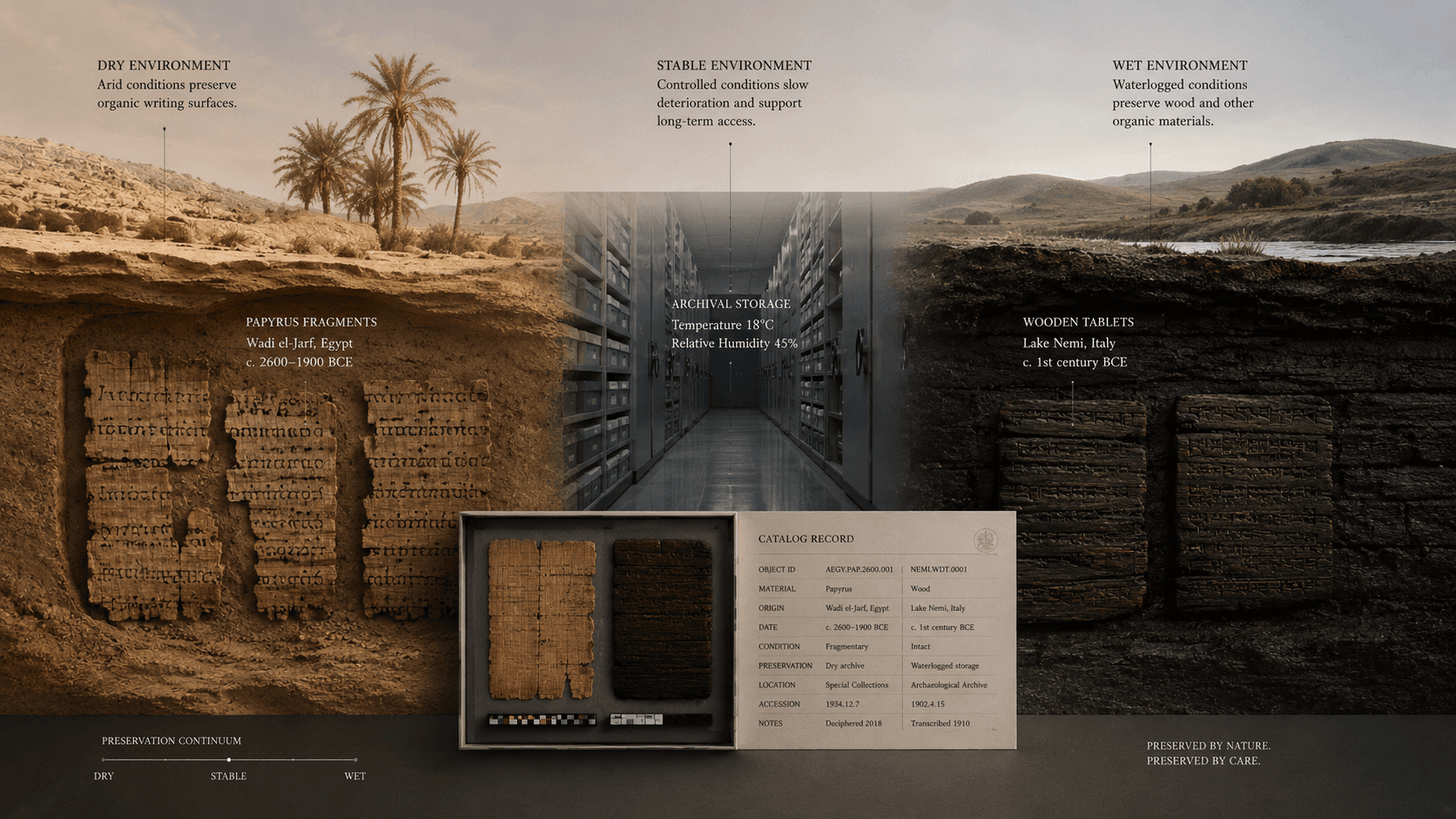
At Oxyrhynchus in Egypt, the dry rubbish mounds preserved papyrus that would have disappeared in wetter places. The discarded papers included letters, accounts, tax records, official notices, and literary fragments. At Vindolanda in northern England, thin wooden writing tablets survived for almost the opposite reason. Waterlogged deposits created conditions with too little oxygen for the organisms that would ordinarily destroy them. Documents cleared from successive phases of a Roman fort were dumped; attempts to burn some of them appear to have failed in the wet ground.
The two sites make poor illustrations for a simple ranking of durable media. Papyrus survived through dryness. Wood survived through saturation. Rubbish preserved kinds of writing that institutions had not selected for permanent honor. In each case, the historical record was shaped by a chain of material accidents and later acts of attention.
Storage is often imagined as the passive interval between creation and retrieval. In practice, a record must pass through several filters. Each filter removes material and amplifies what remains.
What can be written
The first filter operates before storage. A medium's cost, available space, tools, literacy, administration, and social permission influence what is recorded. A monument can preserve a public declaration for centuries while excluding the ordinary negotiations that produced it. Cheap paper can admit shopping lists and private drafts, though most will never be kept.
Durability and representativeness therefore pull in different directions. A highly durable surface may carry a narrow class of statements. A fragile medium may carry everyday life. The surviving sample depends on who could write, what was considered worth recording, and which carriers happened to endure.
Oxyrhynchus is valuable partly because the papers were not a curated portrait of the town. Its rubbish yielded the paperwork of daily and administrative life alongside literature. This does not make the corpus a statistically neutral sample of ancient society. Discard itself is a filter, as are excavation, conservation, publication, and scholarly language skills. The point is that neglect admitted evidence formal commemoration often did not.
What is kept
Archives choose. That statement is sometimes heard as an admission of failure, although selection is among their defining responsibilities. Records arrive in volumes that exceed the resources available to preserve, describe, restrict, and provide. Appraisal asks which have enduring value under an institution's mandate.
The U.S. National Archives estimates that roughly one to three percent of federal records are retained permanently. That figure belongs to one government records system; it is not a law of archives everywhere. Its usefulness is conceptual. Creation is much broader than permanent retention, and institutional memory is deliberately made.
Selection reflects administrative need, law, evidentiary value, cost, collecting mission, power, and historical judgment. Those judgments can preserve accountability and can create silences. Later archivists can describe a gap, acquire complementary collections, or reinterpret a series. They cannot retrieve a record that was never made or was destroyed before it entered custody.
Cheap digital capacity changes the timing of this problem. An organization may store far more material before deciding what matters. Selection returns as maintenance, access control, description, migration, search ranking, and deletion policy. A million unnamed files on neglected media constitute abundance at the level of bits and scarcity at the level of usable memory.
What physically survives
Every carrier has conditions. Paper responds to moisture, heat, insects, light, acidity, and handling; digital media add their own dependencies on manufacture, environment, equipment, and management. Simple lifetime tables disguise those variables.
A promise that a medium lasts a certain number of years usually assumes conditions a household or institution may not meet and ignores the drive, reader, cable, software, or expertise needed to retrieve it. The oldest surviving example of a medium does not predict the future of an ordinary item stored badly.
Vindolanda offers an especially sharp correction. Water usually threatens organic writing materials. At that site, persistent waterlogging excluded oxygen and slowed biological decay. Once excavated, the tablets required active conservation because removal from the preserving environment changed the conditions. Survival until discovery was one achievement; stewardship after discovery became another.
What remains readable
Digital storage makes it easy to confuse intact with usable. A checksum can show that a sequence of bits has not changed. It cannot explain what those bits mean.
The Library of Congress distinguishes bit-level preservation from long-term usability. A file may survive exactly while its format is unknown, its codec unavailable, its font missing, or its software dependent on hardware that no longer runs. A database may open while losing the application logic that connected its fields. A document may render while shedding comments, tracked changes, or layout evidence important to researchers.
Readable is itself layered. The storage device must yield the bits. The format must be identified. Some implementation must interpret it. Dependencies must be supplied or replaced. Significant properties must survive the process. A human must understand enough of the record's language and context to use it.
Migration and emulation answer different parts of this problem. Migration transforms content into a form current systems can read, potentially altering presentation or behavior. Emulation reconstructs aspects of an old environment, preserving more of the original interaction at the cost of additional technical dependencies. Neither is an automatic expression of fidelity. Institutions choose what properties the collection and likely uses require.
What can be found
A preserved record can remain functionally absent. Description, arrangement, cataloging, OCR, transcription, language access, rights review, and search interfaces determine which items surface. The most easily indexed evidence can dominate research even when less tractable material survives beside it.
Digitization can widen access and reduce handling of fragile originals. It also creates a new object that needs storage, integrity checking, metadata, migration, and rights management. A scan may omit a binding, verso, watermark, edge note, or color relationship relevant to later inquiry. A transcript can make text searchable while regularizing uncertain marks. Good systems document these transformations rather than presenting the copy as transparent.
Access must also be limited in some cases. Privacy, cultural authority, copyright, security, and the safety of living people can justify restrictions. Preserving information does not settle who should see it now. UNESCO's documentary-heritage guidance treats preservation and access as linked obligations while recognizing legitimate constraints.
What later readers can recognize
The final filter is interpretation. A future community may inherit records without the categories needed to understand them. Abbreviations, organizational structures, software conventions, social roles, and unrecorded assumptions disappear. Contextual metadata is part of the bridge between a surviving artifact and evidence.
The chain can now be stated precisely. Something must be recordable. Someone must retain it, intentionally or by accident. Its carrier or bits must survive. A reader must be able to recover the representation. The item must be discoverable and legally or ethically accessible. Its context must be intelligible. Failure at any stage changes history, and success at one cannot compensate automatically for another.
Greater storage capacity remains a profound good. It permits institutions and individuals to retain records that earlier costs would have excluded. It can multiply copies, distribute risk, and widen access. Its mistake is to look like the end of forgetting. Capacity moves decisions downstream, where they are less visible: which files are checked, which formats are migrated, which collections are described, which results are ranked, and which absences anyone notices.
The archive is never simply what a society wrote. It is what passed through this material, institutional, technical, and descriptive survival system. Dry sand, wet soil, appraisal schedules, file specifications, catalog fields, budgets, permissions, and patient readers all take part.
SOURCES
- The Oxyrhynchus Papyri, University of Oxford. “Waste Paper City.” https://oxyrhynchus.web.ox.ac.uk/node/3483116 - British Museum. “The Vindolanda Tablets.” https://www.britishmuseum.org/collection/galleries/roman-britain/vindolanda-tablets - U.S. National Archives. “Appraisal Policy.” https://www.archives.gov/records-mgmt/scheduling/appraisal - U.S. National Archives. “Frequently Asked Questions.” https://www.archives.gov/faqs - Library of Congress. “Bit-Level Preservation and Long-Term Usability.” https://www.loc.gov/programs/digital-collections-management/digital-formats/bit-level-preservation-and-long-term-usability/ - Library of Congress. “Sustainability Factors.” https://www.loc.gov/preservation/digital/formats/sustain/sustain.shtml - UNESCO. Memory of the World Programme. https://www.unesco.org/en/memory-world - UNESCO. “Recommendation concerning the Preservation of, and Access to, Documentary Heritage Including in Digital Form.” https://www.unesco.org/en/legal-affairs/recommendation-concerning-preservation-and-access-documentary-heritage-including-digital-form?hub=177179