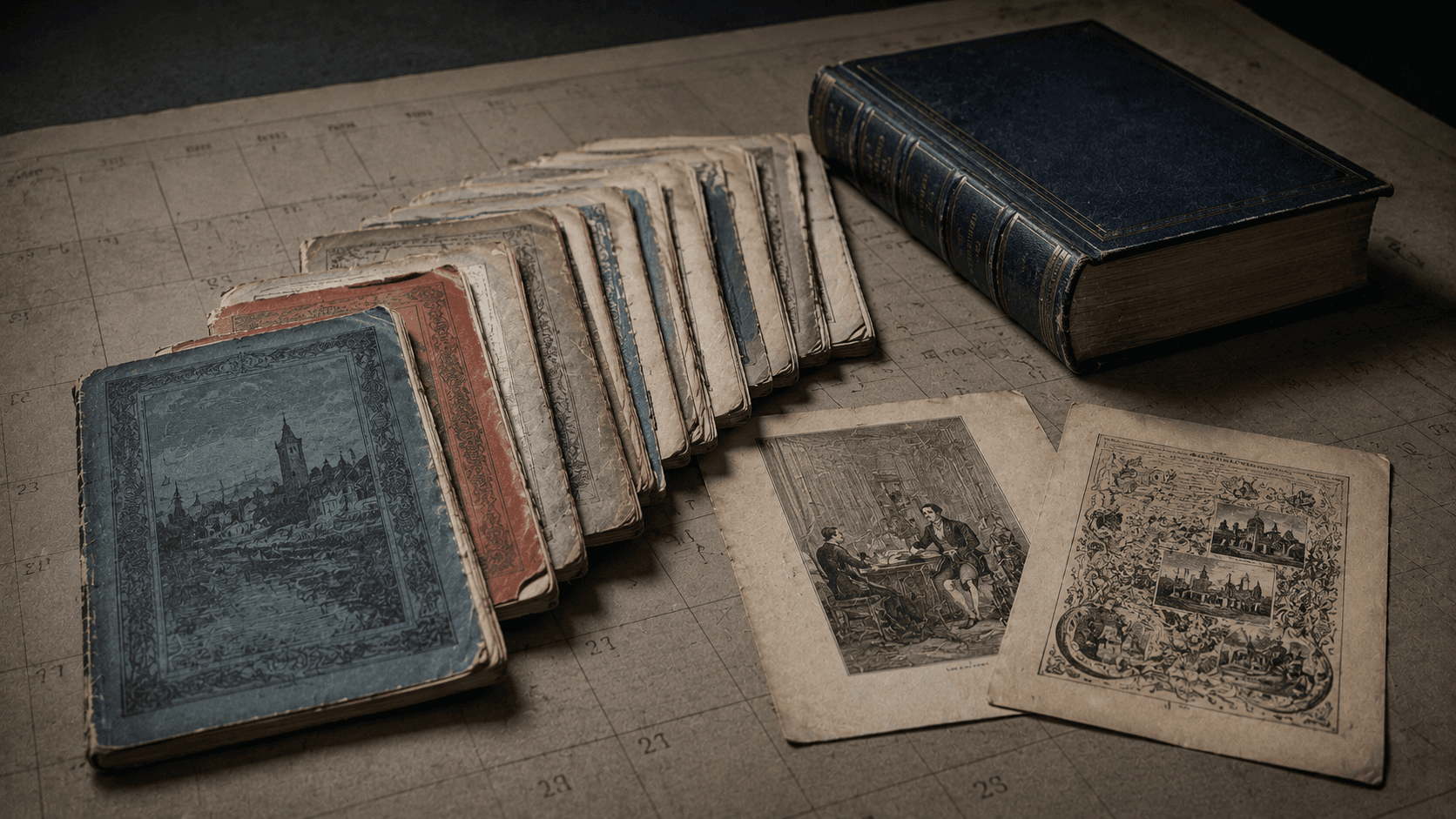
The first readers of Nicholas Nickleby could not buy the novel. In March 1838 they could buy its beginning: a shilling monthly part in a colored wrapper, with illustrations and advertising. Nineteen monthly issues later, the work was complete in twenty parts because the last issue contained a double number.
A modern bound edition preserves the verbal sequence while usually removing the wrappers, most advertisements, and the compulsory intervals. The novel remains; one of its original clocks disappears.
Serial publication is often described as a method of dividing a long work into saleable pieces. That account gets the knife but misses the calendar. A serial is written, manufactured, purchased, discussed, and remembered in recurring public intervals. The next part is absent until a date arrives.
The monthly part was already a publication
An installment of a Dickens novel was not an exposed section of a future book. It was a made object with a price, wrapper, pages, plates, advertisements, and a relation to earlier numbers. The cover announced the series and maintained visual continuity from month to month. Advertising pages situated the fiction among other goods, publications, and services. Illustrations offered scenes and characters through another production schedule.
The reader had something complete enough to buy and incomplete enough to require a return. This condition shaped memory. A character introduced in one number might not reappear for months. Recap, parallel plots, repeated motifs, and clear scene construction helped readers reenter a story after an interval. An ending could create suspense, though suspense was not limited to a cliff edge. A monthly number might close a movement, shift attention, suspend a question, or leave emotional pressure unresolved.
The word “cliffhanger” can make every serial form sound like one mechanism. It also encourages present-day readers to inspect only the last sentence of an installment. The interval affects the whole unit: how much can be introduced, developed, remembered, illustrated, and deferred before the wrapper closes.
Writing inside a moving production
Serial publication overlaps stages that a completed manuscript can keep sequential. While readers hold one number, the author may be drafting a later one, revising another, reviewing proofs, and coordinating with an illustrator. Compositors, engravers, printers, binders, advertisers, and distributors work toward the recurring date. The book's public past grows while its private future remains alterable.
Dickens's working notes make that relationship visible. Plans for his novels include prospective ideas and retrospective records arranged around monthly numbers. Characters, plot threads, motifs, and unfinished business are tracked against units of publication. The notes disprove the easy picture of a writer improvising each installment from nothing. They also disprove the opposite picture of a finished novel merely being cut into pieces.
Planning under serialization is a form of constrained foresight. Earlier numbers cannot be silently revised for their first audience. A name, relationship, or promise already printed becomes part of the world the remaining manuscript must honor or visibly contradict. The author can change direction, but the change has a public history.
Deadlines make the constraint sharper. A late chapter threatens illustration, composition, printing, and distribution. Installment length creates arithmetic: scenes have to fit a number, and short or long material changes what can be placed around them. The recurring unit can discipline invention, encourage padding, produce compression, or establish formal patterns. None of those outcomes follows automatically. Schedule is a pressure, not an explanation of literary value.
Illustration keeps another clock
The serial illustrator needs information before readers do. A scene must be selected, communicated, designed, transferred to a printable plate or block, and produced in time for the issue. This can require an author to supply manuscript, summary, or instruction before the rest of the number is settled.
The resulting image participates in anticipation. It can reveal a character's appearance, emphasize one episode over another, or create tension with the prose. In a part issue, plates occupy a material position and arrive with that month's text. Later editions may move them, reproduce them at another scale, omit them, or commission new illustrations. The illustration program has its own version history.
Coordination can also preserve disagreement. An image may fix a detail the author imagined differently, or a late textual change may leave the plate attached to an earlier plan. Treating illustration as decoration misses that it was another authored and manufactured component tied to the serial schedule.
Did readers write the novel?
Serialization creates an interval in which response can reach the author before the work is complete. Sales, reviews, letters, conversation, and public reaction become available while future installments remain unwritten. This has encouraged a durable story in which Dickens watched popularity and adjusted plots on demand.
The possibility is real; each claimed influence needs evidence. A fall in sales can coincide with a change without causing it. A reader's letter can express a wish the author ignored. Working notes, correspondence, manuscript changes, publisher records, and chronology are necessary before a specific plot turn can be attributed to audience pressure.
Even without direct alteration, public response changes the conditions of composition. An author knows that characters are already being impersonated, criticized, illustrated, and awaited. A private draft usually imagines readers. A serial writer has actual readers occupying the unfinished work.
This does not make the audience a coauthor in any simple sense. It makes publication porous: reception begins before composition is complete.
The bound volume edits time
Once installments are complete, publishers can issue the novel as a volume. Parts may be gathered, preliminaries added, errors corrected, and illustrations reorganized. Wrappers and advertisements are often discarded. A library catalog then describes the book as a stable object instead of nineteen moments of purchase.
The volume offers genuine advantages. It is durable, convenient, and continuous. Readers can finish a plot in days, move backward freely, and experience structures that were difficult to hold across nineteen months. It is a different temporal interface, not a degraded serial.
Continuous reading changes proportion. A repeated reminder that helped a monthly reader can feel redundant; a delayed return seems rapid. Advertisements no longer interrupt the fictional world with the commerce that supported its delivery. The same words operate under another duration.
Some surviving sets preserve original parts, and collectors have bound parts together. These objects complicate the binary: serial material can be physically continuous while retaining wrappers and advertisements. What matters is whether the reader encounters the paratext and understands the intervals through which the work first circulated.
Serialization beyond Dickens
Dickens is exceptionally well documented and cannot represent every serial tradition. Nineteenth-century fiction appeared in monthly parts, weekly magazines, newspapers, and syndication. Installment length, payment, illustration, censorship, distribution, and audience varied across countries and publications. Some authors completed manuscripts before serialization; others composed alongside issue. Some serials were revised extensively for book form.
The general principle survives the variation: cadence can become a production constraint and a compositional resource. Contemporary newsletter fiction, webcomics, episodic games, podcasts, and platform serials operate under different economics, yet release schedules still govern memory and response. The comparison works only while the differences remain visible. A digital creator may revise old episodes; a printed part in readers' homes could not be patched at once. Platforms can supply forms of audience measurement that Victorian publishers did not possess. Subscription systems introduce their own incentives.
The historical serial warns against treating any current cadence as neutral delivery. Weekly, daily, binge release, and completed volume each shape the unit a maker must finish and the interval a reader must cross.
The wait inside the work
When a serial novel is collected, its installments can look like seams left by commerce. Sometimes they are awkward. Sometimes they are where pacing, memory, illustration, and public expectation were organized. Reading the seams does not reduce the novel to its sales model. It restores one of the conditions under which literary choices acquired force.
The first reader of Nicholas Nickleby did not know the whole design. Dickens did not yet possess every finished page. Printer and illustrator worked with partial futures. The monthly wrapper gathered those unequal states into one thing that could be issued on time.
Serialization made incompletion public and periodic. A bound book cannot reproduce that uncertainty because every next page is already there. What survives is the architecture built to carry readers across the months when it was not.
SOURCES
- British Library. “Charles Dickens's Nicholas Nickleby.” https://www.britishlibrary.cn/en/works/nicholas-nickleby/ - Charles Dickens Museum. “David Copperfield in Monthly Parts.” https://www.collections.dickensmuseum.com/object--lib-6126 - Dickens Project, University of California, Santa Cruz. “Composition and Publication.” https://dickens.ucsc.edu/omf-scholarly-pages/publication/composition-and-publication/ - Dickens, Charles. Dickens's Working Notes for His Novels. Library of Congress digitization. https://tile.loc.gov/storage-services/master/gdc/gdcebookspublic/20/19/45/25/97/2019452597/2019452597.pdf - Cambridge University Press. Scholarship on seriality. https://www.cambridge.org/core/product/8973016E70A446AB823B4094175F5655/core-reader