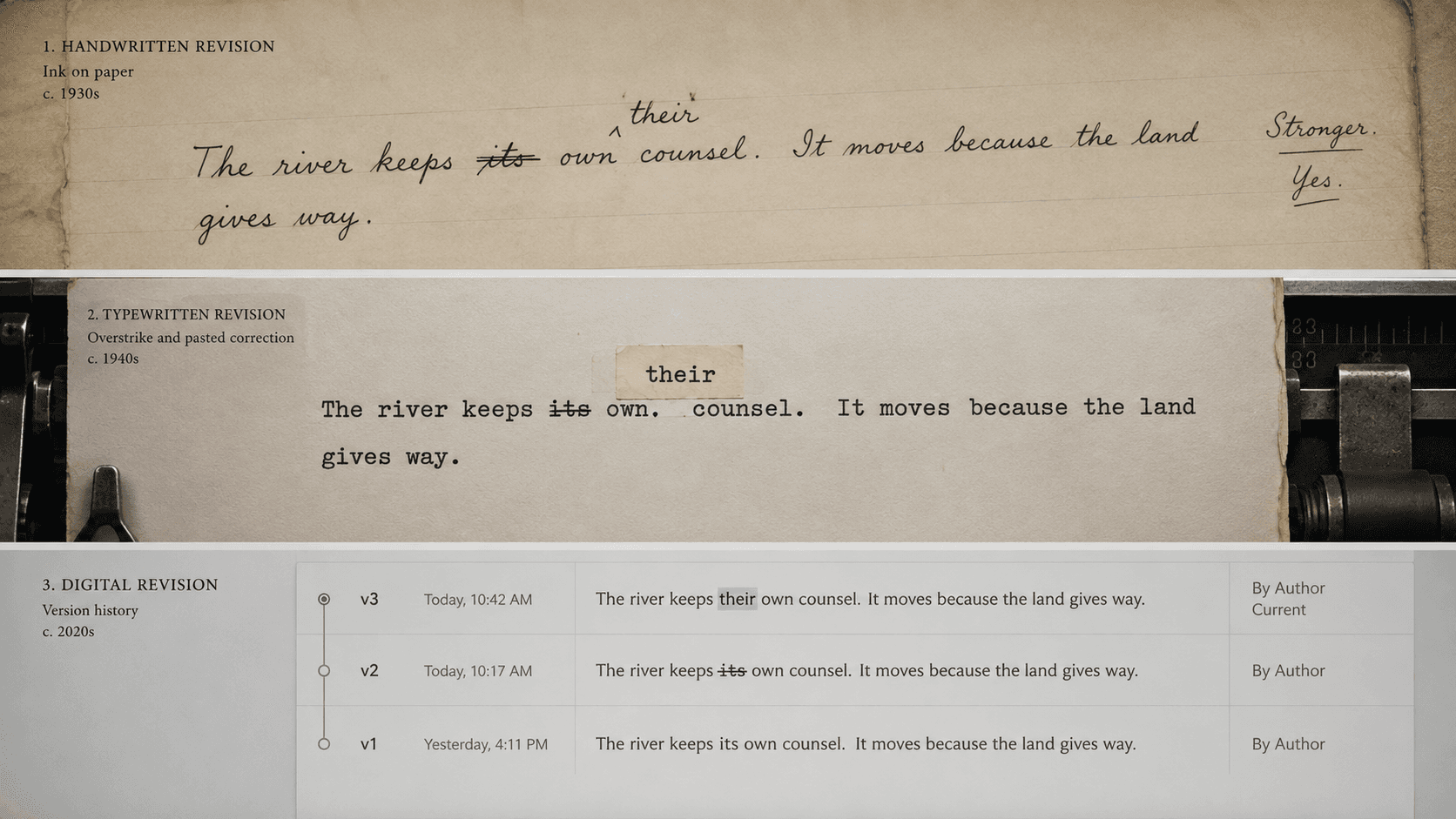
A crossed-out word is unusually generous evidence. It lets a later reader see that one phrase occupied a place and another replaced it, although the visible sequence does not preserve every reason for the change.
In the surviving notebooks for Frankenstein, additions, deletions, substitutions, and more than one hand can be examined through manuscript images and scholarly transcription. The Shelley-Godwin Archive makes these layers legible while warning, by its very method, against effortless mind-reading. A cancellation records an action on a document. It does not preserve every thought that led to it.
Revision is often described as a stage of writing, as though it occurs in the same way on every surface. The material practice is more exact. A tool determines what can be changed locally, what must be recopied, what remains visible, and which prior states can be recovered. Every medium gives changing one's mind a price and produces a different archive of the payment.
Marks that stay
Ink on paper allows insertion, cancellation, substitution, arrows, marginal additions, pasted slips, and new leaves. The writer can work locally until the page becomes difficult to follow, then create a cleaner copy. Erasure may remove a mark imperfectly; overwriting can conceal sequence; paper size can force a continuation elsewhere.
These traces tempt narrative. A critic sees one word crossed out and another written above it, then describes a decisive change in intention. The page supports a narrower statement: the visible inscription changed in an order that can sometimes be reconstructed. The writer may have considered several alternatives before either mark, returned later, accepted another person's suggestion, or changed the phrase for reasons outside the page.
Document type also matters. A rough draft, fair copy, presentation manuscript, printer's copy, and corrected proof do different work. “Fair copy” does not guarantee a revision-free object. The Folger Shakespeare Library's collections include fair copies with corrections, drafts, commonplace books, and prepared presentation texts. Cleanliness is a degree and a purpose, not a stable point called finished.
Revision can continue after type has made a text public. A Folger copy of Thomas Nashe's Almond for a Parrat contains forty handwritten corrections across printed sheets, attributed by scholars to Nashe through handwriting and bibliographical evidence. The printed page became another revision surface. Publication was an event in the text's history, not a seal against further change.
The cost of a clean page
The typewriter gave correction a different economy. A wrong character could be struck over, erased, covered, or marked. A moved paragraph usually required retyping. Carbon copies multiplied the text and could multiply the correction burden. Creating a clean page erased visible disorder by producing another object.
That clean copy could support better revision. Legible text makes repetition, pacing, and structure easier to inspect; another reader can annotate it without first deciphering handwriting. It also separates the surviving record from the process. If rough sheets were discarded, the polished typescript becomes the earliest available witness and can make composition look more linear than it was.
The typist may participate in the change. Ambiguous handwriting has to be interpreted. House style may be applied. A repeated word may be silently corrected or intentionally preserved. Delegated inscription introduces another hand while the mechanical page disguises hand difference behind uniform type.
The point is not that older revision was deeper because it was harder. High cost can encourage patience, discourage experiment, or simply consume time. Writers adapt. Material constraints describe available actions; they do not grade the thought that uses them.
Delete, undo, overwrite
Word processing makes local change cheap. Insert a sentence and the text below moves. Search and replace alters many instances. Copy-and-paste lets a paragraph appear elsewhere without being recopied. Undo can reverse a recent operation.
The screen seems to preserve less evidence because the old word disappears cleanly. Behind the interface, the situation varies. An application may store recent operations for one session, keep periodic versions, synchronize a file history, or preserve only the latest saved state. An export may flatten comments and revisions even when the platform retains them. “Digital” does not specify a revision archive.
Undo makes reversibility feel local and immediate. It does not promise permanent memory. Close a document, cross a retention boundary, replace a synchronized file, or export to another format and the available history can change. The command is an interface to stored states under a particular policy.
That policy shapes behavior and rights. A visible revision history may encourage experiment because changes can be recovered. It can also inhibit experiment when every action appears inspectable. A clean draft can provide creative privacy; comprehensive capture can preserve scholarship and expose material never intended for readers. The design of version history is already a selection about what may become evidence.
The digital archive is edited too
Born-digital collections complicate the idea of total recovery. File creation and modification dates can be reset by copying, migration, or system behavior. Several files with similar names may be sequential drafts, branches, backups, or duplicates. An old format may open only partially in current software. The apparent page can change when a font or application is missing.
Archivists document processing actions because they are part of the evidence. Harvard's born-digital guidance addresses checksums, file renaming, nonrenderable formats, deletions, redactions, and uncertain dates. Temporary files and duplicates may be removed. Private or restricted information may be withheld. A forensic tool's ability to recover deleted data does not settle whether an archive should retain or disclose it.
Migration can make a draft readable while changing margins, spacing, pagination, or revision features. Emulation can recreate more of the old environment but requires additional software and documentation. Keeping the original bits alongside transformed access versions allows later researchers to question the current rendition.
The resulting history is a selection from authorial files, application behavior, storage policy, archival appraisal, technical processing, rights, and access decisions. It cannot replay writing in full.
What deserves to survive
Writers do not owe posterity every false start. An unfinished sentence can be evidence to a scholar and necessary privacy to its author. Collaborators may appear in comments they never expected to publish. Revision histories can contain personal data, negotiations, and material belonging to other people.
Preservation decisions therefore require purpose and consent, not a reflex for maximum capture. A writer may deliberately retain milestone drafts, label versions, export durable formats, and preserve significant correspondence. An institution may restrict sensitive files while documenting their existence. Another project may decide that only the published text falls within scope.
Revision traces can show sequence, collaboration, available tools, and the material work of composition. A manuscript crossing-out, a retyped page, and a software version each reveal what its medium and custodians allowed to remain. Undo moved much of revision's material evidence into storage, application state, interfaces, and policies that are easier to overlook than ink on paper.
SOURCES
- Shelley-Godwin Archive. https://shelleygodwinarchive.org/ - Shelley-Godwin Archive. “Using the Archive.” https://shelleygodwinarchive.org/using-the-archive/ - Folger Shakespeare Library. “Manuscripts.” https://www.folger.edu/research/about-our-collections/manuscripts/ - Folger Shakespeare Library. “Nashe's Almond for a Parrat, Corrected by the Author.” https://www.folger.edu/blogs/collation/nashes-almond-for-a-parrat-corrected-by-the-author/ - Harvard Library. “Describing Born-Digital Material in ArchivesSpace.” https://sites.harvard.edu/joint-processing-guidelines/description/born-digital-description/describing-born-digital-material-in-archivesspace-2/ - Library of Congress. “Bit-Level Preservation and Long-Term Usability.” https://www.loc.gov/programs/digital-collections-management/digital-formats/bit-level-preservation-and-long-term-usability/ - Harvard Gazette. “Saving the Digital Record.” https://news.harvard.edu/gazette/story/2015/05/saving-the-digital-record/