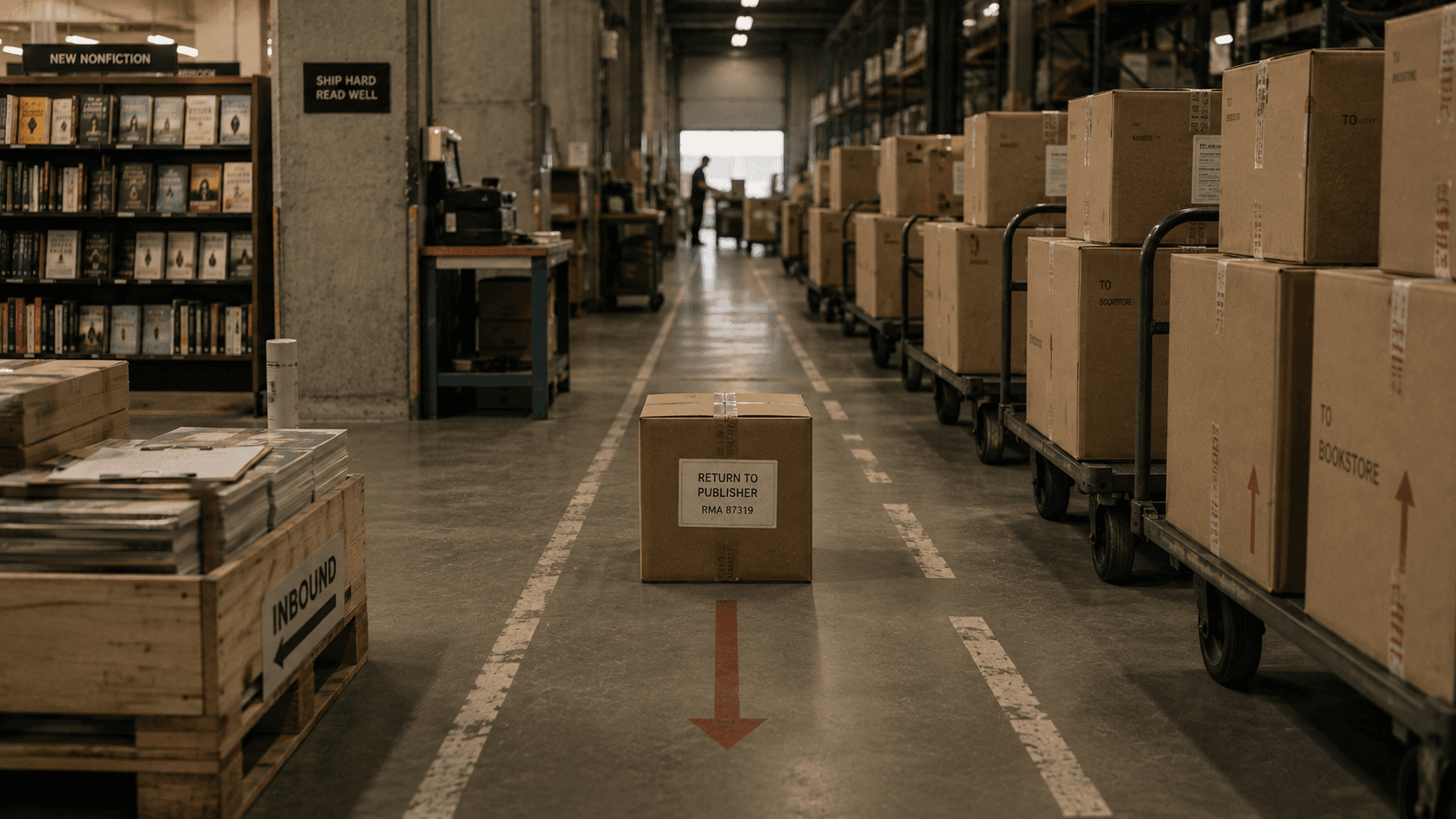
A publisher ships one hundred copies of a new title to booksellers and invoices the trade for all one hundred. Readers buy fifty. Months later, the other fifty copies travel back and credits travel in the opposite direction. The publisher made one hundred provisional trade shipments and fifty net sales after returns; consumer sell-through occurred fifty times.
Under sale-or-return terms, a retailer or wholesaler may send qualifying unsold copies back for credit, subject to the supplier's conditions. The convention is familiar enough in parts of the book trade that an author can hear “we sold into stores” without being told that some of those transactions can reverse.
The returnable book is a contractual technology for assigning uncertainty. Its influence begins before any carton comes back.
The risk reaches the shelf first
A retailer buying on firm sale bears the cost of ordering too many copies. That encourages cautious quantities, especially for an unknown author or unfamiliar press. Returnability makes a speculative order less final. A buyer can test more copies, locations, or display space because eligible stock has a route back.
The store still commits cash or credit, labor, shelf space, and attention. It may pay return freight; damaged copies or late claims may be ineligible. The publisher finances manufacture, processes credits, receives and evaluates stock, and bears some mixture of freight, restocking, disposal, and forecast error. Distributors and wholesalers add their own contracts and costs.
What changes is the consequence of being wrong. A store facing an irreversible purchase may order two copies after demand appears. Under returnable terms it may try ten at release. This does not guarantee placement: weak demand, unsuitable discount, incomplete metadata, or an unclear audience can still keep a title out. The option removes one obstacle to experimentation; it does not supply a reason for interest.
Physical discovery has an inventory cost. Return terms influence who finances the interval between placing a book on a shelf and learning whether a reader wants it.
Entrenchment, not invention
Accounts of modern U.S. and U.K. publishing often connect widespread sale-or-return practice with the Great Depression. Publishers sought to keep booksellers ordering during a severe contraction by reducing the danger of being trapped with speculative stock. The arrangement outlasted the emergency and became ordinary trade infrastructure.
That history supports a story of expansion and entrenchment, not a single invention date. Consignment, credit arrangements, and negotiated return rights existed earlier and in other book trades. Dutch book-trade history, for example, records individual return agreements within a system that developed through different institutions. Fixed-price rules, wholesalers, department stores, subscriptions, libraries, and trade associations gave national markets different ways to divide risk.
Evidence does not justify naming one inventor or birthday for the returnable book. It does show why the Depression-era shift mattered in major Anglo-American markets: once buyers, warehouses, accounting, print planning, sales incentives, and author expectations adapted to reversibility, ending the practice was no longer a return to neutral.
A sale in several tenses
Publishing reports can describe shipments into the trade, consumer sell-through, gross sales, returns, and net sales. These measures answer different questions. A large initial order may show retailer expectation, distribution reach, or event planning. It is evidence of access to shelves, not yet evidence that the same number of readers bought the book.
The distinction makes early performance volatile. Stores can retain slow stock until a seasonal reset; credits can arrive after the launch budget has been spent. Publishers may account for expected returns, and royalty statements may include reserves or later adjustments under particular contracts and practices. The relevant agreement governs an author's payment. Cartons shipped alone do not reveal it.
Calling a returnable trade shipment a “soft sale” can make the transaction sound imaginary. It is real: inventory moves, an invoice is created, shelf space is used, and the retailer has obligations. Its final quantity remains unsettled.
Returnable has conditions
A published U.S. retail terms document from Penguin Random House, effective in 2020, makes the bundle visible. It distinguishes products bought on returnable terms, requires eligible returns to reach a designated facility, credits the account rather than issuing cash, assigns return freight to the retailer, and treats full-copy and stripped-cover returns differently for specified formats. The same document says the company may reject excess claims and that particular sets must be complete. These are the terms of one supplier at a stated time, not rules for the entire industry.
Product status can also close a route that once existed. Penguin Random House's bookseller notices for remaindered titles publish a final return date, illustrating how a change in status starts a limited period for eligible stock to come back. A copy can be physically unchanged while its contractual future changes.
The return journey requires its own production system. Booksellers identify eligible stock, remove or assess labels, sort by supplier, prepare claims, pack cartons, pay freight where required, and reconcile credits. Receivers verify purchases and condition, inspect or scan stock, issue credits, return saleable copies to inventory, and decide what to do with material that is damaged or uneconomic to handle again.
Some historical mass-market arrangements permitted stripped-cover returns, with the retailer destroying the bodies after returning specified cover evidence. That practice must not stand for all formats. Many policies require complete books, and saleable copies may reenter inventory. “Returned” describes a commercial reversal, not one universal physical fate.
The reform problem
The costs are visible: overproduction, two-way freight, packaging, handling, delayed credits, damaged copies, and sometimes destruction. Yet eliminating returns changes the front end as well as the reverse route. Booksellers can respond with smaller orders, faster reordering, demands for different discounts, or preference for proven titles. Leaner inventory can also mean fewer unfamiliar books available for accidental discovery.
Alternatives move the exposure. A higher firm-sale discount compensates a retailer for accepting inventory risk. Consignment leaves ownership with the publisher until a consumer purchase but requires tracking and affects cash flow. Print-on-demand reduces advance stock without deciding whether a distributor's offer is returnable. Better forecasting and rapid replenishment can lower safety quantities, though neither can know every local reader in advance.
Useful reform is specific to title, channel, condition, and time. A bookstore ordering for a one-night event faces another pattern from a wholesaler holding durable backlist. A small press can be damaged by a surprise return that a large house has reserved against. No universal return percentage resolves those differences, and decontextualized averages conceal more than they explain.
An independent publisher evaluating terms should read the distributor's actual agreement: who can return, which products qualify, where they go, when eligibility ends, what condition is accepted, how credit is calculated, who pays freight, and whether returned stock is delivered, restocked, or destroyed. The decision follows the intended route to readers. Direct, institutional, preorder, trade-retail, and one-copy-at-a-time sales do not need identical contracts.
Inventory awaiting a verdict
A full bookstore shelf appears to contain objects already chosen. Economically, some choices remain open. The retailer has decided to present a book, the publisher has financed that possibility, and no reader has yet decided whether the copy will stay.
Return-ability made that interval easier to stock at scale. The returning carton is not an accidental tail of distribution; it is the mechanism's second movement. Any replacement for the convention must account for the uncertainty now carried by that journey, because removing the route back also changes which books are sent forward.
SOURCES
- International Publishers Association. “Are Book Returns Essential to the Book Business or Is It Time to Rethink?” https://internationalpublishers.org/opinion/are-book-returns-essential-to-the-book-business-or-is-it-time-to-rethink/ - Independent Book Publishers Association. Publishing Distribution Practices. https://www.ibpa-online.org/resource/resmgr/docs/DistributionPractices.pdf - Publishers Weekly. “Booksellers on Returns.” https://www.publishersweekly.com/pw/print/20030414/33603-booksellers-on-returns.html - Publishers Weekly. “Returns 101: What New Authors Need to Know.” https://www.publishersweekly.com/pw/by-topic/authors/pw-select/article/71886-returns-101-what-new-authors-need-to-know.html - Finkelstein, David, and Alistair McCleery. Book-history extract on Depression-era trade policy. SAGE. https://uk.sagepub.com/sites/default/files/upm-assets/41503_book_item_41503.pdf - Nederlandse Boekgeschiedenis. “1910–Present: Forms of Trading/Payment.” https://www.nederlandseboekgeschiedenis.nl/en/handbook/1910-present-mass-product-and-cultural-product/536-1910-present-forms-tradingpayment - Penguin Random House. U.S. Retail Terms of Sale, effective 2020. https://www.penguinrandomhouse.biz/booksellers/pdfs/Retail/2020%20Retail%20TOS.pdf - Penguin Random House. “Bookseller Services: Remainder Notices.” https://www.penguinrandomhouse.biz/booksellers/remainders/