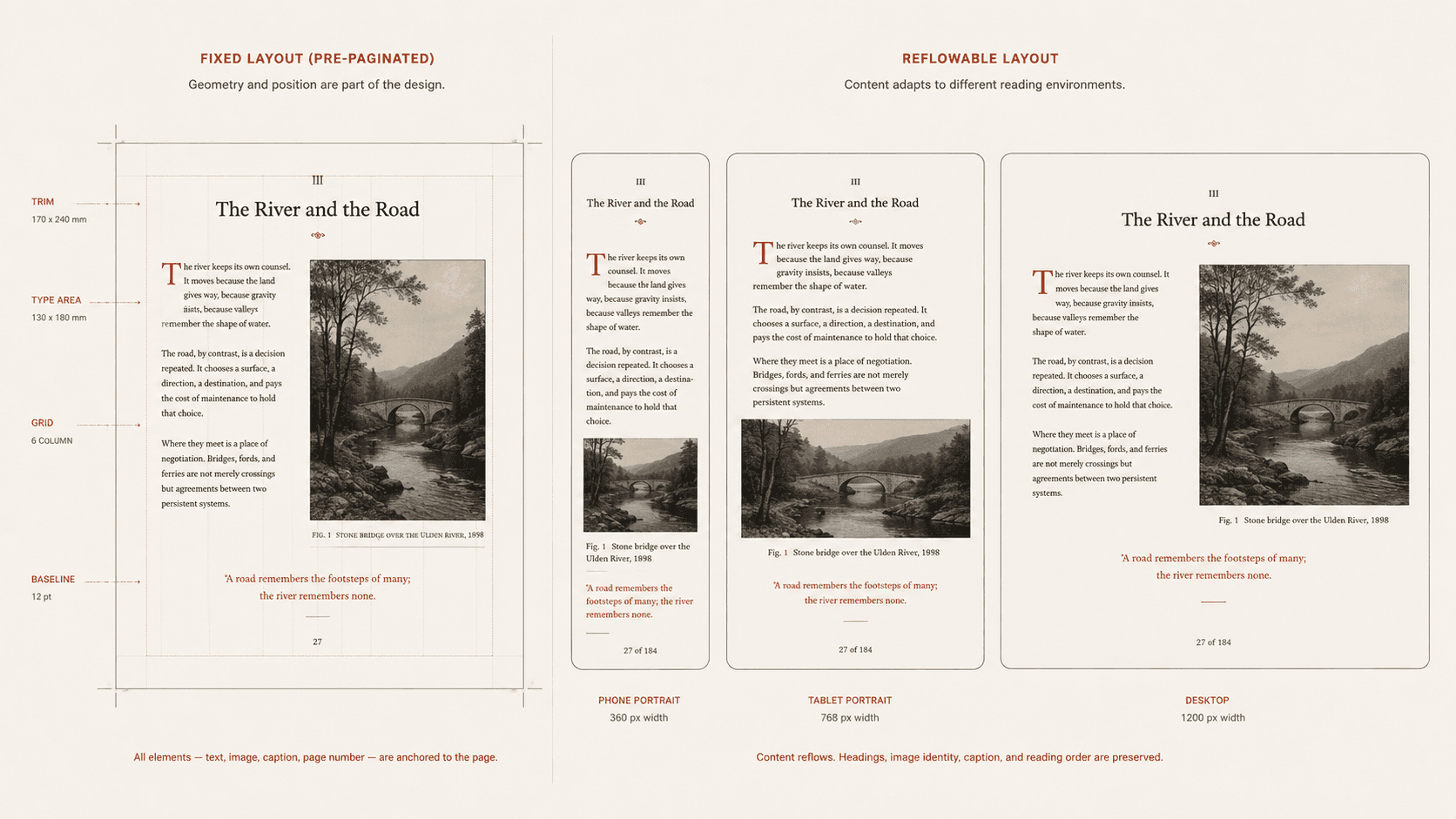
The familiar comparison between PDF and EPUB begins with features: one prints well, one changes type size, one works here, the other is required there. The list becomes stale as software changes, and it obscures the decision that matters. The better question is what the publication cannot afford to change.
PDF and reflowable EPUB make different promises about what should survive a change of computer, screen, or reading condition. PDF gives unusual authority to the composed page. Reflowable EPUB gives authority to structured content while permitting the page to be composed again. Once that distinction is clear, many format decisions stop looking like a contest.
When geometry is the record
A PDF is page oriented. Its imaging model describes marks and objects on a surface so that a page can be reproduced with high fidelity across systems. That makes it well suited to a print-ready interior, a form whose boxes must align, an archival facsimile, a designed report, or any document in which the coordinates themselves carry information.
“Page oriented” does not mean “a photograph.” A PDF can contain searchable text, headings, tags, links, metadata, bookmarks, and a logical reading order. Properly made tagged PDFs can support assistive technology. A scanned image with no text layer and no structure can also be a PDF. The extension tells us the format family, not the quality of this member.
The central advantage remains compositional stability. A caption stays beneath its figure. A line break remains where the designer set it. A reference to page 27 resolves to the same composed surface for every recipient of that edition. When printed on the intended paper size, the output can closely reproduce the production design.
That stability has a cost. Enlarge the text and the page does not simply recompose. It may need to be magnified, which can require horizontal and vertical panning. A phone can display the whole page only by making its contents small. The properties that preserve a press-ready file can obstruct a reader who needs a different type size or measure.
When structure is the record
A reflowable EPUB stores a publication as structured content, resources, metadata, default reading order, and navigation. A reading system composes that material for its current viewport and settings. Lines, screen pages, and sometimes image positions change. Headings, paragraphs, sequence, figure relationships, links, and note roles should remain.
This makes reflowable EPUB appropriate when the words and their structure carry meaning across many reading conditions. Prose fiction is a clear case. Most novels do not become different works when one reader uses a larger serif typeface and another uses a smaller sans serif face. The publisher can set considered defaults while allowing adaptation.
Neither format extension certifies access. Reflow can enlarge beautifully while presenting chapters in the wrong order, unlabeled images, broken note links, decorative headings with no structure, or unusable navigation. A PDF can preserve pages and still omit the tags, order, and descriptions readers need. Authored structure and testing determine whether each format's capabilities are realized.
The invariants test
Before choosing, list the properties the publication cannot lose.
If exact page dimensions, coordinates, line endings, or crop marks must remain, PDF is likely part of the answer. This is usually true for a file headed to a commercial printer. It can also be true for a legal form or a scholarly facsimile in which the relation to an original page is evidence.
If readers need to change type, spacing, color, or viewport while preserving logical sequence, reflowable EPUB is usually the stronger fit. This is usually true for continuous prose and many books with ordinary figures, notes, and tables.
If spatial relations carry meaning, ask whether they can be expressed structurally before fixing them. A diagram may work as a figure with a caption, a long description, and readable labels. A cookbook can often reflow even if its print edition aligns ingredients beside instructions. A children's picture book whose words interact with specific objects across a spread may depend more deeply on coordinates.
If print fidelity and adaptable reading are both important, the defensible choice may be two outputs. They are two publication products preserving different properties from a common edited source, each requiring its own composition and review.
Fixed-layout EPUB is a third answer
EPUB can declare content as pre-paginated, commonly called fixed layout. This preserves designed pages within the EPUB package while retaining EPUB machinery such as metadata, spine order, navigation, content documents, and resources. It is not a PDF placed inside an EPUB wrapper.
Fixed layout can serve comics, facsimiles, and other works whose coordinates carry meaning. It also restricts many reader style changes and can create serious small-screen and accessibility costs. Fixed pages still need logical programmatic order, usable navigation, text alternatives, and magnification. The decision deserves its own analysis rather than being treated as the middle position on a PDF-to-EPUB scale.
Why conversion is often reconstruction
An export from a well-structured source can create both PDF and EPUB efficiently. Converting an already composed PDF into a reflowable EPUB is different. The PDF knows where elements were placed. It may know some logical structure if properly tagged, but coordinates alone do not reveal whether a bold line is a chapter heading, a running head, or a caption.
The conversion process must often reconstruct paragraphs, reading order, notes, headings, image relations, and navigation. Hyphenation inserted for print may need to disappear. Headers and page numbers may need to be excluded from the text stream. Facing-page relationships may need another expression. A result that looks plausible in one preview can contain scrambled semantics.
This is why retaining the source matters. A manuscript or structured production file contains decisions before they are flattened into one page composition. The PDF is an excellent delivery format for that composition and a poor universal source for every future rendition.
Four common decisions
A print interior sent to a printer should normally be a PDF built to the printer's specifications. Its trim, bleeds, fonts, and page geometry are the product being handed off.
A prose ebook should normally be reflowable EPUB. Recreating print pages on a phone protects the least important property while sacrificing reader control.
A diagram-heavy manual may need both. The PDF provides a fixed, printable reference; a carefully redesigned EPUB supplies structured, adaptable reading. Producing both well can require editorial work rather than automatic conversion.
A facsimile or spatial art book may justify PDF, fixed-layout EPUB, or both, accompanied by transcripts, descriptions, or alternate access where the page image alone is insufficient.
Distribution channels add constraints, and those constraints change. Check them at production time rather than promoting them into eternal facts about the formats.
The format decision becomes defensible when the publisher can name which change would damage the book and which change would let a reader use it. PDF protects a composed surface; reflowable EPUB protects structured content through new compositions. Some publications need both promises.
SOURCES
- Library of Congress. “PDF Family, Portable Document Format.” https://www.loc.gov/preservation/digital/formats/fdd/fdd000030 - Library of Congress. “EPUB 3.” https://www.loc.gov/preservation/digital/formats/fdd/fdd000310.shtml - W3C. EPUB 3.3. https://www.w3.org/TR/epub-33/ - W3C. EPUB Accessibility 1.1. https://www.w3.org/TR/epub-a11y-11/ - W3C. EPUB Fixed Layout Accessibility. https://www.w3.org/TR/epub-fxl-a11y/ - W3C. Web Content Accessibility Guidelines 2.2. https://www.w3.org/TR/WCAG22/