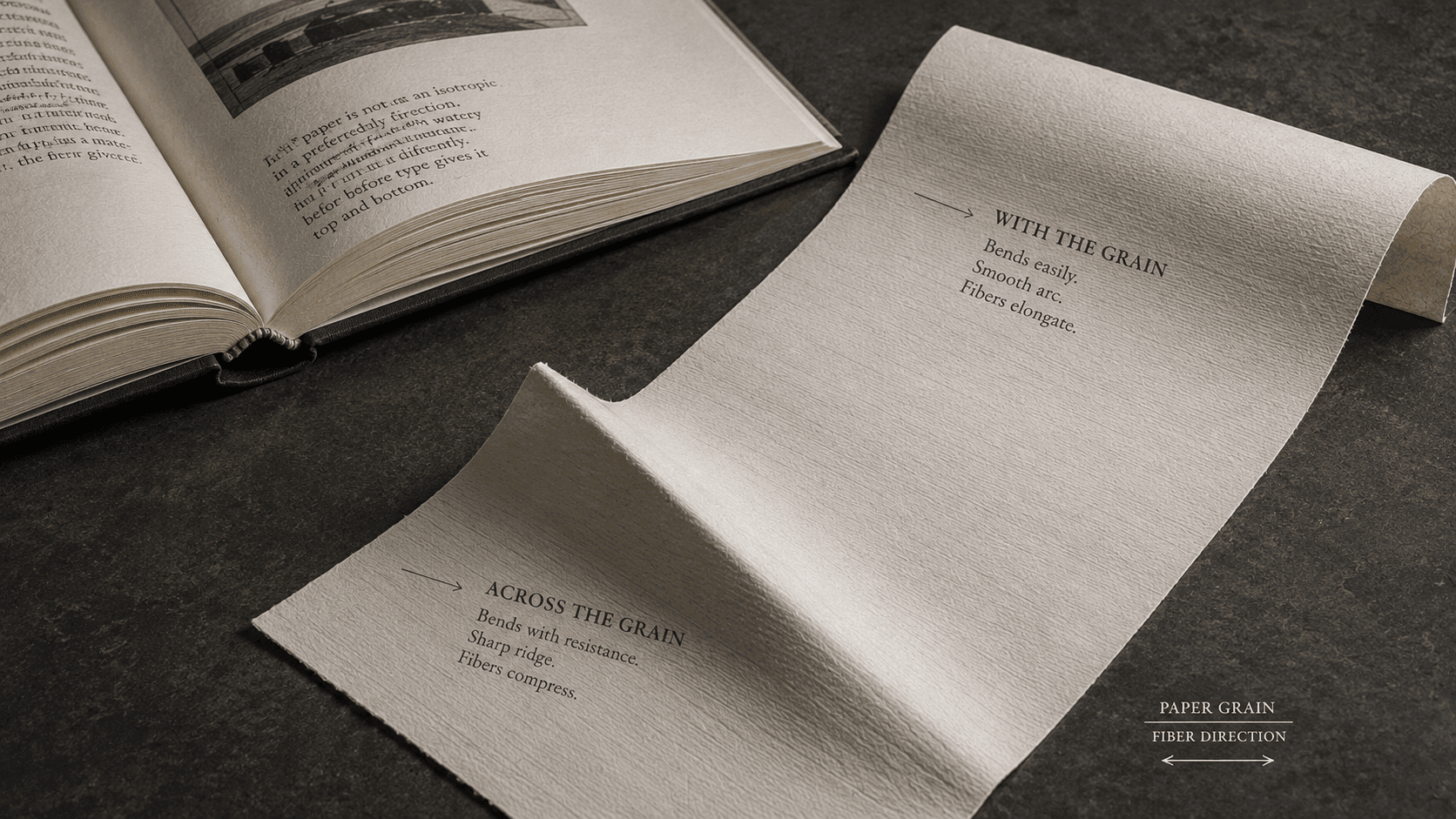
Some new books resist being read. Open one near the middle and the pages rise toward the covers; loosen your hand and the volume closes itself. Binding structure, adhesive, paper bulk, and spine construction can all contribute. One cause is easier to miss because it was present before the pages existed as pages: the paper may be running the wrong way.
In most machine-made stock, fibers become preferentially aligned as watery pulp travels through the machine and the sheet is formed, pressed, and dried. The result is not a field of perfectly parallel fibers. It is directional enough that the sheet bends, folds, expands, and contracts differently along its two axes. A page has a material direction before type gives it a top and bottom.
Finding the hidden axis
Take a loose sheet and make two gentle bends, one parallel to each edge. Do not crease it. The bend offering less resistance generally runs with the grain; bending across the grain feels stiffer. Cornell University Library's preservation tutorial describes this flex test because it is simple and minimally invasive when performed carefully.
Other tests can confirm the result. A narrow dampened strip tends to curl as fibers swell, and a torn edge may behave differently with and across grain. Those methods are destructive and unsuitable for a finished book. Heavy coating, lamination, very thin stock, or a small sample can make any test ambiguous. When the answer matters, the paper supplier or printer should provide the manufacturer's grain designation.
Commercial descriptions commonly use “grain long” and “grain short.” Grain long means the grain runs parallel to the sheet's longer dimension; grain short means it runs parallel to the shorter dimension. Those labels describe the purchased sheet. A 25-by-38-inch grain-long sheet has grain running with its 38-inch side. If it is cut into smaller sheets or pages, production must track where that direction went.
The distinction is easy to lose because a rectangle still looks like the same rectangle after rotation.
The spine is the reference
In a conventional codex, paper grain should generally run parallel to the spine. Folded sections then crease with the grain, and pages turn around an axis they are more willing to follow. Library of Congress preservation specifications call for grain to run parallel to relevant folds. Its preservation glossary connects grain direction with a volume's ability to open.
Turn the relationship ninety degrees and every page must flex across its stiffer axis when the book opens. A fold across grain is more likely to feel bulky or resist a crisp crease. When moisture from adhesive or the environment moves through the sheet, cross-grain expansion can encourage cockling or distortion. A stiff coated stock can make the behavior conspicuous.
The rule extends beyond the text paper. Binder's board has grain too, and case construction generally aligns it head to tail, parallel to the spine. Endpapers, linings, adhesives, cloth, paper, and board respond to moisture and tension as a system. A book can warp when those components pull against one another even if the text pages are correctly oriented.
This is why “lay-flat” is not a single feature. Sewing, spine flexibility, adhesive, page count, gutter, trim, paper, and grain all participate. Correct grain cannot rescue an inflexible binding, while a carefully designed structure can still be undermined by an unwilling sheet.
How imposition can turn the paper
The press sheet is larger than the finished page. Several pages are arranged on it so that printing, folding, cutting, and binding produce the correct sequence. That arrangement is imposition. It must fit the press, use paper economically, and place every page in the required orientation. Grain adds a constraint that a screen preview cannot show.
Imagine a parent sheet whose grain runs along its long edge. One imposition places each future spine parallel to that edge. Fold and trim the sheet, and the finished pages run correctly. Rotate the page forms ninety degrees to fit more pages or use another trim efficiently, and their future spines may now cross the grain. The page numbers and artwork can remain perfectly oriented after digital rotation while the physical fibers are wrong for binding.
A printer can change the parent sheet's grain, choose another sheet size, alter the imposition, modify the trim, or accept the compromise. Each response affects yield, availability, cost, or waste. A request for “grain parallel to spine” therefore belongs early enough to influence those choices.
Short-run digital production can narrow the options. A machine may accept a limited range of sheet sizes supplied with grain in one direction. Print-on-demand interfaces often expose trim, paper color, and finish while keeping imposition and grain outside the customer's choices. That omission does not prove the book will be cross-grain. It means paper weight and binding label cannot answer the question.
Handmade paper complicates the vocabulary. Its fibers are often less strongly oriented than those in paper formed continuously by machine, but “handmade paper has no grain” is unsafe. Vat movement, couching, pressing, and drying can create directional behavior. The sheet should be assessed rather than granted an exception on the strength of its method.
Diagnosing a book that fights back
A book that snaps shut may be cross-grain. It may also have a rigid adhesive spine, heavy coating, tight case, insufficient hinge, or too little gutter. Diagnosis is strongest when several signs agree.
If the object can be handled safely, compare the flex of a page in both directions without creasing it. Observe whether folds look strained and whether the sheet is more willing to bend from head to tail than from spine to fore edge. Check the binding: a perfect-bound book with a heavy glue film can resist opening even with correct grain. Look for rippling near adhesive, distorted boards, or endpapers pulling against the case.
Board warp suggests another part of the system. A board whose grain runs across the spine, or materials with mismatched moisture response, can curve even while the text block behaves acceptably. No single symptom proves the production history, but grain gives the inspection a physical hypothesis.
What to specify and what a proof can show
For a conventional bound book, ask whether the text stock's grain will run parallel to the spine at finished trim. If the printer cannot guarantee it, ask what constrains the choice and whether another stock, parent sheet, trim, or imposition would change the answer. For a case binding, ask about board and endpaper direction too.
Then describe the use. A thick art book on coated paper places different demands on its binding from a short uncoated paperback. A manual meant to remain open on a workbench and a novel held in one hand need different opening behavior. The default grain rule remains relevant, but it belongs inside a functional specification.
A physical proof can answer questions a screen cannot. Let the sample acclimate, then open it in several places without forcing the spine. Look for pages pulling upward, folds under strain, rippling, and board warp. Identify how the sample was made. A digitally printed bound proof may test trim, bulk, and opening while failing to predict the exact paper or binding behavior of an offset production run.
Grain is easy to omit because authoring software has no need to model fibers. The omission becomes consequential when a purchasing form pretends that weight, color, and finish fully specify a sheet. The final page will bend at the spine thousands of times. Its hidden direction is part of the reading interface.
SOURCES
- Cornell University Library. “Paper.” Library Preservation and Conservation Tutorial. https://chinapreservationtutorial.library.cornell.edu/content/paper/ - Library of Congress FEDLINK. Preservation Services Sourcebook. https://www.loc.gov/flicc/rfp/preservation.pdf - Library of Congress. Preservation Specification 100-112. https://www.loc.gov/preservation/resources/specifications/specs/100-112_16.pdf - Dartmouth Library. Dartmouth Book Repair Manual. https://www.dartmouth.edu/library/preservation/repair/dartmouth-book-repair_manual.pdf - Library of Congress. “Preservation Specifications.” https://www.loc.gov/preservation/resources/specifications/index.html