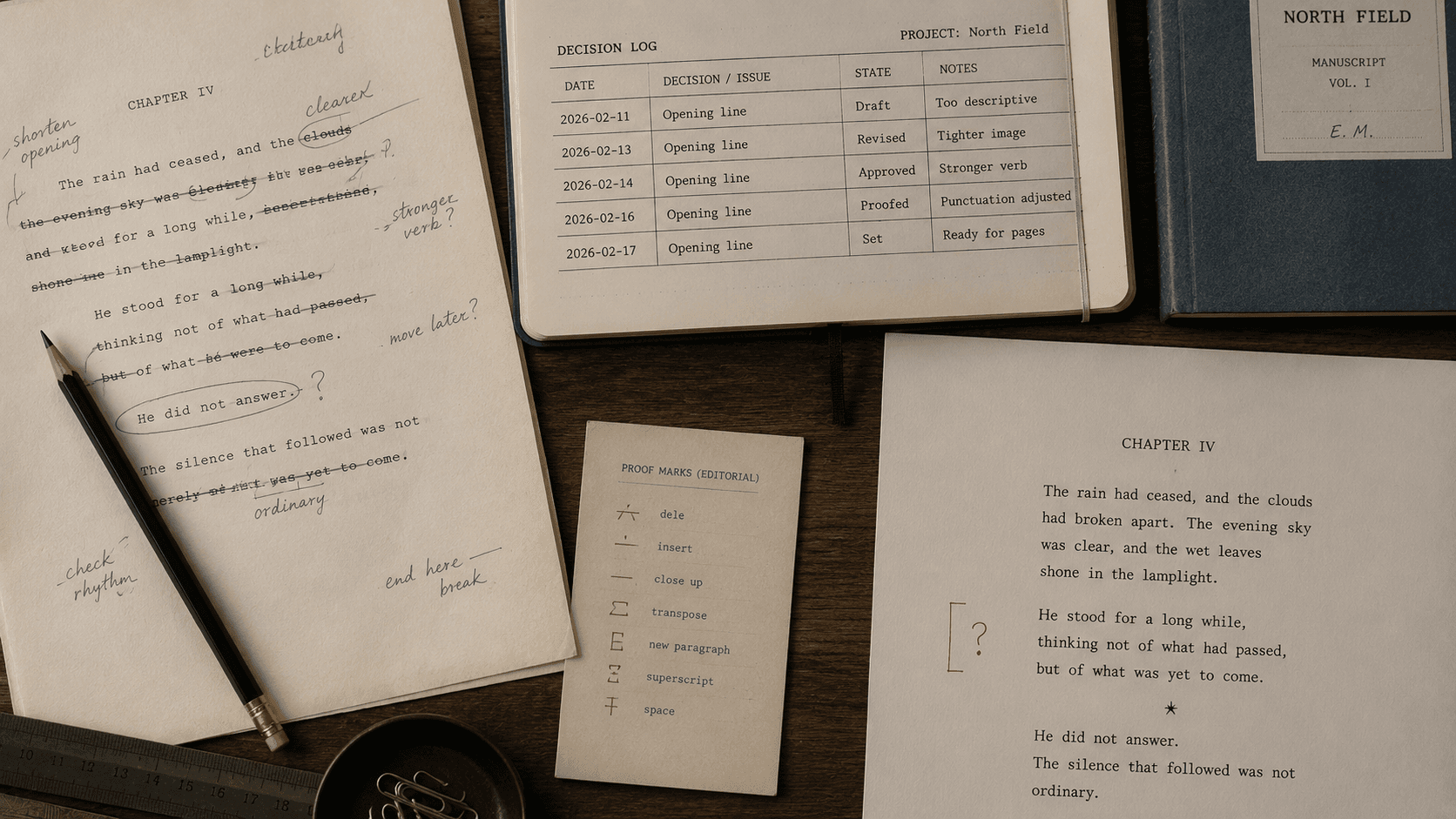
A proofreader encounters “email” in chapter two and “e-mail” inside chapter nine. One is in the narrator's voice; the other appears in a quotation from 1997. If the copyeditor's style sheet records only `email (not e-mail)`, the proofreader may correct the quotation and make the book less accurate.
The missing information is the scope and reason for the decision. An editorial style sheet is a record of choices made for one project: spellings, names, chronology, citation treatment, special terms, deliberate exceptions, and questions still awaiting an answer. It differs from a house guide, which supplies defaults across publications, and from the typographic style sheet that controls visual presentation in CSS or layout software.
Its real test comes at handoff. Can a person who was absent when the choice was made understand what to do, where to do it, and whether the choice is still current?
A rule acquires a history
Suppose a copyeditor finds both forms in a nonfiction manuscript. The current house dictionary prefers “email,” so the editor changes the author's prose and enters a provisional decision: use “email” in narration. Chapter nine, however, quotes a 1997 letter printed in an archive as “e-mail.” The editor checks the source and asks the author whether quotations should retain original spelling.
At this stage the entry is not simply `email`. A compact record might read:
`EMAIL — narration: email; direct quotations: retain checked source form. Evidence: house dictionary; 1997 letter verified against scan. Status: author confirmed 14 May. Owner: production editor. Supersedes: provisional entry of 9 May.`
Those details do different work. The decision states the treatment. Scope prevents a local choice from becoming a global replacement. Evidence lets the next editor understand why the exception exists. Status distinguishes an answer from a proposal. Ownership identifies who can resolve a later conflict, and supersession keeps an old attachment from reviving the earlier instruction.
At copyedit, the quotation remains “e-mail.” At handoff, the production editor incorporates the author's response into the dated master sheet and archives the superseded version as read-only. At proof, the proofreader sees that composition has changed the quotation to “email,” consults the record, and marks the proof to restore the source form. One editorial decision has moved through question, evidence, confirmation, transmission, error, and repair.
Without the record, “consistency” would have produced the wrong word.
House rule, project evidence
A house guide prevents every book from reopening routine matters such as dictionary, punctuation system, and basic citation style. A manuscript supplies the cases that defaults cannot predict: a person's name with a diacritic missing from older sources, fictional geography that shifts between chapters, or a technical term capitalized differently by two standards bodies.
The project sheet records the treatment chosen for those cases. Most entries can be short. The fuller decision–evidence–scope–status model is most useful when a choice is surprising, contested, likely to recur, or expensive to research again. It is a practical model, not a universal industry form.
Evidence may be a link to an organization's official name, a page in a reference work, an author's instruction, or a note that two credible sources disagree. The sheet need not litigate every comma. It should preserve enough context for another worker to apply or challenge a consequential choice intelligently.
The manuscript determines what deserves recording. Fiction may require names, relationships, invented vocabulary, timeline, and point of view. A scholarly book may require transliteration, historical titles, abbreviations, note form, and unusual source types. A cookbook may turn on ingredient names, units, temperatures, and distinctions between prepared and unprepared states. A common word that follows the chosen dictionary and appears once does not need an entry. A proper name appearing in five forms does.
Negative instructions are often as valuable as preferences: retain dialect in dialogue; preserve capitalization in archival quotations; do not expand an abbreviation inside tables. Such entries protect meaningful variation from a later search-and-replace pass.
A query is not yet a rule
An editor eventually reaches questions that evidence alone cannot settle. The author may need to choose between two defensible forms, confirm a fictional fact, or decide whether an inconsistency is deliberate. Until answered, the item belongs among open queries. Quietly entering one option as settled lets uncertainty masquerade as policy.
A small status vocabulary is enough: proposed, queried, author confirmed, superseded. The exact labels matter less than their consistent use. If a decision changes, the active sheet should identify the new instruction and the record it replaces. Older sheets can remain in the project archive, but their filenames and permissions should make their status unmistakable.
Version ownership is a production decision. One named role should maintain the authoritative sheet, fold in approved responses, issue dated versions, and resolve conflicts between annotations. Copyeditors, authors, proofreaders, designers, and indexers may contribute, but several editable “final” sheets produce a memory with no present tense. A simple filename such as `project-style-2026-05-14-approved` is more useful than `style-sheet-final-NEW2`.
The record must also state the limits of the work. Copyediting, fact-checking, permissions review, legal review, and citation audit may overlap, but they are not interchangeable. A name on a sheet might mean “form used consistently,” “checked against the author's source,” or “independently verified.” Conflating those states gives later workers confidence the project did not earn.
From copyedit to composed pages
Build the sheet while resolving the manuscript. Reconstructing it at the end loses the questions, reversals, and evidence that make it useful. When a decision changes, search earlier chapters and update the active record in the same session. Before handoff, remove private shorthand, close or label open queries, and add an example where the instruction would otherwise be hard to recognize.
Some entries matter beyond wording. Flag special characters, nonbreaking relationships, lines that must retain their breaks, unusual headings, recurring display elements, and names that affect an index. A production editor may learn that a chosen character is absent from the licensed font. The sheet can record the approved solution without pretending that the typographic problem was an editorial preference.
At proof, the sheet becomes a guide and a diagnostic instrument. The proofreader tests the composed pages against the decisions but can still raise an error created by the decision itself. Corrections should return to the authoritative record if the book will have another format, printing, or edition. Otherwise the print proof may be repaired while the EPUB inherits the old instruction.
The completed record can support indexing, audiobook pronunciation, translation, later corrections, and reprints. Circulation should still be limited appropriately. Sensitive biographical information, legal concerns, and confidential author notes do not belong in every production package merely because they once informed an edit.
Two systems called style
The shared name is revealing. A typographic style sheet says how a paragraph or heading should appear in a particular presentation. An editorial style sheet records how textual decisions should be applied across the work. Both move choices out of individual memory and make controlled change possible.
Their consequences differ. Alter a typographic class and every heading may acquire a new size. Alter an editorial instruction and every occurrence may acquire a different meaning or factual claim. The first can often be regenerated from sound structure; the second needs an account of authority, evidence, and scope.
On the final proof, the chapter-nine quotation still contains the older spelling. The proofreader leaves it there because the active sheet identifies the exact source and confirmed exception. What looks inconsistent on the page is accurate in the book. The record has done its work by preventing a remembered preference from overruling documented evidence.
SOURCES
- Chartered Institute of Editing and Proofreading. “Glossary of Editorial and Publishing Terms.” https://www.ciep.uk/resource/editorial-glossary.html - Chartered Institute of Editing and Proofreading. “What Is Copyediting?” https://www.ciep.uk/resource/what-is-copyediting.html - Einsohn, Amy, and Marilyn Schwartz. The Copyeditor's Handbook. University of California Press. https://www.ucpress.edu/books/the-copyeditors-handbook-2/paper - Indiana University Press. “Manuscript Preparation Guidelines.” https://iupress.org/manuscript-preparation-guidelines/ - University of Chicago Press. “Manuscript Preparation Guidelines.” https://press.uchicago.edu/resource/emsguide.html