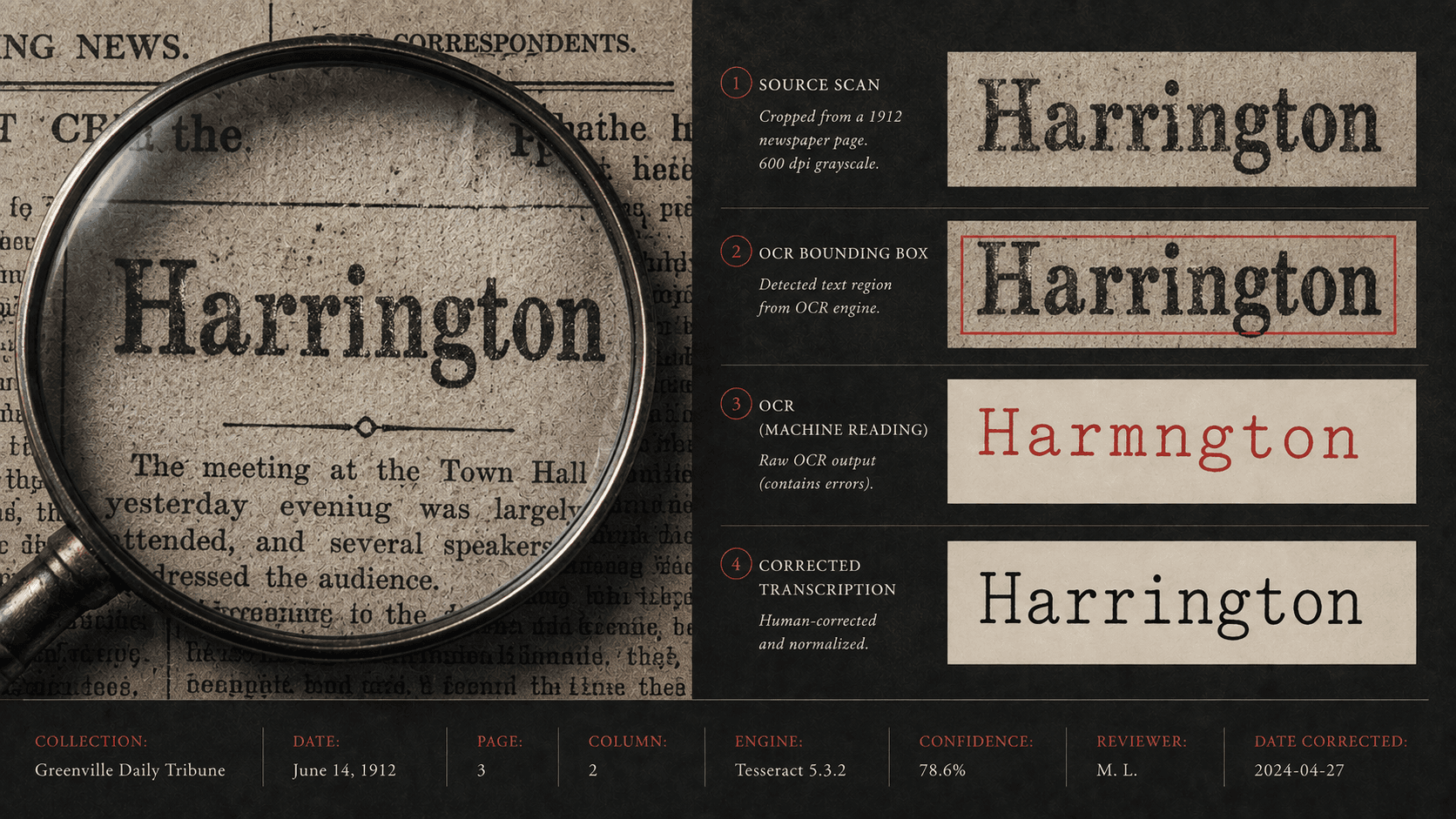
A scanned newspaper can show a surname clearly enough for a person to recognize it while the search box insists the name is absent. Open the hidden text and the reason appears: software read an *rn* as an *m*, joined two columns, or treated a stain as punctuation. The page is present. One machine reading of it is present too. They are different artifacts.
Optical character recognition is often described as extracting text from an image. The phrase suggests that letters sit inside pixels like objects in a drawer. OCR does something more consequential. It infers characters, words, lines, and sometimes document structure from visual evidence. Its output is a transcription made by a system under particular assumptions.
That transcription can be enormously useful without becoming the source.
Capture and recognition answer different questions
Professional digitization treats image capture as its own act. The Federal Agencies Digital Guidelines Initiative asks cultural-heritage programs to create and assess reasonable reproductions of original materials, document processing, manage masters and derivatives, and retain technical and structural metadata. OCR appears later in that workflow. It does not replace the requirements placed on the image.
The distinction is epistemic as well as technical. A preservation image supports inspection of type, spacing, damage, handwriting, page order, marginal marks, and features a recognition model may not know how to name. OCR supplies machine-actionable strings for search, selection, linguistic analysis, and access. If recognized text says “modern” while the image shows “modem,” a user needs to know whether the difference came from printer, scanner, model, or corrector.
An image is not neutral evidence. Capture can crop edges, introduce skew, lose faint ink, exaggerate contrast, or misrepresent color. FADGI therefore defines quality management around imaging. The lesson is not that one layer is true and another false. Each transformation has claims, limits, and provenance.
The error has a shape
Aggregate accuracy can conceal mistakes most damaging to research. A system might recognize common prose extremely well while failing on proper names, dates, prices, mathematical expressions, or non-dominant languages. If one error in a thousand falls inside the only surname a historian searches, the corpus is functionally incomplete for that query.
Errors are patterned. Broken or touching type changes letter boundaries. Fraktur and other historical typefaces differ from modern training data. Newspaper columns challenge layout segmentation. Tables require row and column relationships that a plain stream cannot express. Hyphenated line endings can be preserved, removed, or mistaken for punctuation. Marginal notes may enter the main reading order. A running header repeated across hundreds of scans can become false body text hundreds of times.
Confidence scores do not settle this. They are outputs of a model and may be calibrated differently across software and content. High confidence can accompany a plausible error; low confidence can accompany an unusual but correct name. A score can guide review, but it is not editorial authority.
Quality depends on use. Imperfect OCR can make a collection discoverable: a result leads the reader to a scan that remains the evidence. An accessible reading edition needs coherent order, headings, language, and far fewer disruptive errors. A scholarly text may require explicit treatment of spelling, abbreviations, lineation, revisions, and uncertainty. One output should not inherit authority merely because it serves all three interfaces.
Layout is part of recognition
Documents are spatial arguments. A two-column page must be segmented before lines can be ordered. A caption should remain related to its image without entering body text arbitrarily. A footnote reference belongs with a note. A table cannot be recovered by listing cells in the order an engine encountered them.
Structured formats such as ALTO XML can record recognized strings with coordinates and layout regions. A viewer can highlight a matching word on the source page. Reviewers can compare machine text with visual evidence. Other formats can preserve reading order, pages, headings, and processing information. The particular choice depends on the repository, but plain text alone discards many relationships.
The Library of Congress's textMD standard makes production history explicit. It can record character and encoding information, the application or agent that created a text object, and OCR-related quality measures. Software, version, settings, and workflow produced the recognized text. Calling that operational authorship identifies responsibility without pretending that a model wrote the source document.
Correction creates another editorial layer
Manual correction is often called cleaning OCR, as if the process removed dirt to reveal what was already there. Correctors make decisions. They choose whether to preserve line breaks and original spelling in a diplomatic transcription, regularize selected features in a normalized reading text, or join words and remove running matter for a search index. These outputs can all be responsible and still disagree.
A carefully reviewed text improves discovery and reading. The danger lies in erasing its editorial status. If corrected OCR overwrites raw output and becomes detached from the scan, later users cannot tell which readings came from the model, which from a person, and which policy governed intervention.
A layered repository can retain the preservation image, original OCR, corrected text, layout structure, and revision history. It can label an uncorrected search index. It can link words or regions back to coordinates. It can preserve uncertainty rather than forcing an illegible mark into a confident letter. Not every project can afford every layer; the distinctions guide proportionate risk.
For a newspaper corpus, the economical choice may be image masters plus uncorrected OCR for search, with targeted correction around exhibitions or high-value names. For a legal record, critical edition, or accessible textbook, acceptable risk differs. The useful question is not “What OCR accuracy do we have?” It is “Which errors would defeat this use, and where can a reader inspect the evidence?”
Search changes what survives intellectually
OCR affects historical memory even when every scan is retained. Researchers search the recognized layer. Pages whose language is recognized well appear in results; pages set in damaged type, unusual scripts, or complex layouts become quieter. A false negative can make an item practically absent. Repeated false positives can distort frequency analysis.
This is no reason to distrust digital collections wholesale. It is a reason to treat search as an instrument with historical and technical bias. Repositories can publish engines, languages, evaluation samples, and known failure modes. Researchers can inspect page images, sample misses as well as hits, and avoid treating corpus counts as transparent measurement.
The same principle applies when OCR revives an out-of-print book. If recognized text becomes an ebook, production should compare it with the source, restore structure, distinguish printing errors from recognition errors, and record the edition used. Otherwise the workflow can manufacture a clean-looking text whose mistakes have no place in the work's publication history.
Keep the disagreement
A useful digital page can hold several accounts of itself. The image records what capture preserved of appearance. OCR records what a system inferred. Layout markup records how regions relate. Correction records what an editor judged. Metadata records how those accounts were produced.
They will sometimes disagree. Preserving disagreement is a more accurate record of transformation. Future software may recognize the page better. A scholar may prefer diplomatic transcription to normalized prose. An accessibility team may add structure the first project could not afford. Those possibilities remain open when source and provenance survive.
OCR does not recover a text because no unambiguous character sequence was waiting inside the bitmap. It performs a reading. Responsible publishing makes that reading useful without asking it to impersonate the page.
SOURCES
- Federal Agencies Digital Guidelines Initiative. Technical Guidelines for Digitizing Cultural Heritage Materials, Third Edition, 2023. https://www.digitizationguidelines.gov/guidelines/FADGITechnicalGuidelinesforDigitizingCulturalHeritageMaterials_ThirdEdition_05092023.pdf - UK National Archives. “Digitisation.” https://www.nationalarchives.gov.uk/information-management/manage-information/preserving-digital-records/digitisation/ - Library of Congress. “Technical Metadata for Text (textMD).” https://loc.gov/standards/textMD/elementSet/index.html - Library of Congress. “ALTO: Analyzed Layout and Text Object.” https://www.loc.gov/standards/alto/