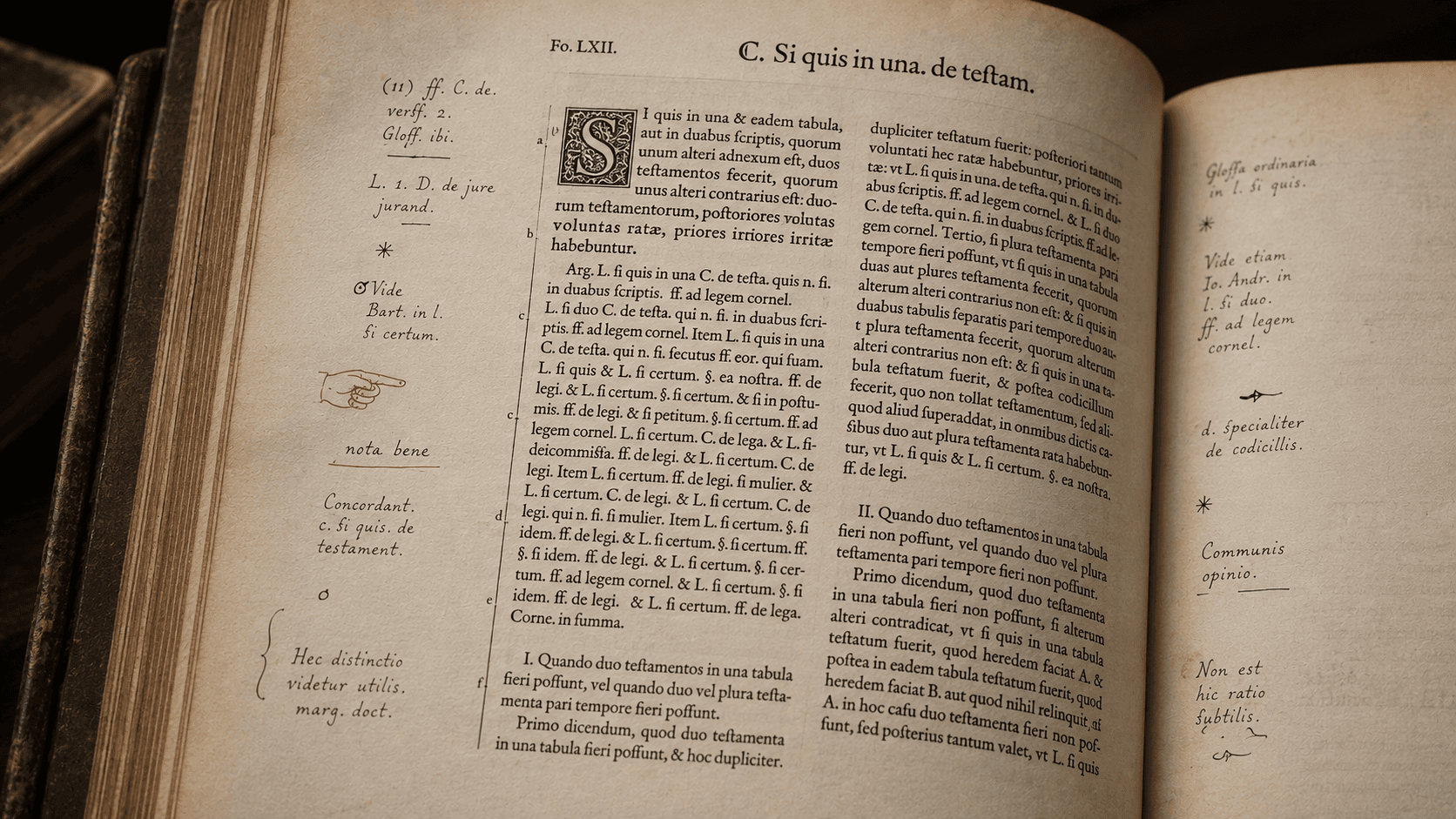
A large margin in a book can look expensive because it contains less printed matter per sheet. In surviving copies of Littleton's Tenures examined by the Folger Shakespeare Library, the expense also bought working capacity. Readers filled the unusually generous margins of these legal books with notes, making the empty edge part of the instrument.
Modern typography often describes margins as whitespace: a compositional interval that frames the text block, manages density, and gives a page rhythm. Those are real functions. The language of emptiness leaves out the other people who have worked at the edge: scribe, rubricator, corrector, compositor, binder, scholar, student, owner, censor, and ordinary reader.
The margin has never had one origin or one use. It is better understood as capacity held open around a text.
The planned edge
Late-medieval manuscript pages could be designed for several textual channels. Main text occupied one region; planned glosses, corrections, headings, reference signs, and running matter occupied others. Enlarged initials and paraphs announced divisions. Symbols joined a passage to commentary in a margin.
This organization complicates the image of a pristine book later invaded by handwriting. Some marginal systems were built into the page before a later reader arrived. Research on notes before print traces signs connecting main text and marginal commentary from at least the eleventh century, with increasingly elaborate systems in the thirteenth. The modern footnote did not exist in finished form, but the interface problem was recognizable: a page had to host a statement and a parallel qualification without merging their voices.
Margins made the relationship spatial. Commentary beside a passage could be consulted with a short movement of the eye. The cost was competition for surface. Dense gloss could surround a small island of primary text until the supposedly subordinate channel occupied most of the page.
The edge also carried making. Ruling defined writing areas in manuscript production. Correctors added signs and instructions. Printers and binders used space and marks related to assembly and trimming. The page's geometry negotiated among text, production, protection, and anticipated use, though the balance varied among particular books and practices.
Print did not close the page
Early printed books were often completed by hand. Initials could be supplied, pages numbered, errors corrected, and navigation added after sheets came from the press. Manuscript and print practices overlapped because mechanical reproduction did not remove the need for local work.
Printers could also anticipate annotation. Textbooks and legal books left interlinear or marginal space for use. The large-paper copies of Littleton's Tenures are powerful evidence because the use survives: notes accumulate where the format gave them room.
An annotated 1482 edition of Euclid in the Folger collection presents a related case. Printed diagrams share the volume with calculations, proofs, and comments by several hands. The book became a workplace across time. Its margins preserve encounters among a printed authority and successive readers who tested or extended it.
The evidence requires restraint. A mark may be difficult to date. Ownership of a volume does not prove that an owner wrote every note. A pointing hand can signal importance, amusement, disagreement, or material useful for another purpose. Ink records an action more securely than a state of mind.
Paper cost, format, status, genre, binding, and intended use influenced margins without producing one universal rule. Large margins could invite annotation, signal luxury, protect a text block, support a composition, or do several things at once. Small margins conserved material and created a different visual density. The surviving legal and mathematical books show specific working uses; they do not supply an origin story for every blank edge.
Whitespace does work too
Unprinted space affects perception. It separates levels, allows the eye to group related matter, controls emphasis, and keeps a text block from colliding with the edge. These visual functions share the same capacity used by note, hand, binding, and production.
A contemporary designer can therefore ask more than whether the page feels balanced. Will binding consume the inner space? Do running heads, notes, or folios need a stable zone? Is the publication expected to be annotated? Does the margin communicate openness appropriate to the work, or merely imitate prestige?
The answers differ between a pocket novel, study Bible, workbook, scholarly edition, and museum catalog. Generosity becomes meaningful only after the recipient and use are known.
When the note leaves the edge
Reflowable ebooks have no stable outer margin. A reader can enlarge the type, rotate the device, change measure, or choose a theme. The physical relation between a phrase and a blank beside it cannot be guaranteed.
Digital annotation replaces adjacency with an address. A note is attached logically to a target: a passage, image, location, or resource. The W3C Web Annotation model describes bodies, targets, selectors, creators, and motivations so annotations can in principle be shared, reused, and migrated. The note can travel without occupying the page and can be hidden without erasure.
That separation creates powers a paper margin does not have. Notes can be searched, filtered, shared with a group, layered by reader, linked to other resources, or kept private. Several people can annotate the same passage without competing for surface. The underlying text can reflow while the logical target remains.
It also creates dependencies. The publication may live in one file, the annotation in a platform account, and the address in a proprietary locator. If an edition changes, the selected text may no longer match. If export is unavailable, “my notes” can mean notes a service permits the reader to access. A public interoperability standard does not guarantee that any particular application implements it.
Paper binds the note to one physical copy. That limits reach and gives the note a visible material custody. Digital systems can detach custody from both book and reader while allowing search, sharing, and multiple layers. The working space has moved from a reserved edge to a relationship among text, address, account, and interface.
SOURCES
- Wakelin, Daniel. “Designing the Page.” Cambridge University Press. https://www.cambridge.org/core/services/aop-cambridge-core/content/view/DFAC91EC629BB141D17859CA7EEA70B0/9780511976193c4_p79-103_CBO.pdf/designing_the_page.pdf - Folger Shakespeare Library. “Technologies of Writing in the Age of Print.” https://folgerpedia.folger.edu/Technologies_of_Writing_in_the_Age_of_Print - Folger Shakespeare Library. “Extravagantly Large Paper.” https://www.folger.edu/blogs/collation/extravagantly-large-paper/ - Houston, G. W. “Footnotes Before Print.” Cambridge University Press. https://www.cambridge.org/core/books/abs/books-before-print/footnotes-before-print/8D2B4F6B2D81545F9207547A53BA8DC7 - Folger Shakespeare Library. “Mathematical Diagrams from 1482.” https://www.folger.edu/explore/collection-highlights/mathematical-diagrams-from-1482/ - W3C. Web Annotation Data Model. https://www.w3.org/TR/annotation-model/