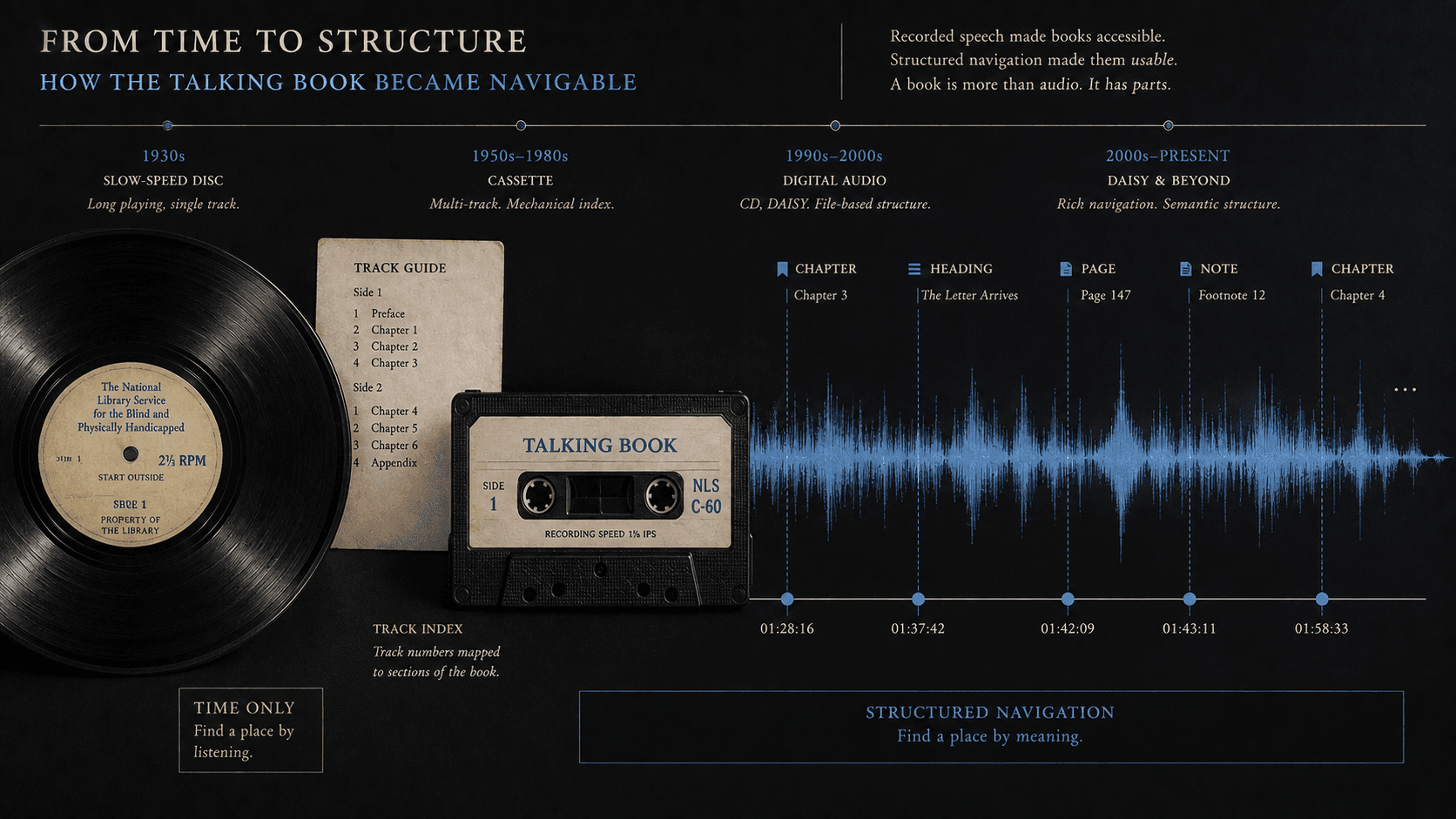
There is a large difference between knowing that a passage occurs near the middle of a twelve-hour recording and being able to return to page 147. The first is memory expressed as duration. The second is an address shared with another edition.
Recorded books solved access to the voice before they solved access inside the book. A disc could be replayed, a cassette rewound, and a track selected, but the structure available to the listener was constrained by the medium. Chapters helped. They did not make a reference work, textbook, collection of notes, or cookbook as navigable as its print counterpart.
The digital talking book became more book-like when elapsed time acquired editorial structure.
The machine belonged to the book
The history of talking books in the United States begins as an institutional system, not a file format. The Pratt-Smoot Act established a national library service for blind adults in 1931. The National Library Service records two important developments in 1933: a uniform English braille system and development of the talking book within the program.
Those early recordings used slow-speed discs designed to hold much more speech than ordinary records. They required appropriate playback machines. Media, player, cataloging, regional libraries, postal circulation, maintenance, and public funding all participated in access. In 1935, a Works Progress Administration project built 5,000 machines for library loan. Later generations of discs and cassettes reduced weight, extended duration, changed handling, and required another succession of compatible players.
The object called a talking book therefore included an environment. A preserved slow-speed disc without a suitable machine retains sound and loses practical readership. A machine without the library network reaches few people. This format history is also a history of distributing and repairing the interface.
Physical media had navigation. A listener could change a disc, select a side, move among cassette tracks, listen for announcements, or use mechanical features designed to locate beginnings. NLS machines added controls suited to their readers, including variable speed and track handling. Analog listening was never one undifferentiated stream.
Its addresses were nevertheless coarse and costly. Rewinding to a remembered phrase consumes time and attention. A print reader can move among contents, heading, page, note, and index at several scales. Accessible audio needed equivalent choices without requiring the listener to traverse every intervening second.
Structure enters the timeline
Work on what became DAISY began at the Swedish Library of Talking Books and Braille in 1988. The international DAISY Consortium formed in 1996, bringing accessible-reading organizations together around digital talking-book standards.
Replacing analog recording with digital audio was insufficient. An MP3 can remain almost as structurally opaque as a tape. The DAISY model related audio to marked-up document structure and a navigation system. Headings could have levels. Pages could become targets. Notes, sidebars, captions, producer-supplied explanations, and other components could be identified rather than fused into one timeline.
Consider a history chapter with three sections. Inside the second section, print page 147 begins, a footnote interrupts the argument, and a boxed chronology follows. A structured talking book can let a reader jump directly to the chapter, move to its second heading, target page 147 for a class reference, skip the footnote during a first reading, then enter the chronology deliberately. A flat audio file can contain every same spoken word while withholding those choices.
Hierarchy matters because the stops are not uniformly important. Moving to the next section is different from moving to the next chapter; passing a paragraph is different from declining an endnote. Structured markup lets the player offer several scales of movement.
The page after the visible page
Page navigation in a talking book can sound like print nostalgia. Audio has no rectangle and no necessary page turn. Why preserve a boundary the new medium does not need for composition?
Because composition was only one job of the page. Page 147 can coordinate a student with a teacher, a reader with a citation, or a braille edition with a print source. The audio reader may need to locate an assignment announced in print terms. A digital target can retain that address without pretending that a duration of speech is a visual page.
The National Library Service's current instructions for contracted productions specify navigation markers for pages, hierarchy, notes, sidebars, and other features. These rules document one production regime rather than a universal audiobook standard. They demonstrate that marker placement is editorial work. Preliminary numbering, unnumbered pages, repeated schemes, and ambiguous source hierarchy must be interpreted.
Born-digital or born-audio works may have no meaningful print pagination. They should not invent page numbers for tradition's sake. Headings, named locations, bookmarks, search, elapsed time, and stable textual fragments can supply other addresses. The aim is coordination, not preservation of a surface the publication never had.
Skipping as a form of access
Accessible publishing is sometimes described only as making all content available. A usable book also lets readers decline, defer, and choose. A sighted reader can pass over a running head, glance past a note, or inspect a sidebar later. If audio forces every page announcement, image description, note, and ancillary element into the main narration without distinction, availability becomes compulsion.
Structured audio can make secondary material skippable while retaining it. That designation does not declare the material unimportant. It gives the listener editorial control already exercised by other readers. A scholar can enter every note; a reader following the main argument can move on; either can return.
The distinction needs care. A safety warning, essential table, or sentence carrying the argument cannot be labeled optional because it interrupts smooth narration. Producers' notes should explain visual or structural information where necessary without becoming commentary on the author's work. Navigation exposes organization; it does not authorize a producer to demote difficult content.
Several products called audiobooks
Commercial audiobook platforms commonly offer chapter menus, bookmarks, playback speed, position syncing, and search in some contexts. These are valuable. A narrative novel may need little more than accurate chapters. A dictionary, study Bible, legal work, cookbook, textbook, or anthology can require much finer navigation.
Calling both products “audiobooks” hides differences in purpose and infrastructure. NLS talking books operate within an eligible-reader library service and particular production specifications. DAISY names a family of accessible standards and practices. An EPUB may combine text with media overlays or support text-to-speech. A retail audiobook may be a performed adaptation with its own chapter structure. These categories overlap without being interchangeable.
The production question is functional: what will a reader need to locate, compare, skip, repeat, cite, or share? The answer should determine hierarchy and targets, followed by testing with the people expected to use them.
What accessible audio made visible
Digital audio navigation is often presented as a special layer added to a normal book. It did something more general. It separated navigation from sight and from the printed surface, revealing that headings, pages, notes, and landmarks are conceptual structures before they are visual arrangements.
That insight returns to every format. An ebook with styled but unmarked headings is harder for assistive technology and less robust for navigation. A long web document that offers only a scroll bar gives sighted readers visual feedback but still withholds useful addresses. A podcast archive with inconsistent segment metadata creates a similar problem at another scale.
Digital sound can jump instantly; that ability alone supplies no destination. Publishers and standards makers had to identify where a reader might reasonably want to go. Random access became meaningful through editorial structure.
SOURCES
- Library of Congress, National Library Service. “History.” https://www.loc.gov/nls/who-we-are/history/ - Library of Congress, National Library Service. “Instructions for Applying Navigation Markers.” https://www.loc.gov/nls/who-we-are/guidelines-and-specifications/contract-specifications/instructions-for-applying-navigation-markers/ - DAISY Consortium. “History.” https://daisy.org/about-us/history/ - DAISY Consortium. “Structure Guidelines: Introduction to Structured Markup.” https://daisy.org/guidance/info-help/guidance-training/standards/daisy-structure-guidelines-introduction-to-structured-markup/ - ANSI/NISO. Z39.86-2005, Specifications for the Digital Talking Book. https://www.daisy.org/z3986/2005/Z39-86-2005.pdf