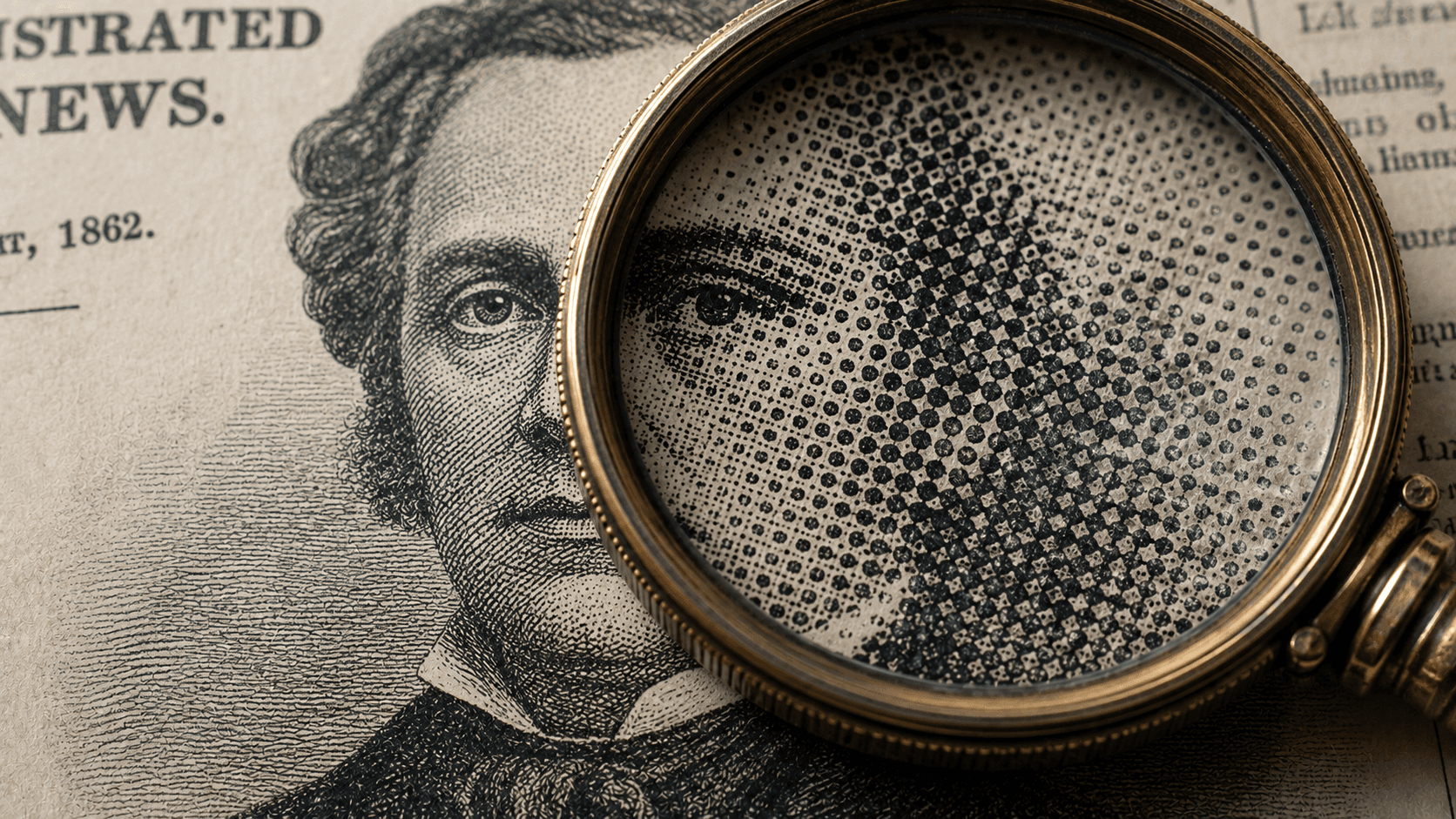
Look at a printed face through a loupe and the skin dissolves. A shadow becomes a crowded field of inked dots. A highlight becomes a sparse one. At ordinary distance the face returns, carrying tones the press never printed as continuous tones.
This is the productive deception of the halftone. A photograph offers gradual changes from light to dark. A conventional relief press is better at a simpler decision: a raised area receives ink and transfers it, while a recessed area does not. Halftoning translates one system into marks the other can reproduce.
The press deposits one ink film. The apparent grays emerge from how much paper the dots leave exposed.
The incompatible originals
A continuous-tone photographic print varies density across a smooth-looking range. Under magnification its image-forming material has structure, but it is not organized into the regular printable cells familiar from newspapers. Reproducing that range directly on the same relief press as movable type posed a physical problem.
Wood engravings and other hand-made interpretations could carry photographs into print by translating tone into lines and marks. Photogravure, collotype, and related photomechanical processes found other solutions, some capable of exceptional tonal results. They did not all fit the speed, cost, plate, and press workflows needed to place photographs routinely beside type in mass publications.
The screened halftone made a particular bargain. It divides the image into small cells and represents desired tone through the proportion covered by ink. In an amplitude-modulated screen, dark regions contain larger dots and light regions smaller ones while their centers remain on a regular grid.
At a suitable size and distance, the visual system integrates the pattern. Apparent gray emerges from black ink and paper. The image is discrete in manufacture and continuous in perception.
Resolution is an agreement with the press
A finer screen can carry smaller detail and make dots less conspicuous, but only if plate, press, ink, and paper can hold them. Use a ruling too fine for the process and highlight dots disappear, shadow dots fill, edges become unstable, and tonal distinctions collapse. A coarser screen gives up some delicacy in exchange for reliable reproduction.
Imagine a pale cloud made from five-percent dots and a dark coat built from ninety-five-percent dots. On a smooth coated sheet, a controlled process may hold the tiny highlight dots and keep small paper openings in the coat. On porous newsprint, some highlight dots may fail to transfer while ink spread closes the shadow openings. The cloud loses faint detail and the coat becomes a flat black shape even though the source percentages did not change.
Paper scatters light as well as absorbing ink. A printed dot can grow physically and appear still darker through optical effects, producing what printers describe through dot gain or tone-value increase. A file specified as “50 percent black” therefore does not guarantee a perceived half gray on every press. The number enters a characterized process.
The same relationship governs image preparation. Sharpening intended for one output may be harsh or ineffective in another. A dark photograph whose shadows remain open on a luminous monitor can close on absorbent paper. Prepress is the controlled translation of distinctions into what a process can reproduce.
When several dot fields meet
Process color separates an image into several colorant channels, each receiving its own halftone. Overlay regular grids carelessly and they interfere, creating visible moiré. Conventional screening uses selected angles to make the interaction less disruptive, often forming a small rosette. Other screening methods distribute dots differently.
Color on the page is produced twice over. Each separation converts a tonal instruction into area, and printed colorants combine optically and physically on paper. Misregistration shifts their relationship. Tone-value changes alter balance. Paper color becomes the lightest available point and participates in every mixture.
Halftone and color management are related without being the same system. A color profile describes how a device or printing condition relates numeric values to color. Screening determines how channel values become printable marks. A well-tagged image can be screened poorly; an excellent screen can reproduce an unsuitable color conversion with great fidelity.
The historical consequence was larger than illustration style
Photographs appeared in books through pasted-in prints and specialized processes before halftone became commonplace. Those methods produced important publications but often required separate manufacture and insertion or presses unlike those used for type. Cost and workflow limited routine use.
Halftone blocks could enter a relief-printing workflow and be printed with text. As processes stabilized in the late nineteenth century, photographs became more practical in newspapers, magazines, catalogs, and books. The transition was gradual and existed beside photogravure, collotype, rotogravure, and other processes. No single “first newspaper halftone” adequately describes that system change because the answer depends on whether one counts a patent, experiment, commercial issue, relief process, or sustained production.
The change expanded what mass print could present as evidence. A portrait offered a public figure with the authority attributed to a camera. A scientific book showed specimens and apparatus. A catalog displayed goods. A newspaper reproduced a distant scene. Readers learned to accept a field of dots as a photograph and often overlooked the translation.
That authority needs qualification. Cropping, retouching, contrast, screen, caption, paper, and scale shape what survives. Early reproduction can remove subtle tonal information or make retouching inseparable from the photographic surface. The printed image carries photographic evidence through an editorial and industrial process.
Contemporary technical manuals are revealing here. A late-nineteenth-century manual on photo-lithography describes materials, exposure, transfer, and shop control rather than one magical apparatus arriving complete. Publishing technology becomes ordinary when workers can repeat it.
The dot after the press
Digital screens use pixels rather than inked halftone dots, but print screening remains embedded in contemporary production. Raster image processors convert pages into device instructions. Digital presses use screening strategies even though their marking systems differ from metal relief blocks. Image software previews separations and output behavior.
The halftone has also become a deliberate style. Designers enlarge dots, expose rosettes, and imitate coarse pulp or newsprint screens. Once visible, the mechanism can evoke mass circulation, mechanical mediation, age, or cheapness. That style depends on historical memory: readers recognize an artifact of reproduction even when the current process does not require it at that scale.
Visible dots are neither automatically charming nor defective. Suitability depends on reading distance, image purpose, paper, and press. A children's activity book, an art monograph, a newsprint insert, and a one-color manual need different translations.
A photograph made printable
Under magnification, halftoning looks like a reduction. Smooth tone has become binary marks. At reading distance, it looks like an increase in capability: a press transferring one ink film produces faces, clouds, metal, and skin. Both descriptions are accurate at their scale.
The halftone's lasting lesson is specific. Reproduction succeeds when information is represented in terms the next process can carry, and when everyone remembers that the representation has limits. The photograph on the page is convincing because the dots disappear from attention, not because they cease to be there.
SOURCES
- Library of Congress. “Illustrated Book Study: Digital Conversion Requirements for Printed Illustrations.” https://www.loc.gov/preservation/resources/rt/illbk/index.html - Library of Congress Prints & Photographs. “Halftones.” https://www.loc.gov/pictures/item/tgm004832/ - Library of Congress. “Picture Processes.” https://guides.loc.gov/american-women-prints-photographs/understanding-pictorial-collections/picture-processes - Fritz, Julius. Photo-Lithography. 1896. Library of Congress. https://www.loc.gov/resource/gdcmassbookdig.photolithography00frit_0/?sp=3&st=list - Smithsonian Libraries. Richard Benson, The Printed Picture. https://www.si.edu/object/printed-picture-richard-benson%3Asiris_sil_924168