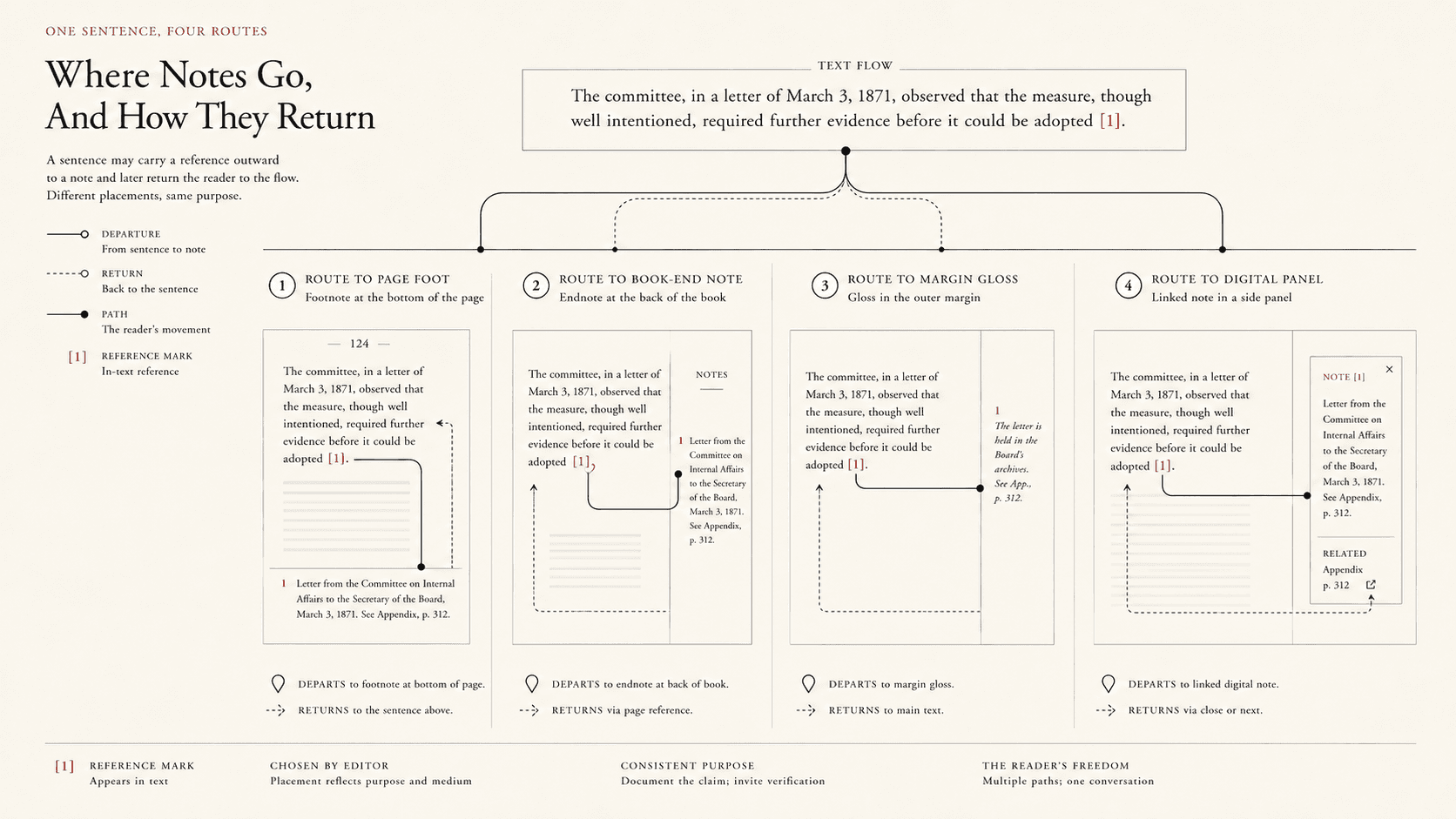
A note marker is a small invitation to leave. The reader can continue the sentence, look down, turn to the back, follow a link, or open a panel. Each choice changes the distance between assertion and qualification, and each interface makes one choice cheaper than the others.
Notes allow a book to sustain parallel channels. The main prose can make an argument while a second channel supplies evidence, translation, variant, source credit, definition, complication, or joke. Placement determines how often the channels are likely to meet.
The usual dispute asks whether footnotes or endnotes are better. The answer depends on what the note is for and which journey a reader should be able to make.
Departure
The marker has to be perceived without overwhelming the line. In print it is commonly a superscript number, letter, or symbol. Symbols work for a small number of notes and become difficult to extend. Numbers scale and provide an address, though repeated sequences by page, chapter, or book create different lookup behaviors.
Linked commentary long predates the modern printed footnote. Manuscripts used signs to connect passages with marginal notes by at least the eleventh century, according to G. W. Houston's study of notes before print, and such sign systems grew more elaborate in the thirteenth. The forms and purposes differ from contemporary scholarship, but the interface problem is continuous: mark a departure without merging two voices.
The marker also allocates authority. A discreet number can make the prose appear smooth while placing evidence elsewhere. A crowded field of markers tells the reader that nearly every claim has another channel attached. Neither effect is innocent, and neither is always wrong.
In an ebook, visual superscript is insufficient. The reference should be marked with an appropriate semantic role and implemented as a usable link. Its accessible name must make sense in context. “1” may be understandable when announced as a note reference; a decorative asterisk with no role may be noise.
Distance
A footnote reduces physical distance. The eye travels to the bottom of the page and back, often while the sentence remains visible. The cost is surface: notes compete with main text and can force awkward page breaks or leave a small island of prose above a deep apparatus.
An endnote preserves a more continuous main page. The reader travels farther, sometimes to the end of a chapter or book, and must keep a return location in mind. This distance can be welcome when notes are chiefly documentary and consulted selectively. It can become punitive when a qualification is necessary to understand the sentence.
Margin notes keep commentary adjacent and visible, an arrangement with manuscript and early-print precedents. They require generous geometry and careful coordination when several notes correspond to nearby lines. They work poorly when a format cannot preserve the outer edge.
Placement ranks information by effort. Moving a note away makes skipping it easier in practice. Editors should notice the decision. If every reader needs the definition before the next sentence, the material may belong in the prose. If the note documents a source for readers who wish to verify it, parallel placement may protect both fluency and evidence.
Destination
A note is not reached merely because its text exists. The marker must identify a destination, and the destination must identify itself as the corresponding note. In print, number and page architecture do the work. In EPUB, identifiers, links, and structural semantics establish the relation.
EPUB's structural-semantics vocabulary includes roles for note references, footnotes, and endnotes. These roles state what an element is. They do not require a reading system to display it at the foot of a temporary screen page or in a popover. Semantics remain stable while rendition varies.
That separation is valuable. Reflow makes page-bottom footnotes unstable because text size and viewport determine where the bottom occurs. A reading system may show the note in a panel, move to a note section, or display it inline. Producers should build a correct linked structure rather than target one app's preferred animation.
The destination needs enough context to orient the reader. A page with dozens of notes should expose the correct note immediately, not merely open at the top of the section. Nested notes and links inside notes require particular care. A visually attractive popup can become unusable if it cannot be scrolled, selected, enlarged, or navigated with assistive technology.
Return
The return trip is the neglected half of note design. After consulting the parallel channel, the reader needs to resume near the point of departure.
In a printed footnote, proximity and spatial memory usually make return easy. In endnotes, the reader may keep a finger in the text, use two bookmarks, or flip by remembered page. The book delegates navigation to the body.
In EPUB, a backlink can return to the reference. When one note has several references, a single generic return may be ambiguous; each departure may need a distinct target and meaningful path. Reading systems can also maintain navigation history, but publication links should not assume one implementation will repair an incomplete structure.
A practical QA pass performs the whole trip. Encounter the marker in a sentence. Identify it without relying only on visual position. Activate it. Confirm that the intended note is reached and readable. Follow the return. Check where focus and reading position land. Repeat with adjacent notes, long notes, multiple references, and links inside notes.
Validation can confirm that many references and identifiers are syntactically legal. It cannot decide that a return is disorienting or that a note's label is useful when spoken.
When the channels should merge
The note system can become a way to avoid editing. A paragraph accumulates qualifications in the basement because the main claim has not been narrowed. A definition every reader needs is exiled to preserve a polished sentence. A digression long enough to become an essay remains attached to a number because no one has decided whether it belongs.
Before placing a note, name its role. Evidence can remain parallel when the prose is intelligible without immediate verification. A textual variant may belong to a scholarly apparatus. A translation can require proximity if it changes the reading. A substantial counterargument may deserve the main text because remote placement alters the apparent strength of the case.
This is editorial architecture rather than a ban on abundant notes. Some works are built from layered voices. A critical edition would be damaged by absorbing its apparatus into continuous prose. The goal is to make movement proportional to purpose.
Different readers and uses will prefer different costs. A narrative reader may value continuity; a researcher may value immediate evidence; a learner may need definitions nearby; a reader using speech needs clear references, destinations, and returns. Print and digital editions can implement different placements while preserving the note's role.
The final editorial question is simple enough to ask of every marker: which readers need this material, and how much work should the book require them to perform before they can use it?
SOURCES
- Houston, G. W. “Footnotes Before Print.” Cambridge University Press. https://www.cambridge.org/core/books/abs/books-before-print/footnotes-before-print/8D2B4F6B2D81545F9207547A53BA8DC7 - Folger Shakespeare Library. “Technologies of Writing in the Age of Print.” https://folgerpedia.folger.edu/Technologies_of_Writing_in_the_Age_of_Print - Folger Shakespeare Library. “Extravagantly Large Paper.” https://www.folger.edu/blogs/collation/extravagantly-large-paper/ - W3C. EPUB 3 Structural Semantics Vocabulary 1.1. https://www.w3.org/TR/epub-ssv-11/ - W3C. EPUB 3.3. https://www.w3.org/TR/epub-33/ - W3C. EPUB Accessibility Techniques 1.1. https://www.w3.org/TR/epub-a11y-tech-11/