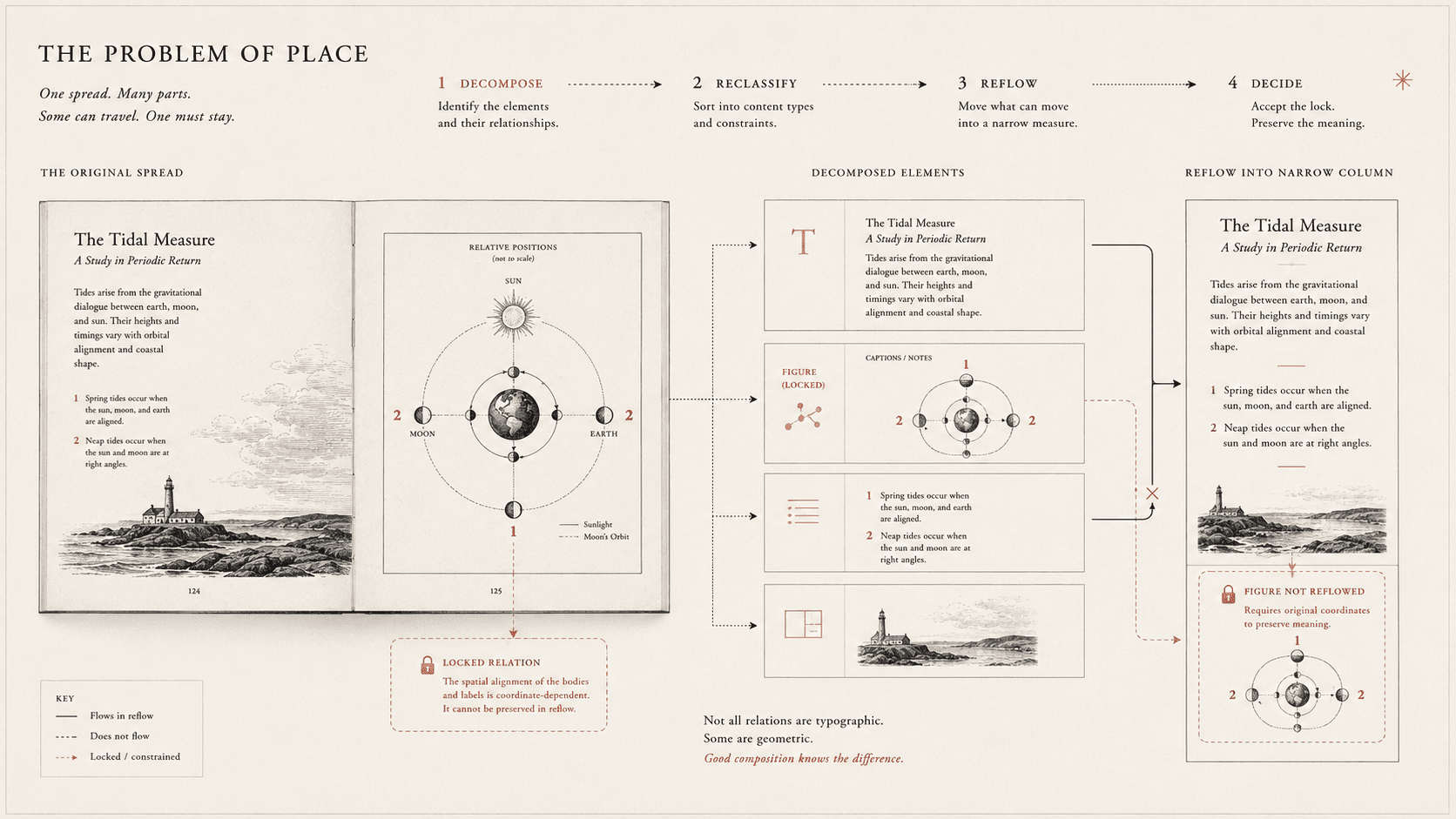
An illustrated book is not automatically a fixed-layout book, and a book with no pictures can still contain lineation or spatial relationships that ordinary reflow would damage. The decision turns on a demanding test: does meaning depend on geometry?
If words, images, panels, labels, or marks can move into a clear structured sequence without losing their relationships, reflow gives readers and devices valuable freedom. If coordinate, scale, adjacency, overlap, or reveal carries meaning that cannot be represented adequately another way, fixing the composition may protect the work.
This test begins with the page rather than the genre label.
What EPUB means by fixed
EPUB 3 describes rendition layout as either `reflowable` or `pre-paginated`. Reflowable is the default: a reading system dynamically composes content for the viewport and user settings. Pre-paginated content presents a fixed page for each spine item.
The fixed page remains an EPUB content document inside a package with metadata, manifest, spine, navigation, styles, images, and other resources. It is not a PDF embedded in an EPUB wrapper. The distinction matters because the publication still needs logical sequence, meaningful structure, and working navigation beneath its coordinates.
The EPUB specification cautions that pre-pagination often restricts users' ability to change presentation and can reduce usability and accessibility. This is not a prohibition. It establishes the cost that geometry must justify.
Test the relationship, not the illustration count
Start by naming what breaks when the page reflows.
A photograph followed by a caption and discussed in nearby prose usually has a structural relationship that survives recomposition. Group the figure and caption, place them near the reference in source order, label them clearly, and let the viewport set the exact page.
A diagram may also reflow if it scales, its labels remain readable, its explanation is available, and the prose refers to stable components rather than position. A recipe can place ingredients before instructions on a narrow screen even when a print spread uses side-by-side columns. A textbook can convert a boxed aside into a properly identified complementary section.
These are redesign decisions. The digital book need not imitate the print page to remain faithful to its information.
Now consider a comic in which panel size controls duration, one panel overlays another, and a page turn creates a reveal. Serializing the captions and images may preserve every ingredient while changing the grammar. A picture book can depend on a sentence pointing toward an object across a spread. A facsimile edition may study annotations by coordinate. Here geometry participates in meaning.
“Meaning” should be stated precisely. Decorative alignment, a designer's preference for a particular line break, or fear of a different-looking page is not enough. Identify the relation a reader would lose. If the team cannot name it, it has not yet justified restricting adaptation.
Try structured alternatives first
Before fixing layout, test what ordinary structure can carry.
Can a figure and caption be grouped and placed after the paragraph that introduces them? Can callouts become labeled asides? Can a complex chart include a summary and data table? Can a comparison become a real table that supports header relationships? Can poetry lineation be preserved with appropriate markup and styling without fixing the entire page? Can panels become an ordered sequence at narrow widths while retaining a spread at wide ones?
The purpose is not to force every work into generic paragraphs. HTML, CSS, and SVG can express hierarchy, figures, tables, language, emphasis, relationships, and responsive arrangements. The design may need to be conceived for transformation rather than converted from coordinates after print is complete.
Some alternatives improve the work even if fixed layout remains. A long description for a diagram, a clear panel order, or prose that identifies a figure by name makes the publication more understandable across modes.
Fixing layout does not fix order
A fixed page that looks obvious can have incoherent source order. Text boxes may be stored in the order they were created, not read. A two-page spread may alternate left and right content incorrectly in the spine. An image of a page may contain all visible text while exposing none of it programmatically.
W3C guidance for fixed-layout accessibility calls for visual and programmatic reading order to align. Synthetic spreads need consistent page progression. Images require suitable alternatives. Readers must be able to navigate and magnify. Fixed-layout publications remain subject to applicable WCAG and EPUB Accessibility requirements.
Magnification deserves separate attention from reflow. Zoom makes the page larger and can require panning horizontally and vertically. It preserves relationships but may hide the wider context. Test at high magnification, on small screens, in both orientations where supported, and with the navigation and reading modes the audience will use.
If a page is built as one image, supply access to its textual and structural information according to purpose. OCR alone is not a complete alternative; it can misread, lose order, and omit visual relations. A transcription, description, properly ordered text layer, or alternate edition may be necessary.
Mixed and multiple editions
A publication does not always need one layout rule. EPUB can support mixed approaches under defined conditions, though reading-system support and production complexity require careful testing. A book might keep its prose reflowable and treat a small number of essential facsimile or spatial sections differently.
Separate outputs can also be honest. A fixed-layout edition may preserve an artwork's composition, while an accessible reflowable edition provides structured text and descriptions. A print PDF may serve exact reproduction. These editions must be kept in sync and described accurately; an alternate that omits material is not equivalent merely because it opens more easily.
Budget affects what is possible. A fully responsive redesign or parallel edition can be expensive. That constraint should be recorded as a production limitation, not converted into a claim that visual fidelity settles every reader's needs. Scoping can focus work on the pages and relations with greatest impact.
Reading-system reality
The EPUB specification defines a common model, while reading systems vary in optional feature support and presentation. Spread behavior, orientation, zoom, overlays, scripting, fonts, and SVG can differ. No evergreen compatibility chart can replace testing the actual distribution targets at a stated time.
Build a small matrix from audience and content risk. Include a narrow phone, a larger screen, relevant assistive technology, and the principal reading systems through which the book will be delivered. Record app and device versions, settings, steps, and failures. A difference across systems can be an intended rendering variation, a publication defect, or an implementation bug; reproducible evidence helps distinguish them.
The decision record
For every proposed fixed section, document four things.
Name the geometry-dependent meaning. Record the reflowable or responsive alternatives tested and why they were insufficient. Identify the access consequences and the alternative representations supplied. Define the reading systems and conditions in which the result was reviewed.
If these questions cannot be answered, the page needs editorial analysis before technical production.
Reflow and fixed layout preserve different fidelities. Reflow protects the reader's ability to recompose structured content. Fixed layout protects relationships carried by a surface. Good production names the essential relationship and records which adaptation the edition can responsibly restrict.
SOURCES
- W3C. EPUB 3.3. https://www.w3.org/TR/epub-33/ - W3C. EPUB 3.3 Reading Systems. https://www.w3.org/TR/epub-rs-33/ - W3C. EPUB Accessibility 1.1. https://www.w3.org/TR/epub-a11y-11/ - W3C. EPUB Fixed Layout Accessibility. https://www.w3.org/TR/epub-fxl-a11y/ - W3C. Web Content Accessibility Guidelines 2.2. https://www.w3.org/TR/WCAG22/ - W3C Web Accessibility Initiative. “Complex Images.” https://www.w3.org/WAI/tutorials/images/complex/