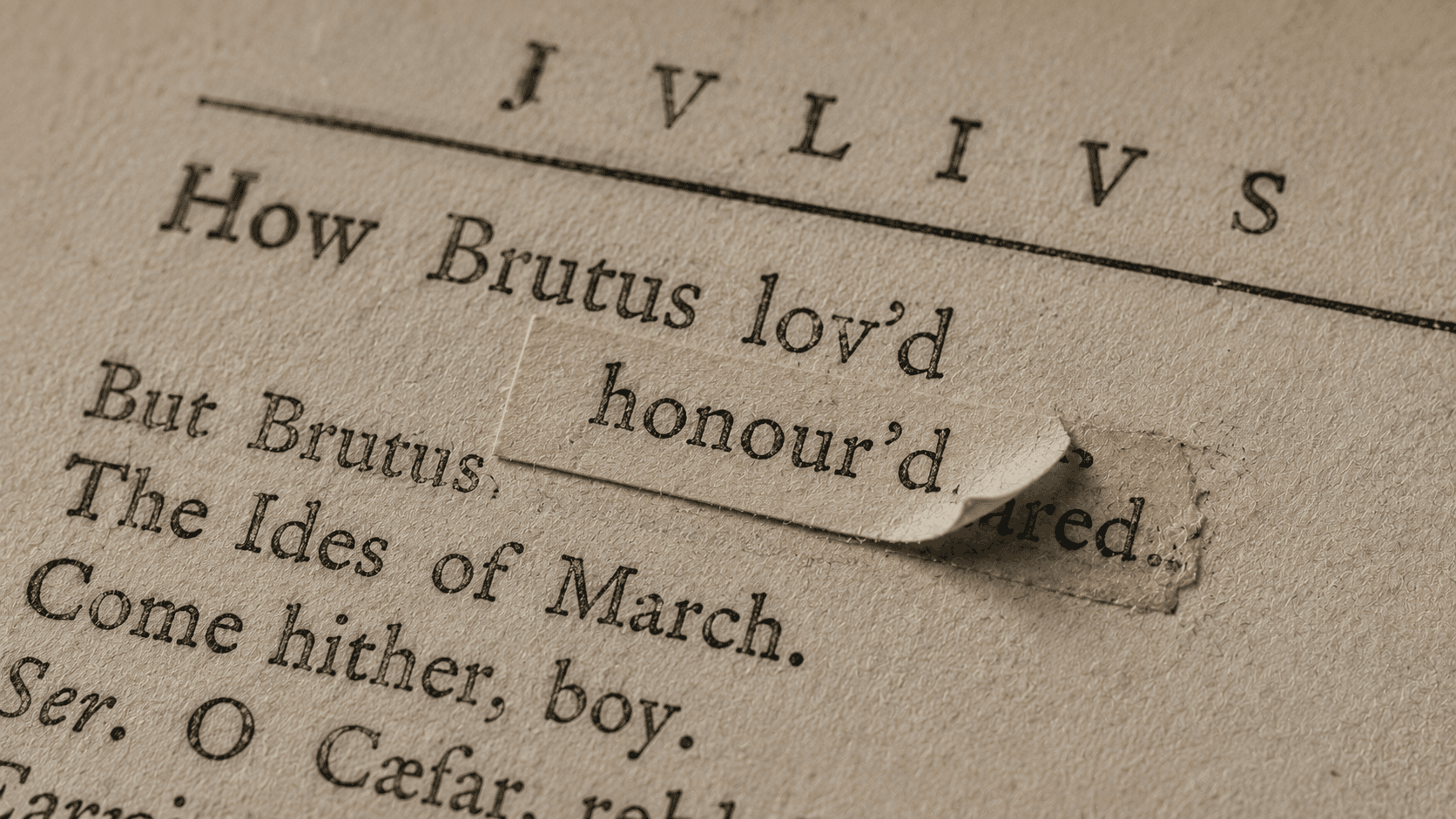
In a 1613 printing of the King James Bible, a small slip of paper covers one word at Matthew 26:36. The word visible on the slip is “Jesus.” Beneath it, according to the Folger Shakespeare Library's examination of the copy, the page says “Judas.” The correction is slightly askew. It conceals the error and preserves evidence that the error was there.
This pasted repair is called a cancel slip. Its scale places it on a longer timeline of discovery. The mistake survived proofing and printing, but someone found it before the copy's history was considered closed. Too late to reset the page economically, they printed a new word and attached it by hand.
Print has version history. It is distributed among type, sheets, replacement parts, instructions, bindings, and readers rather than gathered into one log.
When the press can still stop
An error found before a print run can be corrected in proof. An error found during hand-press production can lead the printer to stop, alter standing type, and resume. Sheets printed before the intervention retain one reading; sheets printed after it carry another. Both can belong to the same impression.
The Folger documents a seventeenth-century petition title page that survives in corrected and uncorrected states. A misspelling and a wording difference reveal that type changed during production. The printed copies do not merely report a revision. They embody its before and after.
Establishing sequence is not always easy. If one reading is an obvious error and another resolves it, the inference is strong. If both are plausible, a bibliographer may need press evidence, paper, settings, multiple copies, correspondence, or other context. “Different” does not automatically identify “earlier,” and “later” does not automatically mean “authorized.”
The stop-press correction makes uniformity conditional. Movable type can reproduce pages with remarkable consistency, but the type remains alterable while it stands. Printing many copies does not require printing every sheet before anyone learns anything.
How much must be replaced?
A cancel slip repairs a word or passage by pasting a printed patch over it. The method is economical and conspicuous to anyone who looks closely. Adhesive can fail; the edge can lift; the hidden reading can sometimes be recovered. What production intended to erase becomes attractive evidence to an archive.
If the problem occupies too much space, a printer can replace a whole leaf. The original leaf is the cancelland; the substitute is the cancel. In a bound book, the replacement needs to be attached to the gathering, often leaving a stub or another physical sign. A careful insertion can be difficult to notice without examination.
The Folger describes a copy in which both cancelland and cancel were bound in. The intended substitution became an addition. That copy now preserves a poem the corrected configuration would have removed. Whether through error, resistance, or circumstance, binding changed the correction's outcome.
Larger changes can involve replacing a gathering, issuing a revised impression, or altering later copies in other ways. Each intervention has a material threshold. The form of the correction reveals when it became possible, what was still available, and how much labor someone was willing to spend.
The reader as production worker
An errata list moves correction into the published book. It identifies locations and supplies intended readings, but it does not change the type already printed. The reader must remember the correction, annotate the page, or consult the list when the passage matters.
One Folger copy contains a reader's handwritten correction corresponding to an errata instruction. Another listed change in the same volume was left undone. The list published an authorized request; the owner decided how fully it would enter that particular copy.
The arrangement complicates the idea of a final text. A copy with an untouched errata list contains both error and correction, spatially separated. A corrected copy contains the reader's hand. A copy missing the list may preserve neither the instruction nor its application. The edition's corrected state is partly procedural.
Modern readers still perform related work when they insert a publisher's correction sheet, consult an online errata page, or update an ebook. Digital distribution can apply a change invisibly to many copies, increasing consistency while making prior states harder to inspect. Print leaves more debris.
Edition, impression, issue, state
Ordinary speech uses “edition” for almost any version. Descriptive bibliography needs more distinctions. An edition broadly gathers copies produced from substantially the same setting of type or typographic basis. An impression refers to copies printed in one production event or run from that setting. An issue can distinguish groups offered or presented differently within an edition. A state identifies a variation within an impression, such as a stop-press correction, that is not proclaimed as a new edition.
Specialists refine these definitions, and neighboring disciplines use the same terms differently. In printmaking, an impression may mean a single print, while an edition often names the limited set. Folger curator Erin Blake has written about this collision of vocabulary. The warning matters because categories are analytical tools, not labels that objects naturally carry.
For the reader, the central fact is simpler. Two copies with the same title page and publication date can contain different readings. One physical book cannot always stand for the entire print event. Comparing copies is how bibliographers reconstruct changes that no surviving production record states.
Identifiers do not dissolve this. An ISBN identifies a publication product according to assignment rules; it is not designed to distinguish every stop-press state or pasted correction. A catalog record can note a cancel or variant in a particular copy, but the supply-chain identity and the bibliographical history operate at different scales.
Correction is not innocence restored
Errata are easy to treat as embarrassing residue around an otherwise finished book. Anthony Grafton's history of Renaissance correction shows a culture of scholars, printers, authors, and readers working through the difficulty of producing accurate texts. Correction was part of learned production, with status, labor, argument, and limits of its own.
Changing a page can introduce another error. A replacement leaf can omit something present in the cancelland. A handwritten instruction can be misapplied. A “correction” can reflect censorship, commercial pressure, changing doctrine, or a later preference rather than recovery of an original intention. Authority has to be established, not inferred from chronological position.
The latest version is especially unreliable as a universal goal for literary and historical work. An archive may value the uncorrected state because it documents production. A critical editor may record all variants. A reader may want the author's revision. Another scholar may study how a printer regularized the author's manuscript. The correction history supports these uses only when its branches survive.
This does not make accuracy relative or errors desirable. It means accuracy has a history. A corrected word answers “what should this passage say?” while the lifting slip answers another question: “what happened to this copy?”
Copies as a distributed log
Software version control can show a sequence of commits if everyone used the system and the repository survives. Print's record is less orderly. One copy carries an uncorrected sheet, another a corrected state, another a pasted slip, another an errata list with annotations, and another a later binding that rearranged the evidence. No single copy is the master log; the population of copies is the log.
That condition explains why libraries preserve duplicates that appear redundant and why digitizing one “representative” copy cannot capture every state. It also explains the value of precise copy notes. A catalog that records a cancel, missing leaf, annotation, or jacket is not describing damage around the text. It is recording which branch of the publication history this object contains.
The little slip over “Judas” performs two acts at once. It corrects a consequential word for the reader and leaves a seam for the historian. Its imperfection is what lets both acts remain visible.
SOURCES
- Werner, Sarah. “Correcting Mistakes.” Folger Shakespeare Library. https://www.folger.edu/blogs/collation/correcting-mistakes/ - Blake, Erin. “Two Disciplines Separated by a Common Language.” Folger Shakespeare Library. https://www.folger.edu/blogs/collation/two-disciplines-separated-by-a-common-language/ - Folger Shakespeare Library. Printing and Misprinting: A Companion to Mistakes and In-House Corrections in Renaissance Europe. Catalog record. https://catalog.folger.edu/record/1153836 - Grafton, Anthony. The Culture of Correction in Renaissance Europe. Princeton University Press. https://history.princeton.edu/about/publications/culture-correction-renaissance-europe