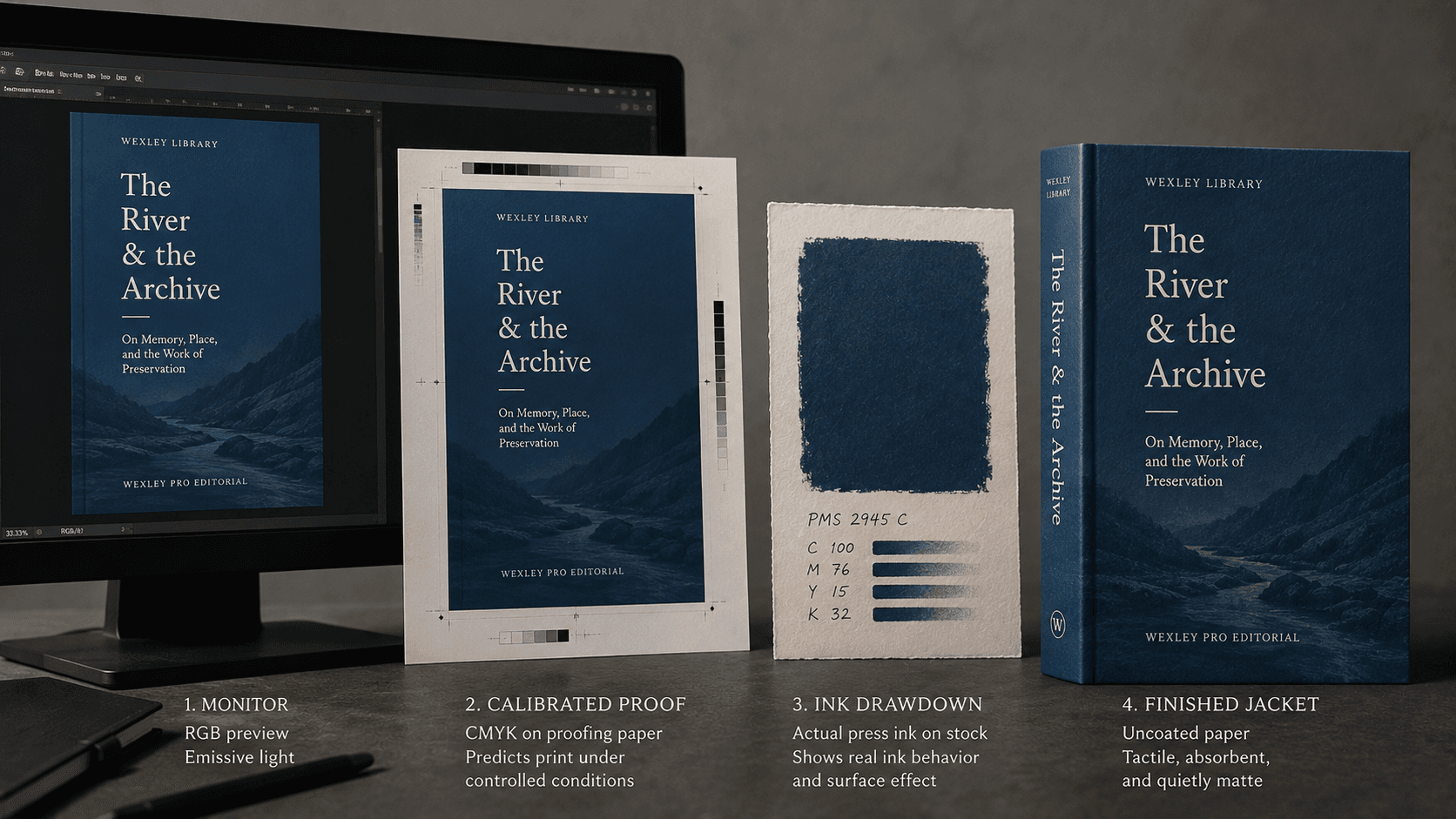
A designer selects a blue on a calibrated monitor. An author approves the cover on an uncalibrated laptop. A printer receives a PDF containing four percentages. The press lays ink on warm uncoated paper, and the finished book is examined beneath yellow room light. The encounters are related. Physically, no two are the same event.
Color production is often reduced to a warning: screens use RGB, presses use CMYK. The warning is helpful and incomplete. There are many RGB spaces and many CMYK printing conditions. Numeric values do not become reliable color descriptions until someone identifies the space, device, substrate, illumination, and transformation in which they will be interpreted.
Color management coordinates those interpretations. It does not make their materials identical.
A number needs a world
Three values such as 30, 90, 200 can describe a color in one RGB encoding. The same triplet in another RGB space can describe a different color because the primaries, white point, and transfer behavior differ. Four CMYK percentages depend on intended ink, paper, press condition, separation method, and total ink limit.
A color space defines relationships between numeric coordinates and colorimetric meaning. A device profile characterizes how a device or standardized condition reproduces color. The International Color Consortium's architecture lets a color-management system translate source values through a common colorimetric reference into a destination description. This common reference is the profile connection space; it is a transfer language, not another printer or monitor.
Profiles do not contain an absolute collection of colors every device can reproduce. If a saturated source color falls outside the destination's gamut, conversion must decide what to do. It may clip the color to a boundary or compress relationships so several colors remain distinguishable. Rendering intent and workflow affect that choice.
“Convert it to CMYK” is therefore unfinished. Which CMYK condition? For which paper and press? At what point in editing? With what treatment of out-of-gamut color and black? A conversion without those answers is guesswork given the appearance of prepress discipline.
Assigning and converting are different acts
Suppose an image's numbers were created in Adobe RGB but its profile label is missing. Assigning the correct Adobe RGB profile tells software how to interpret the existing numbers; it does not change them. Assigning sRGB instead would reinterpret those same numbers and shift the appearance.
Converting from Adobe RGB to a destination space changes the numeric values in an attempt to preserve the intended appearance under a new interpretation. The converted file may use different RGB values or CMYK percentages because the destination speaks another numerical language. Repeated conversion can accumulate rounding and gamut decisions.
The distinction explains a frequent production mistake. An application asks whether to assign, convert, or discard a profile, and the user chooses whichever option makes the screen look familiar. The image then carries an undocumented interpretation into print. Source profiles and an agreed conversion policy should settle the choice before visual habit does.
Emitted light and reflected ink
A monitor emits light. A printed page reflects available illumination through paper and ink. Increase a display's brightness and a shadow can appear open and luminous. Put the print under dim warm light and the relationship changes. Gloss, texture, fluorescence, surrounding colors, and visual adaptation participate.
Profiling manages these differences; it cannot abolish them. A controlled system aims for a defined visual relationship under stated conditions. It cannot make ink emit screen light or make every reader's room conform to a proofing booth.
Paper sets the brightest point of ordinary print. On cream stock, unprinted areas are cream. Transparent inks interact with that base. Uncoated paper usually produces different density, detail, and color behavior from a coated sheet. A spot ink mixed to a physical standard can still change across substrates and illumination.
These limitations are properties of print, not failures to imitate glass. A successful design anticipates them.
What the profile and output intent promise
An ICC profile can describe a monitor, scanner, printer, press condition, or abstract color space. Source values are interpreted through a source profile and transformed toward a destination profile. Applications can preserve source encodings, assign known profiles, or convert values. The operations should be documented because later production may need another destination.
For print exchange, PDF/X standards constrain parts of a PDF and use an output intent to identify the intended printing condition, commonly through a profile or standardized characterization. The declaration gives prepress a destination against which to interpret and check color.
Its promise is bounded. An output intent does not prove every image was converted correctly, the press currently matches the characterization, the paper is unchanged, or visual choices are good. It replaces one unknown—“for what printing condition was this prepared?”—with a claim that can be tested.
Web publishing is also moving beyond an implicit sRGB-only model. CSS Color Level 4 defines colors in several spaces, including wide-gamut and perceptual forms. The capability is real, while output still travels through browser, operating system, display profile, hardware, and ambient light. Richer syntax cannot make an uncharacterized screen trustworthy.
Proofs answer bounded questions
A soft proof simulates a destination on a display. It can help identify out-of-gamut colors, anticipate contrast changes, and compare rendering choices. Its value depends on a calibrated and profiled monitor, controlled conditions, correct source data, and a valid destination profile. It cannot show paper texture, reflected-light behavior, metallic ink, embossing, or binding.
A contract proof is a controlled physical prediction produced to an agreed standard. It can serve as a production reference while using a proofing process and substrate different from the final press sheet. Standards define tolerances because prediction is not identity.
A press sheet shows production ink on production stock under current conditions. It is closest to the manufactured result and arrives late, when changes are expensive. Ink and paper appearance can still change with drying and illumination.
These artifacts answer different questions at different times. A soft proof is useful for iterative image adjustment. A folded dummy answers trim and sequence while saying little about color. A contract proof coordinates expectation. A press check controls current production. Approval should state the property reviewed.
A compact workflow for a book
Begin by identifying important relationships. Is an exact brand color required, or is the aim a range and mood? Do photographs need neutral grays and consistent skin tones? Must charts remain distinguishable without color? Does a spot ink carry meaning unavailable through process printing?
Obtain the printer's intended output condition and file requirements before final conversion. Keep editable source images with valid profiles. Soft proof against the destination and inspect shadow detail, saturated color, small colored type, and fine reversals. Request physical evidence that matches the project's risk.
For a first printing on unfamiliar stock, include representative dark images, saturated areas, subtle neutrals, and difficult detail in proofing. Record the approved condition and retain sources, because a later printer or paper change creates a new destination.
Avoid choosing color by screen memory. A hex value copied from a website is ordinarily an sRGB instruction unless context says otherwise, not a press specification. A CMYK recipe copied from another printer can describe a different paper and process. A physical swatch is relevant only when ink, substrate, age, and viewing condition relate to the new job.
Reproducible difference
Color management cannot promise identical appearance everywhere. Its achievement is more useful: transformations become describable, repeatable within tolerances, and open to proof.
The contract consists of specific declarations. These numbers belong to this space. This profile describes this condition. This output is intended for this paper and process. This proof predicts these properties under these lights. Each declaration reduces the opportunity for a device or operator to improvise.
Publishing finishes a color specification by naming its chain of interpreters and deciding which differences can be accepted. Reproduction then becomes controlled translation rather than a demand that unlike materials behave as one.
SOURCES
- International Color Consortium. “ICC Specifications.” https://www.color.org/icc_specs2/ - International Color Consortium. “ICC Profile Information.” https://www.color.org/info_profiles2.xalter - International Color Consortium. “Frequently Asked Questions.” https://www.color.org/faqs/ - Library of Congress. “PDF/X Format Family.” https://www.loc.gov/preservation/digital/formats/fdd/fdd000124.shtml - W3C. CSS Color Module Level 4. https://www.w3.org/TR/css-color-4/ - Federal Agencies Digital Guidelines Initiative. Technical Guidelines for Digitizing Cultural Heritage Materials, Third Edition. https://www.digitizationguidelines.gov/guidelines/FADGITechnicalGuidelinesforDigitizingCulturalHeritageMaterials_ThirdEdition_05092023.pdf