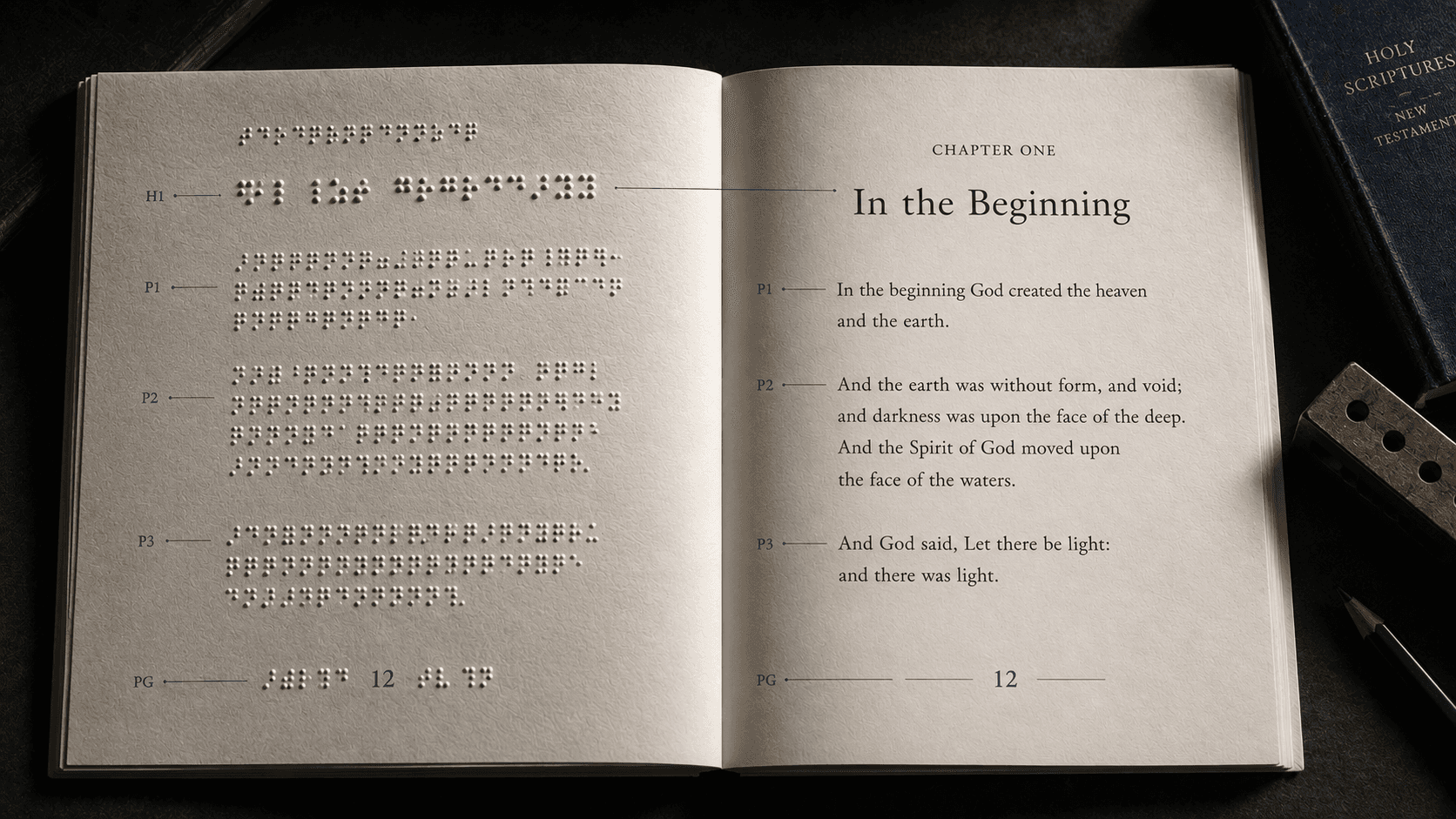
A bold heading in a print book can announce itself before a sighted reader has read a word. Its size, weight, position, and surrounding space expose hierarchy at a glance. Emboss the same letter shapes as raised outlines and the result would be difficult to read by touch. Replace each print character with a braille pattern without reconsidering layout, and the heading may become legible as text while losing its job as navigation.
That difference contains an entire production discipline. Braille is a writing and reading system. A braille edition must encode language, represent structure, use tactile space deliberately, and decide what to do with visual information in the source. The work is called transcription when the language remains the same, but transcription should not suggest mechanical substitution.
A cell is not a tiny printed letter
The standard braille cell has six possible dot positions, arranged in two columns of three. Its nonblank combinations can represent letters, punctuation, numbers, contractions, indicators, and other meanings according to code and context. Eight-dot cells are used in some computer and specialized settings, while the familiar literary system is organized around six.
Louis Braille published an account of his method in 1829. It included music notation, an early reminder that the system was designed to encode more than an alphabet. The patterns did not freeze there. Braille codes developed, competed, and were standardized through institutions and communities. Unified English Braille, or UEB, now supplies rules for much English-language material in participating countries. Mathematics and technical writing can involve additional code decisions; North American production may use Nemeth Code under defined policies.
A print letter can often be represented by a braille cell, but the relationship is contextual. UEB uses indicators to establish number mode, capitals, emphasis, and other conditions. It includes contractions in which a cell or sequence stands for more than the corresponding uncontracted letters. A symbol can change meaning according to the mode in force. The transcriber has to know the code and understand the text well enough to apply it.
A font supplies glyphs for characters already encoded. Braille transcription decides which braille symbols and structures represent the source. A visual braille typeface can be useful for teaching or display, but changing the font of a print manuscript does not perform those decisions.
The book must be transcribed too
Consider a chapter opening. Print may use a half title, ornament, drop cap, centered heading, italic epigraph, and generous blank space. The verbal content is only part of what tells the reader where the chapter begins and what is subordinate to what.
Braille formatting has its own means of expressing those relationships. The Braille Authority of North America's Braille Formats sets out treatment for heading levels, contents, lists, notes, tables, boxes, poetry, plays, captions, and other structures. A centered or cell-5 heading is not a tactile imitation of 24-point bold. It is a braille convention that lets a reader recognize hierarchy through placement and spacing.
This is why semantic source files matter. If a manuscript enlarges and bolds a line but never identifies it as a heading, a conversion system sees appearance without reliable role. If a table is built from tabs and spaces, its relationships can collapse when tactile width changes. If footnotes are placed manually at page bottoms, the source may not state which note belongs to which reference.
An accessible source does not remove the need for transcription. It supplies better evidence. Proper headings, lists, notes, language, table headers, image alternatives, and reading order give the transcriber a map of intended structure. The braille edition can choose tactile forms instead of reverse-engineering meaning from coordinates.
Two page numbers can be correct
Braille cells need enough size and separation to be distinguished by touch. Lines and pages therefore hold less verbal material than a typical print page. Contractions can reduce length, while complex formatting, uncontracted content, tables, mathematics, and illustrations can expand it. One print volume may become several braille volumes.
There is no responsible universal conversion ratio. Page size, embossing specifications, language, code, contraction, source design, and content all matter. The production consequence is substantial. A long book has to be divided at usable points. Preliminary matter identifies the volume and what it contains. Running navigation and continuation conventions help a reader move through an edition whose physical segmentation differs from its source.
Print page numbers can remain useful even though they no longer identify the braille page. Imagine that print page 147 begins halfway down braille page 263. A print-page indicator marks the transition in the braille text. A student can answer a teacher's instruction to turn to print page 147, while the braille reader still uses braille page 263 to navigate the tactile volume. Both addresses are correct because they coordinate different objects.
The arrangement demonstrates a larger truth about accessible publication. Fidelity does not require pretending that the new medium has the old geometry. It requires preserving the relationships readers need, including relationships to another edition where those are part of use.
Tables, pictures, and structures that resist substitution
Tables expose the limits of direct conversion quickly. A sighted reader can scan row and column headers, compare distant cells, and use rules or shading to maintain position. A braille reader encounters a narrower tactile line. A transcriber may retain a simple table, rearrange it, create a listed form, divide it, or provide explanatory notes according to purpose and the governing standard.
If spatial comparison is essential, flattening every cell into prose can destroy the relationship. If the visual grid is incidental, preserving it at great tactile cost may burden the reader. The decision is editorial because it asks which structure carries the information.
Images raise a related choice. Some require prose description. Some can become tactile graphics with simplified lines, textures, labels, and keys. Some are decorative and need no content equivalent. A map, geometric diagram, family tree, and ornament should not enter the same conversion queue merely because all are tagged as images.
Specialized notation reinforces the point. Mathematics and music do not become accessible when visible symbols are named one by one. Their relationships, modes, and conventions must be encoded in systems developed for tactile reading. Braille's 1829 history with music makes this principle older than digital accessibility guidance.
Automation and accountability
Braille translation software performs extensive routine conversion. It applies code rules, handles many contractions and indicators, and makes production at scale possible. Its sophistication is evidence of the system it implements, not evidence that the system has disappeared.
Output still depends on correct language, source structure, code settings, exceptions, and format decisions. Proper names interact with contraction rules. A symbol can shift meaning when a mode is entered or terminated incorrectly. A table can be syntactically converted and practically unreadable. Page transitions, transcriber notes, and volume divisions need review. The National Library Service supports certification in braille transcription and related specialties because publication-grade work carries responsibilities that an unreviewed file cannot assume.
Proofreading is tactile too. A visual comparison of dot patterns can miss spacing, embossing, or sequence problems apparent to a braille reader. Quality includes the physical dot and page, encoded symbols, and the reading experience. Braille users should participate in evaluation rather than serve as abstract recipients of sighted compliance.
Authors need not become transcribers. Publishers do need structured sources, time for qualified transformation, a defined code and audience, and a workflow that does not postpone accessibility until type is supposedly final.
The edition that reveals the book
Print makes many structural decisions through sight. Size announces hierarchy. Proximity groups a caption with an image. Position distinguishes a running head from body text. A page turn gives the hand one kind of sequence while the eye surveys another.
Braille cannot inherit those cues merely by inheriting the words. It publishes their functions again in a tactile system. The result may occupy more pages, divide into more volumes, and use another material architecture. Those changes make it an edition designed for its reader, not a compromised facsimile.
Braille reveals how much of a book exists in relationships that print readers mistake for appearance. Accessibility did not create the distinction among language, hierarchy, navigation, and spatial evidence. It made that distinction impossible for publishing to ignore.
SOURCES
- Library of Congress, National Library Service. “About Braille.” https://www.loc.gov/nls/services-and-resources/informational-publications/about-braille/ - Library of Congress. “Louis Braille: His Legacy and Influence.” https://www.loc.gov/exhibits/louis-braille/exhibition-items.html - Braille Authority of North America. “Unified English Braille.” https://www.brailleauthority.org/unified-english-braille-ueb - Braille Authority of North America. “Unified English Braille Codebooks.” https://www.brailleauthority.org/unified-english-braille-codebooks - Braille Authority of North America. Braille Formats: Principles of Print-to-Braille Transcription, 2016. https://www.brailleauthority.org/formats/formats2016.html - Library of Congress, National Library Service. “Braille Certification.” https://www.loc.gov/nls/who-we-are/guidelines-and-specifications/braille-certification/