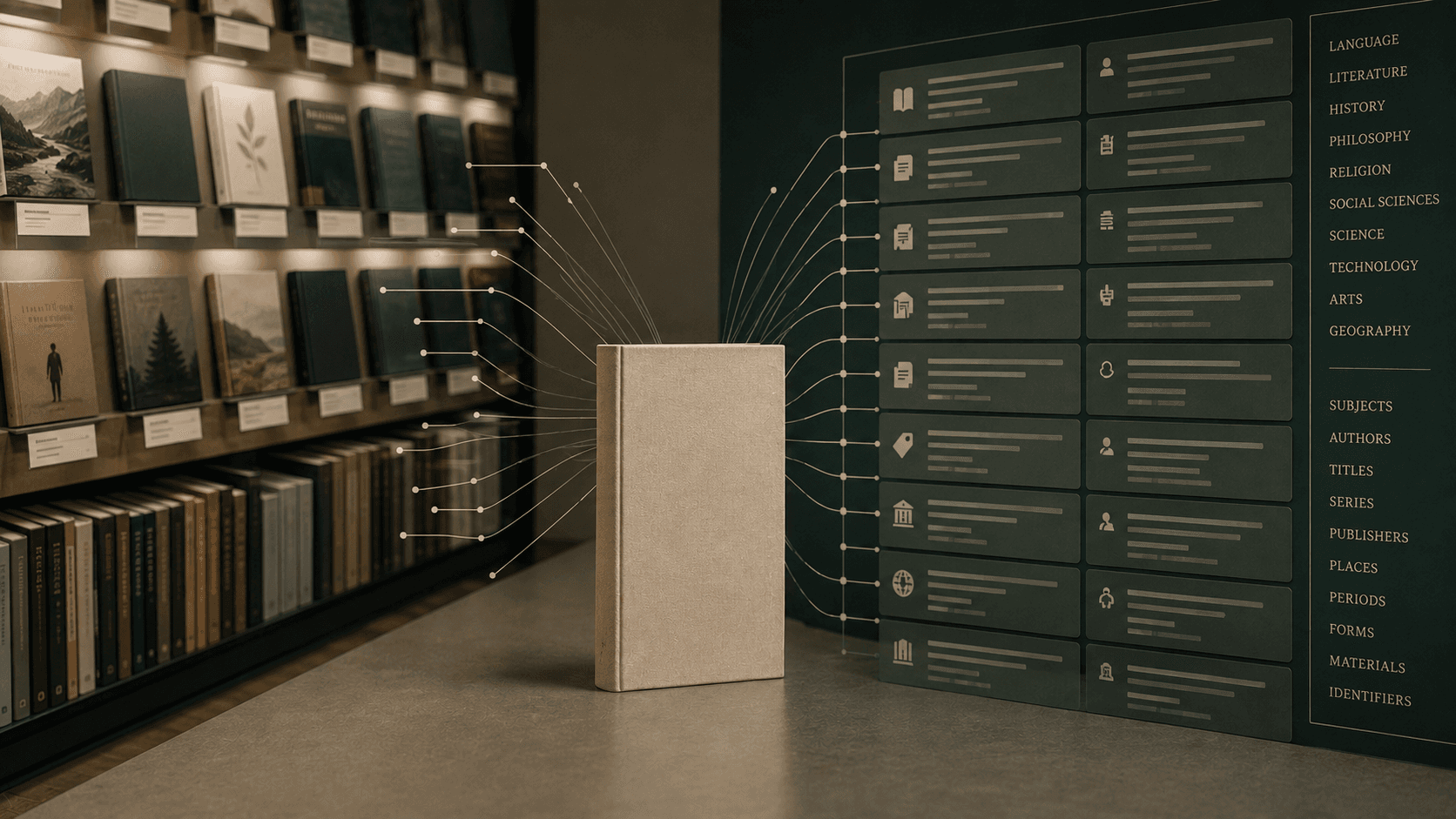
Consider a hypothetical biography of a botanist who became a political organizer and wrote popular travel books. A bookstore must decide where a browsing customer is most likely to encounter it. A library may make it retrievable by the person's name, scientific work, political movement, places traveled, historical period, and form of the work. Both institutions describe the same book. They do not ask the same question.
In North American publishing, BISAC Subject Headings commonly carry the trade description. In many libraries, Library of Congress Subject Headings contribute to subject access. The systems overlap and can appear side by side in metadata, which makes them easy to mistake for alternative labels drawn from one master taxonomy.
They are governed vocabularies built for different uses. Mapping between them is often necessary. The mapping itself is an editorial decision.
The commercial neighborhood
BISAC stands for Book Industry Standards and Communications. The Book Industry Study Group maintains its subject-heading list through an industry committee. Each descriptor has a nine-character code and a human-readable heading organized from a broad area toward a more specific subject.
The codes standardize exchange among publishers and trading partners. Retailers can use them for browse pages, search, sales reporting, recommendations, merchandising, and initial shelving. A store may map BISAC headings into its own departments rather than reproduce the official wording. The code proposes a commercial neighborhood; it does not dictate the exact shelf used by every seller.
BISG recommends choosing the most specific applicable headings, identifying a main subject, and using no more than three as a best practice. The recommendation forces judgment. A book contains many subjects, while trade metadata asks which small set will place this particular product accurately for its likely audience.
Adding broad or weakly related headings can dilute that signal and send a title into misleading browse paths. The primary heading should describe what the book principally is, not an audience the publisher merely hopes to borrow.
The first difficulty appears as soon as this trade classification leaves its own system. An automatic crosswalk may take a precise BISAC heading and look for an equivalent library term. One trade descriptor can require several controlled headings once geography, historical period, and form are expressed separately. Several trade categories may collapse into one library concept. Another term may have no reliable equivalent because the two communities did not decide to name the same distinction.
Mapping is therefore a claim that, for a stated purpose and at a stated version, two categories are close enough. A system that discards the original scheme, code, and version turns a documented judgment into an unexplained label.
The long catalog
Library of Congress Subject Headings, or LCSH, has been maintained since the late nineteenth century and is used by libraries well beyond the Library of Congress. It is a controlled subject-indexing language with authorized forms, cross-references, and rules for combining headings and subdivisions.
A cataloger analyzes what a resource is about and applies headings according to policy. Topical headings can be qualified through geographic, chronological, form, and other subdivisions; names can be connected to authority records. The resulting access points join the book to a catalog accumulated across publishers, periods, languages, and collections.
LCSH is distinct from Library of Congress Classification. Subject headings support retrieval and relationships. Classification contributes to a call number and a principal place in a classified sequence. A book can have several subject access points while occupying one main shelf location. Genre/form terms can add another layer by describing what the resource is rather than what it is about.
This system works over a longer institutional horizon than a frontlist campaign. A retailer needs current customers to find an available product; a library expects future users to retrieve an acquired item after its cover treatment and market category have receded. Retail systems do retain backlist, and libraries also encourage browsing. The difference is one of institutional center, not a rule separating all practice.
The botanist enters both systems
For the imagined biography, a publisher would consult the current BISAC list and choose headings based on the book's actual emphasis. Biography might be primary if the life is the organizing form; political history, science, or travel might merit additional treatment if they occupy substantial parts of the work. Naming an exact heading without the finished book and current list would manufacture precision.
A library record could establish the botanist as a biographical subject, add access for relevant scientific, political, geographic, and chronological subjects, and identify the form according to its cataloging conventions. A future reader might find the book through a relationship the publisher had no reason to make primary in a retail feed.
The difference is not a contest in descriptive truth. The library creates more and differently structured access points; the trade record makes a smaller number of consequential placement choices. Each system retains distinctions that the other may not need.
Both vocabularies also change. BISG committees consider proposals, add and revise headings, and deprecate others as publishing markets develop. Library vocabularies likewise preserve histories of preferred terminology, including terms later judged outdated or harmful, and revise them through documented institutional processes. Versioning matters because a backlist code can remain valid in a publisher database after a receiver's categories have moved.
Criticism is most useful at this level of specificity. Saying every classification system has bias identifies a condition but no repair. A particular term, cross-reference, governance process, or missing distinction can be examined and changed.
No pair is universal
BISAC is a North American trade scheme. Thema supports international, multilingual book-trade classification, and national markets use their own schemes and adaptations. Library communities use other subject languages and classifications alongside or instead of LCSH. A publication distributed across territories may need several scheme-specific records maintained with local knowledge.
The variation is more than translation. Markets divide subjects differently, place emphasis on different educational and cultural contexts, and update at different times. Library systems operate under their own cataloging codes, authority structures, scripts, and national responsibilities. A cross-border metadata workflow needs to preserve each source scheme instead of treating BISAC as a universal base from which local labels are rendered.
That source often disappears from the reader's view. A trade heading travels through ONIX, is mapped into a retailer's private taxonomy, and returns as a browse menu. A library discovery layer may combine local subjects, authority data, classification, and full-text terms. Both interfaces can make institutional decisions look like properties naturally present in the book.
Publishers should retain the scheme identifier, code, literal heading, and version where the workflow permits, then review mappings when vocabularies change. Machine suggestions can surface candidates, but books crossing disciplines, identities, age ranges, or fiction and nonfiction boundaries require informed review. Authors contribute most by describing the work accurately, distinguishing its main subject from its incidental topics, and resisting the urge to copy a successful comparison title's categories.
The hypothetical botanist may ultimately be found through science, politics, travel, biography, a friend's recommendation, a jacket image, or chance. Classification cannot reproduce everything inside the work. It creates a limited set of approaches, and responsible metadata keeps a record of who built each one and for which institution.
SOURCES
- Book Industry Study Group. “BISAC FAQ.” https://www.bisg.org/BISAC-FAQ - Book Industry Study Group. “Selecting a BISAC Code.” https://www.bisg.org/selecting-a-BISAC-code - Book Industry Study Group. “Complete BISAC Subject Headings List.” https://www.bisg.org/complete-bisac-subject-headings-list - Library of Congress. “Subject and Genre/Form Headings.” https://www.loc.gov/aba/cataloging/subject/index.html - Library of Congress. “Process for Adding and Revising Library of Congress Subject Headings.” https://www.loc.gov/aba/cataloging/subject/lcsh-process.html - Library of Congress. Subject Headings Manual. https://www.loc.gov/aba/publications/FreeSHM/freeshm.html - EDItEUR. “Thema Subject Categories.” https://www.editeur.org/151/Thema/