The Newton Project sometimes assigns page identifiers to manuscripts whose original foliation is inconsistent. The intervention lets editors and readers refer to a precise surface while making clear that the address is modern. A text can exist without page numbers; conversation about exact places in it still needs an agreed system.
Page numbering is often treated as the invention that made books navigable. Readers had already learned to resume, survey, point, compare, and cite through physical and textual devices. Printed pagination became unusually powerful for a more specific reason: many copies from the same setting could share the same compact address. “Page 147” could travel beyond one object, provided the other reader held a compatible edition.
Finding the way back
The first navigational problem is private. A reader needs to return.
A codex supplies physical clues before formal apparatus appears. A bookmark, thread, turned corner, or mark can preserve a stopping place. A scroll can be returned to an approximate region through its material sequence. These are affordances rather than evidence that every reader used them in the same way.
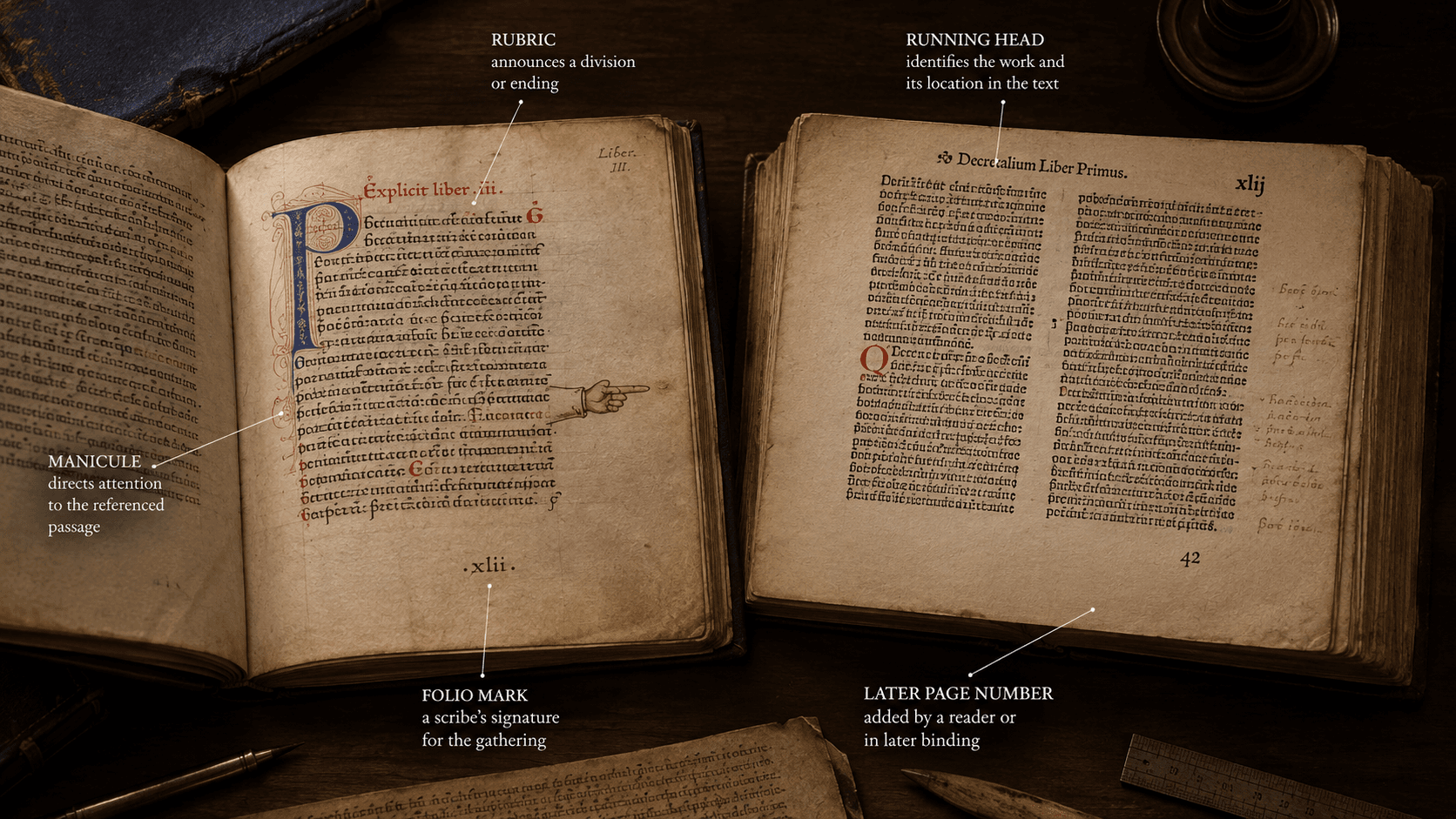
Textual divisions make return less approximate. A named book, chapter, prayer, argument, or episode gives a place conceptual identity. Enlarged initials, rubricated headings, and paraphs help the eye find those divisions. In late-medieval English books, makers used such devices with running heads and marginal material to clarify how parts related. An unnumbered page could be dense with orientation.
Numbers are efficient because they are short and repeated. They do not replace conceptual memory. A reader may remember “the beginning of the trial” or “the diagram of the planets” before remembering its page.
Seeing the shape
Surveying asks a different question: what kind of work is this, and how are its parts arranged? Tables, summaries, chapter lists, canon tables, running titles, and later contents pages provide different views of structure. They tell the reader what divisions exist and sometimes how divisions correspond across texts.
These devices often precede stable printed pagination. Their addresses could name a division or use physical sequence. A table can direct a reader to the chapter containing a subject even if the exact sentence still has to be found by scanning. A running head answers “what region am I in?” rather than supplying a unique coordinate.
The table of contents and page number became natural partners because one named the conceptual destination and the other gave it a compact physical address. A list of numbers alone cannot explain the book's shape; a list of chapter names without locations requires more searching once the correct region is known.
Pointing and comparing
Makers and readers also pointed within pages. Enlarged initials signaled units. Paraphs separated thoughts. Manicules, the small pointing hands drawn in margins, selected passages. Reference symbols connected lines in a main text to comments beside them. A reader could underline or add a verbal cue.
This scale matters because a page number remains too coarse for many uses. One page may contain several paragraphs, notes, and a figure. Modern scholarship adds section numbers, line numbers, paragraph numbers, quotations, or named headings. Digital links can target an identifier attached to a particular element. The page is one level in a larger address system.
Comparison puts further pressure on the system. A scholar may move between text and commentary, one language and another, a citation and its source, or several versions of a work. The medieval and early-modern page often held more than one channel. Main text, gloss, correction, and finding aid occupied distinct positions, with symbols linking them. Modern interfaces distribute similar work among footnotes, panes, tabs, and hyperlinks.
Printer's signatures and catchwords served another nearby problem: maintaining the carrier's sequence. Signatures helped assemble folded gatherings. Catchwords repeated the opening word of the following leaf, providing a check at a transition. Catchwords also have manuscript histories. Neither device told a reader where an argument about justice appeared; they helped ensure that the physical text continued correctly.
Foliation supplied a more formal address. A folio number identifies a leaf, whose front and back are recto and verso. Pagination gives each side its own number. “12r” and “12v” therefore name two surfaces of folio 12. The vocabulary persists in manuscript description because the leaf as object matters. A loose or moved leaf can complicate a neat sequence, and editorial identifiers may need to record that complication rather than hide it.
Making the address social
Citation turns navigation into a shared protocol. A usable address lets one person direct another to the same evidence. Printing made repeated page settings possible at a much larger scale, so a page reference could resolve across a community of copies.
The repeatability was never absolute. Corrected sheets, cancel leaves, binding differences, and missing matter complicate the idea of identical early copies. A later edition can reset the text and move every page. Translations, paperbacks, and large-print editions do the same. Page citation is stable within a compatible edition rather than within the work in the abstract.
Ancient and scriptural works are therefore often cited through divisions intended to survive editions: book, chapter, section, verse, or line. The address follows the structure. Printed pages then help a particular reader reach it without becoming part of the durable citation.
Reflow separates the maps again
A reflowable EPUB has changing page boundaries, but its content still has a default order, headings, identifiers, navigation links, and document fragments. A screen page answers what fits under the current settings. It usually cannot tell another reader where the same passage will appear.
Reading systems offer percentages, generated locations, search results, bookmarks, and links. Some locations belong to a platform rather than the publication. Percentages are approximate. Search requires remembered words and can yield several matches. Headings are durable but broad. A link can be exact and still be difficult to express outside the system that exposes it.
The digital book has not returned readers to navigational chaos. It has separated functions that repeatable print settings made easy to combine. Resuming may use synchronized position. Surveying uses publication navigation. Pointing uses a fragment or highlight. Comparing uses links and multiple views. Citation remains difficult because it asks for an address that travels across systems and editions.
Page numbers did not rescue lost readers. Their achievement was to compress a place in a reproducible setting into a mark that other people could use. When the setting ceases to be shared, navigation continues through the older mixture of structural, verbal, and local maps in new technical forms.
SOURCES
- Library of Congress. “Differences between Manuscripts and Incunabules.” https://guides.loc.gov/manuscript-facsimiles/differences-manuscripts-incunabules - Library of Congress. “Don't Get Out of Sorts: Composing Text.” https://blogs.loc.gov/bibliomania/2025/01/15/dont-get-out-of-sorts-composing-text/ - Wakelin, Daniel. “Designing the Page.” Cambridge University Press. https://www.cambridge.org/core/services/aop-cambridge-core/content/view/DFAC91EC629BB141D17859CA7EEA70B0/9780511976193c4_p79-103_CBO.pdf/designing_the_page.pdf - The Newton Project. “A Short Scheme of the True Religion.” https://www.newtonproject.ox.ac.uk/view/texts/normalized/THEM00138?end=par23&start=hd4 - W3C. EPUB 3.3. https://www.w3.org/TR/epub-33/