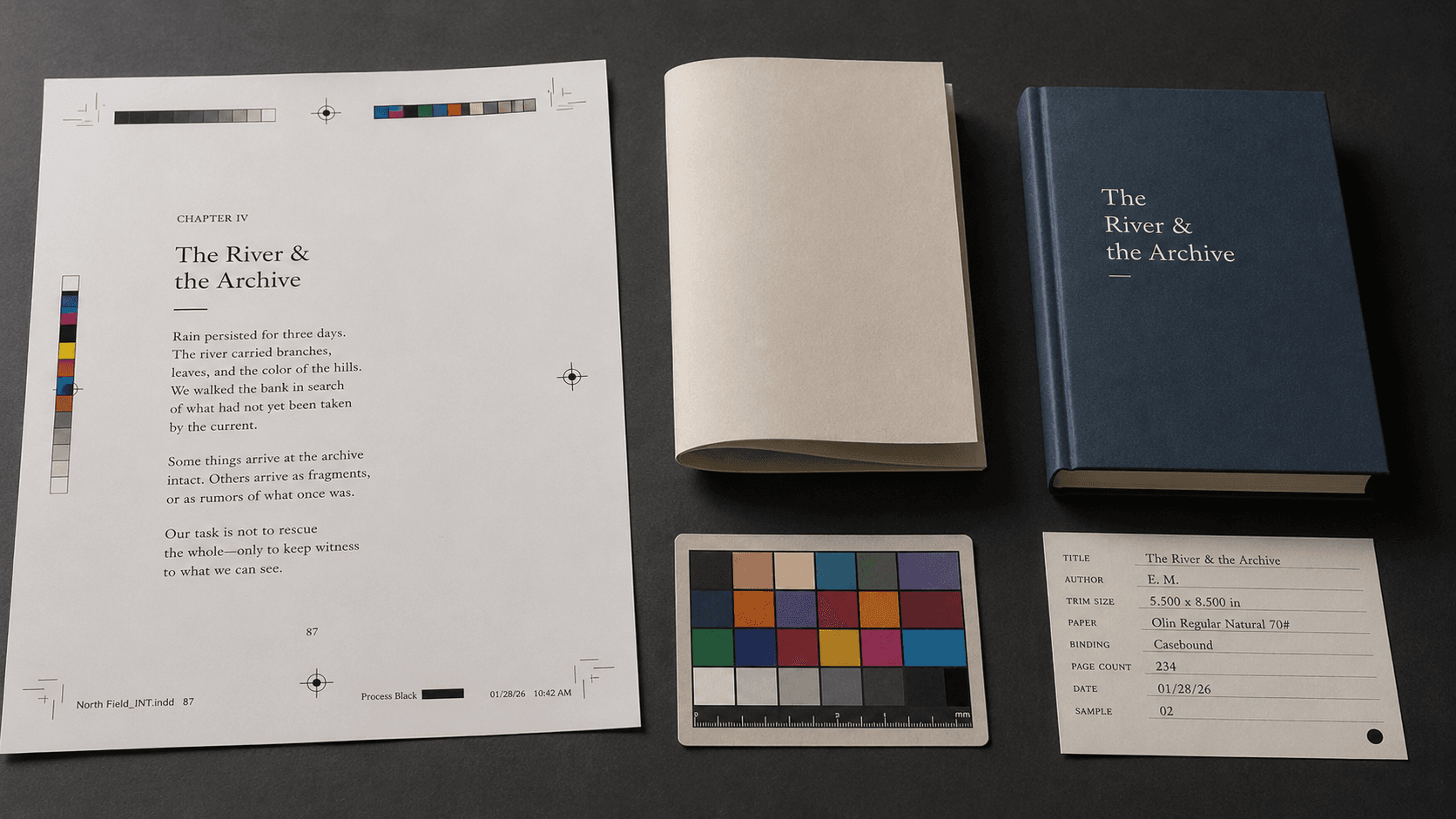
A page proof can show that chapter seven begins on a recto, the footnotes fit, and a figure sits beside the paragraph that discusses it. The same proof viewed on a laptop cannot show how the paper feels, whether a dark image plugs up on press, how closely the cover wraps the boards, or whether the bound book stays open. It may resemble the finished book, but resemblance does not define its scope.
A proof is evidence produced at a particular stage to reduce a particular uncertainty. When a publisher sends one without naming the question, “please check everything” becomes an invitation to approve properties the artifact cannot demonstrate.
The text has acquired dependencies
Proofreading usually occurs after copyediting and composition. The manuscript has become pages. That change makes new errors visible: a bad line break, omitted text, an incorrect running head, a stranded heading, a broken cross-reference, or a figure separated from its callout.
It also makes every change more consequential. Add two sentences and a paragraph may move to the next page. That movement can displace a figure, alter a contents entry, break an index locator, and turn a recto chapter opening into a verso. A replacement word can improve accuracy while producing an awkward line. The book is now a network of composed relationships.
This is why university presses commonly ask authors to reserve proof-stage changes for errors instead of fresh rewriting. The rule protects reviewed work from unnecessary disturbance. It should never become an instruction to leave a serious factual, legal, ethical, or textual error in place. Consequential corrections should be made, documented, and rechecked across everything they disturb.
The practical distinction is between correction and alteration. A correction brings the proof into agreement with the approved text or repairs a production error. An author alteration changes approved text at a late stage. Some alterations are justified. Naming them accurately helps the production team assess their cost and dependencies.
Which question is open?
“Proof” covers several artifacts, and vendors do not always use the terms identically. Ask what process made the artifact and which property it is intended to predict.
A typeset page proof supports review of text, hierarchy, line and page composition, notes, running matter, cross-references, and placement. A PDF can represent final geometry closely when fonts and rendering are handled correctly, but it says little by itself about paper and binding.
An imposition proof or folded form checks sequence, orientation, signatures, bleeds, and page position. Its color may be deliberately unrepresentative. A managed soft proof can simulate an identified output condition well enough to reveal likely color and tonal problems, but its value depends on profiles, calibration, display capability, viewing conditions, and the intended destination. A controlled physical color proof can serve as an agreed reference under specified illumination while still differing from the final stock or surface.
A paper dummy tests trim, bulk, sequence, weight, and handling, sometimes with blank pages. A bound sample can reveal opening behavior, gutter loss, cover alignment, and construction. If it was produced by a different printing process, it may establish the object without predicting the press sheet. Every proof therefore has a fidelity profile: the properties it represents closely, approximately, or not at all.
Approval needs an object
Instead of writing “approved” across an artifact, record what was reviewed. Text and pagination approved subject to listed corrections. Cover position and bleed approved; color not represented. Color proof accepted as the production aim under the stated viewing condition. Binding sample accepted for materials and construction, with foil placement still open.
Scoped approval can feel bureaucratic until a dispute occurs. Then it distinguishes a missed error from a property nobody was shown. It also prevents casual comments on one feature from becoming acceptance of unrelated decisions.
Corrections need a controlled record. Identify the page and location, state the current and intended reading when ambiguity is possible, and avoid distributing instructions among chat, email, and several differently annotated PDFs. The record should make both the change and its completion traceable.
Verification is a separate act. Suppose an author adds a missing sentence on page 83. The typesetter makes the change correctly, but the extra lines push a figure to page 84. The caption stays behind, the contents page still points to the old section opening, and two index locators now refer to the wrong page. Checking only the new sentence confirms the instruction while missing the damage. The corrected paragraph, adjacent composition, relocated figure and caption, cross-references, contents, and index all belong to the verification path.
Even a one-word replacement can require this treatment. It may be applied to the wrong occurrence, introduce a repeated word, change hyphenation, or pull a heading onto the preceding page. Proof corrections are transactions with side effects.
What an author should inspect
Begin with integrity. Are all chapters and sections present and in order? Did any passage disappear or duplicate? Do headings retain their hierarchy? Are quotations, extracts, poems, equations, tables, captions, and notes complete?
Then inspect navigation. Compare the table of contents with actual headings and pages. Test cross-references and links. Check running heads, folios, blank pages, chapter openings, note numbering, and figure calls. If an index is present, sample and verify locators after pagination is stable.
Look closely where composition can alter meaning. A line break can divide a name badly. A hyphen can be mistaken for part of a word. Superscripts can fall to the baseline; italics, small capitals, symbols, or diacritics can disappear during import. A table row can lose its header. The correct image can receive another image's caption.
Read changed passages in context instead of reviewing only a correction list. Compare them with the approved manuscript where fidelity matters, especially after conversion among applications. Visual comparison tools can help, but they do not decide whether a difference was intentional.
Accessibility should have been designed earlier, yet proofing can confirm that headings, reading order, text alternatives, tables, and language information survived production. A visual PDF cannot reveal all of these properties through appearance. Review the structured output with the tools and reading modes it is expected to support.
Choose evidence by risk
Not every book requires every proof. A text-only paperback in a stable workflow carries less color risk than a photographic monograph. A large offset run makes an unnoticed cover or imposition error expensive. Diagrams conveying safety information demand more checking than ornamental spot art.
List the failures that would be costly, irreversible, or harmful, then match each one to evidence. If color is consequential, establish the printer's output condition and choose a suitable color proof. If binding and paper behavior matter, handle a representative object. If sequence is complex, inspect an imposed or folded form. If several formats derive from one source, verify that corrections propagate and that each format's structure still works.
Budget spent on the wrong proof buys confidence rather than knowledge. An office print cannot establish press color merely because it is physical. A calibrated soft proof may reveal more about tonal conversion than an attractive sample made by an unrelated device. The production method limits the claim.
No prior artifact can answer every question the finished run will settle. Good proofing identifies what remains uncertain, assigns each material risk an appropriate test, and records exactly what the evidence justified approving.
SOURCES
- University of Chicago Press. “Publishing Your Book with the University of Chicago Press.” https://press.uchicago.edu/resource/publishing_with_chicago.html - Cambridge University Press. “Authors' Publication Journey.” https://www.cambridge.org/core/services/authors/publication-journey - Chartered Institute of Editing and Proofreading. “Glossary of Editorial and Publishing Terms.” https://www.ciep.uk/resource/editorial-glossary.html - Office for National Statistics. “Editing and Proofreading.” https://service-manual.ons.gov.uk/content/writing-for-users/editing-and-proofreading - International Color Consortium. “ICC Specifications.” https://www.color.org/icc_specs2/ - Library of Congress. “PDF Family, Portable Document Format.” https://www.loc.gov/preservation/digital/formats/fdd/fdd000030.shtml