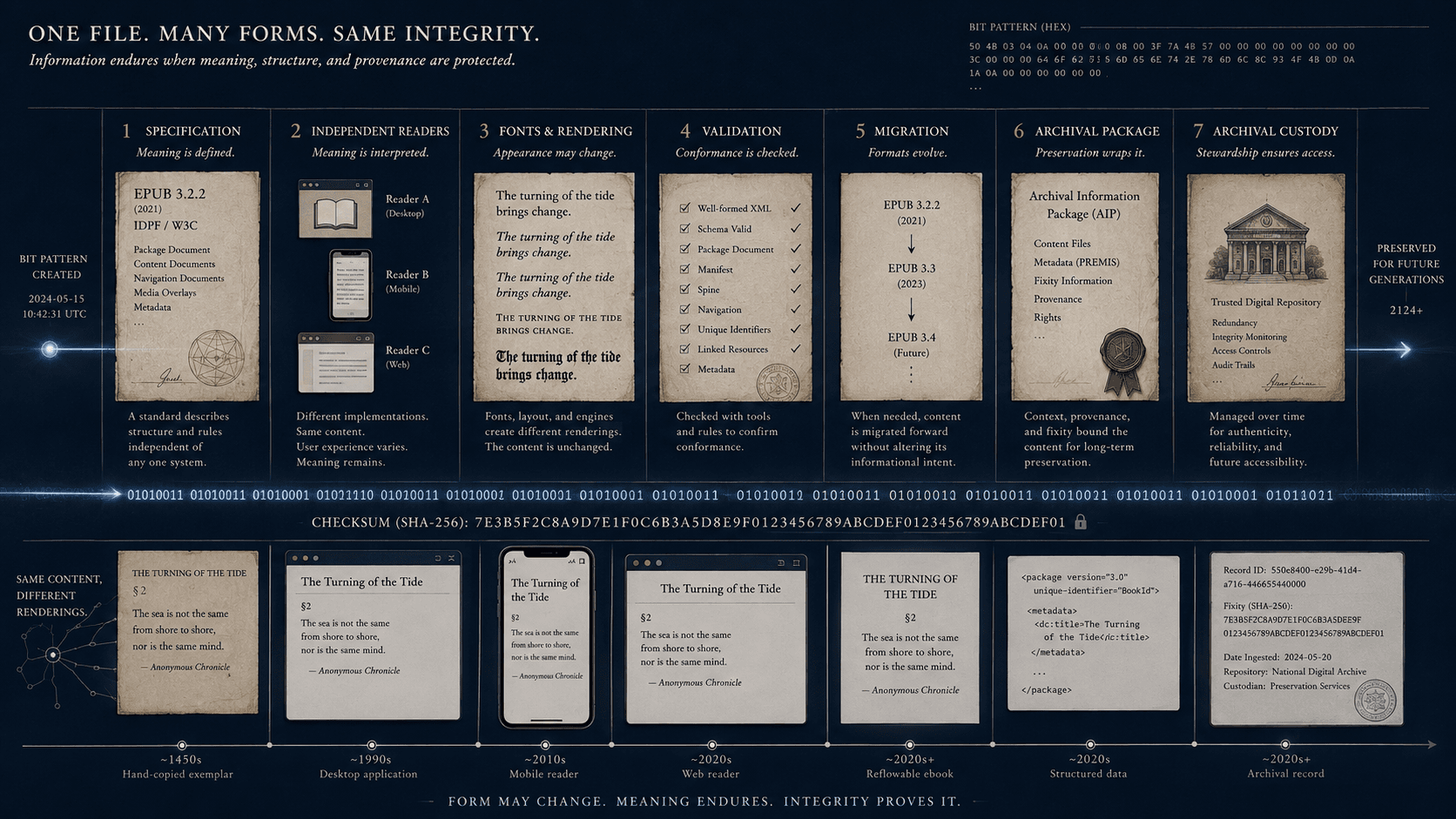
A checksum can establish that a file has not changed since it entered an archive. Years later, the same checksum can confirm that the repository possesses an exact copy of a file no available program can interpret. The file's identity has survived while its intelligibility has not.
A format is an agreement about how stored symbols should be turned into text, pages, images, sound, structure, or behavior. The agreement can be written in a public specification, embodied in software, inferred from examples, or guarded inside a product. Its longevity depends on much more than the medium holding the bits.
Calling a format open, standard, popular, or archival identifies a particular strength. None of those words means permanent.
The agreement must be disclosed
Future readers need to know how the bytes are organized and what they mean. A publicly available, complete specification makes independent implementation and diagnosis more possible. Licensing and patent conditions affect whether people are permitted and able to build readers or writers.
Disclosure is a strong preservation property and only one. A specification can be open and immense, rely on other standards, leave important behavior optional, or attract few correct implementations. A simple proprietary format can become widely recoverable because many tools read it and the community understands its conventions.
The Library of Congress evaluates format sustainability through seven factors: disclosure, adoption, transparency, self-documentation, external dependencies, impact of patents, and technical protection mechanisms. The framework resists a winner chosen by one label. A format can score well in one dimension and poorly in another.
Transparency concerns how readily the representation can be analyzed. Plain text is highly transparent at the character level, yet character encoding and missing context still matter. A compressed package may be less directly inspectable while remaining well documented and easy to unpack. Encryption can render an otherwise documented format unavailable without keys and legal authority.
The agreement needs witnesses
A specification without working implementations is an agreement no one currently knows how to keep. Adoption creates tools, sample files, expertise, test suites, validators, documentation, and institutional familiarity. Several independent implementations reduce reliance on one vendor's continued interest.
Popularity is still not permanence. A dominant product can disappear, and widespread files can depend on online services, licensed fonts, codecs, scripts, or account authorization. Adoption can preserve de facto behavior that a formal specification omitted, which later implementers may have to study empirically.
Validation acts as a witness of another kind. It can show that a file conforms to stated rules and does not rely on certain accidental behaviors. A valid file may remain inaccessible, semantically poor, or dependent on external resources. Conformance improves the odds that another implementation can interpret it; it does not settle what parts of the publication future users will value.
Self-documentation helps a file explain itself. Embedded metadata can identify format version, title, creator, language, and technical properties. Containers can include resources needed for rendition. The information must be accurate and sufficient. A field labeled “final” provides less durable identity than a documented edition record.
The bits are the floor
Bit preservation protects the exact sequence through redundant storage, integrity checking, controlled transfer, and monitoring. Without it, higher-level interpretation has nothing stable to act upon.
The Library of Congress explicitly distinguishes this floor from long-term usability. A future system may need the format specification, software, codec, fonts, linked resources, operating environment, or hardware behavior. A database may retain records but lose the queries and interface logic that gave fields meaning. A publication may preserve text and lose timing, interaction, or layout essential to the work.
The appropriate unit of preservation can therefore be larger than the file. It may include documentation, dependencies, rights information, sample renderings, source material, and an environment. This does not imply that every dependency should be embedded. Fonts and media have licensing and size consequences. Live links may be intentionally current rather than frozen. Networked works may derive meaning from changing sources. Preservation begins by identifying the dependency.
What must remain significant
No strategy preserves every property at equal cost. A novel can often migrate while retaining text, order, headings, notes, and modest typography. A facsimile requires page images and their relation to an original. An interactive work may require timing, input, and software behavior. An author's draft may require comments, revisions, and the old application's rendering.
These are significant properties: features selected as necessary for the object's identity, evidence, or intended use. Selection is contextual. A library preserving a publication for reading may prioritize differently from an archive studying composition or a museum preserving software art.
The choice should be documented because later users may disagree. Retaining original bits alongside transformed copies leaves room for new methods and interpretations. Sample renderings can show what custodians believed the object should look or behave like, while source files can expose structure hidden in final delivery.
“Archival format” makes sense only within this relationship. The file must be well made, its important properties identified, and an institution capable of managing it. An approved extension saved once on an unmonitored drive is not archival practice.
Migration and emulation keep different parts
Migration transforms a file into a format supported by current systems. It can improve disclosure, access, and manageability while changing presentation or behavior. The process needs quality control, provenance, and retention of prior versions where significant information may have been lost.
Emulation recreates aspects of an older environment so the original file and software can operate. It may preserve behavior migration cannot, but it increases the number of components that require stewardship. Emulator, operating system, application, fonts, and documentation become part of the access chain.
Neither strategy is faithful by nature. A plain-text migration can be excellent for a textual record and destructive for a designed page. An emulator can recreate an interface and still fail to reproduce original display hardware or network conditions. Hybrid strategies are common because different copies answer different research and access needs.
The National Digital Stewardship Alliance's Levels of Digital Preservation places storage and fixity beside control, metadata, and content management. No single preservation action completes the work.
EPUB and PDF promise different recoveries
EPUB exposes a publication as structured web content, package metadata, resources, navigation, and a default reading order inside a container. In reflowable form, it expects a reading system to compose content for current conditions. Its preservation strengths include disclosure and structure; its risks include implementation variation, external resources, optional features, and poor authoring.
PDF emphasizes a page-oriented final-state representation. It can preserve composed appearance across systems and can include tags, logical structure, links, metadata, and embedded resources. Its risks vary across profiles and files: missing fonts, weak tagging, encryption, external dependencies, and opaque or image-only content can each matter.
The example has no universal winner. A well-formed, self-contained, structured file under active stewardship is different from a malformed or locked file with the same extension. The publication's significant properties decide which agreement is relevant.
Questions for the future reader
Before choosing a format, ask what must be reconstructed. Is it the text, the page, the interaction, the editing history, or several of these? Is the specification available and implementable? Do independent tools exist? Does the file identify itself and contain the resources it needs? Which fonts, services, keys, links, or devices sit outside it? Can conformance be tested? Can the organization monitor, migrate, and document it? Will the original be retained?
These questions do not eliminate uncertainty. They replace reassurance with evidence.
A format's future is social as well as technical. Authors use it consistently. Toolmakers implement it. Standards bodies document it. Archives monitor and transform it. Readers continue to demand access. The agreement survives when enough of these participants keep the evidence and practice needed to interpret what the bits still hold.
SOURCES
- Library of Congress. “Sustainability Factors.” https://www.loc.gov/preservation/digital/formats/sustain/sustain.shtml - Library of Congress. “Bit-Level Preservation and Long-Term Usability.” https://www.loc.gov/programs/digital-collections-management/digital-formats/bit-level-preservation-and-long-term-usability/ - Library of Congress. Recommended Formats Statement. https://www.loc.gov/preservation/resources/rfs/index.html - Library of Congress. “Sustainability of Digital Formats.” https://www.loc.gov/preservation/digital/formats/ - Digital Preservation Coalition. Digital Preservation Handbook. https://www.dpconline.org/handbook - National Digital Stewardship Alliance. “Levels of Digital Preservation.” https://www.ndsa.org/publications/levels-of-digital-preservation/ - W3C. EPUB 3.3. https://www.w3.org/TR/epub-33/ - Library of Congress. “PDF Family, Portable Document Format.” https://www.loc.gov/preservation/digital/formats/fdd/fdd000030 - Library of Congress. “EPUB 3.” https://www.loc.gov/preservation/digital/formats/fdd/fdd000310.shtml